How to Choose the Best Laser Welding Machine for Your Business

Time:2026-10-31 Author:Liam
0%

Choosing a laser welding system is a production decision, not a showroom decision. The right machine must suit your materials, joint designs, output targets, and operators’ skill levels. Fortune Business Insights estimated the global laser welding market at USD 2.78 billion in 2023 and projected USD 4.67 billion by 2032. That forecast signals growing interest, but it does not mean every factory needs the same setup.

Start with the workpiece. A thin stainless-steel enclosure, a copper connector, and a thick structural part demand different process windows. Compare fiber, pulsed, and continuous-wave options against your actual jobs. Ask suppliers to weld your samples, then inspect penetration, distortion, spatter, and repeatability. Keep the settings. Record the results. A Welding Machine Laser that produces a clean sample once may still struggle across a full shift.

Look beyond the laser source. Check the chiller, extraction, fixtures, controls, service coverage, and operator training. Request cycle-time evidence and a clear breakdown of consumables and maintenance costs. Industry market forecasts describe broad demand; they cannot predict your payback. Your own production trial can. And brochures can be persuasive. Sometimes too persuasive. Treat quoted speeds as test conditions, not promises, and ask what changes when material thickness or joint fit varies. The best choice is the machine that reliably meets your quality requirements, integrates with your workflow, and earns its place on the factory floor.
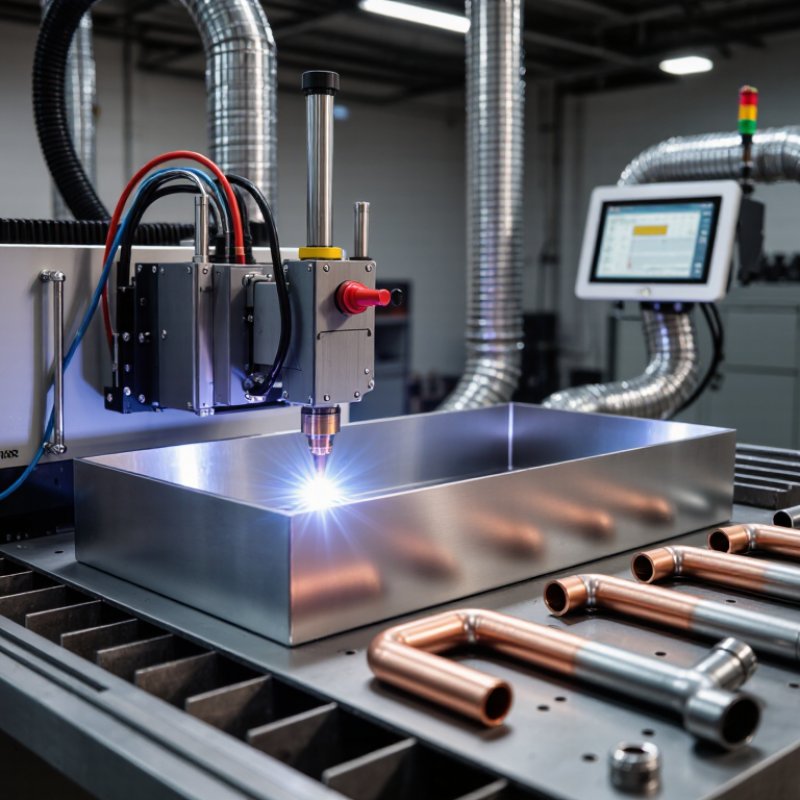
How to Choose the Best Laser Welding Machine for Your Business

Define Your Business’s Welding Requirements

Before comparing laser welding machines, define the work they must handle each week. List the metals you weld, their grades, and the thinnest and thickest parts. A 1 mm stainless-steel enclosure presents different heat and fit-up challenges from a 6 mm aluminum bracket. Note whether parts are flat, curved, or awkward to position. Those details affect power needs, tooling, and operator access.

Describe the joints and the finished result you need. Are welds visible, load-bearing, or sealed against leaks? Record acceptable bead width, distortion, and rework levels. Then estimate production realistically: parts per shift, weld length per part, and time spent changing fixtures. That matters. A machine that handles one perfect sample may struggle with a mixed production queue. Test representative parts, including the less tidy ones.

Consider the shop environment and the people who will use the equipment. Measure available floor space, electrical capacity, ventilation, and access for maintenance. Check what training operators need, and plan suitable protective measures for laser work. A common planning mistake is treating maximum speed as the main requirement. Consistency and safe, repeatable operation may matter more. Keep it practical. Your initial estimates will probably need revision after sample welds; record what changes and why.

Compare Laser Types, Power Levels, and Welding Capabilities

Choosing a laser welding machine starts with the material, joint design, and production pace—not the highest wattage. Continuous-wave fiber lasers deliver steady energy and suit many fast, deeper welds in steel or aluminum. Pulsed lasers provide controlled bursts, which can reduce heat spread on thin sheet and delicate components. Diode systems may fit selected applications, but confirm their performance on your actual material.

Power needs depend on thickness, fit-up, travel speed, and shielding. A small gap between parts can change the weld, even when the machine’s rated output looks sufficient. Compare sample welds for penetration, bead width, distortion, and post-weld cleanup. Grand View Research estimated the global laser welding market at USD 2.7 billion in 2023 and projected 5.9% annual growth from 2024 to 2030. That market forecast signals adoption, not a guarantee that one laser type suits every shop.

Tips: Ask suppliers to weld your own parts at your planned speed. Inspect cross-sections, not just the shiny surface. Keep a record of settings; they may need adjustment. A trial can reveal an awkward truth: the joint, rather than the laser, may be the real bottleneck.

Match Machine Specifications to Your Materials and Production Volume

A laser welding machine should match the material, joint, and expected daily workload. Stainless steel often tolerates a different process window from copper, which reflects near-infrared light and conducts heat rapidly. Compare laser type, output power, beam size, pulse control, and the thickness range you actually weld. A bright showroom sample proves little if your real parts have gaps, coatings, or tight corners. Test representative joints before choosing.

Production volume changes the priorities. For short runs, flexible controls and quick changeovers may matter more than maximum speed. For repeated parts, check duty cycle, fixture compatibility, cooling capacity, and access to maintenance. The International Federation of Robotics reported about 541,000 industrial robot installations worldwide in 2023 (World Robotics 2024). That figure is not specific to laser welding, but it shows why automation compatibility deserves attention. The awkward truth: a fast machine can still become a bottleneck if loading and inspection are slow.

Tips: Bring sample parts and record weld time, seam appearance, and rework. Ask for results across several runs, not one perfect seam. Leave room in the specification for variation; real production is rarely as tidy as a test bench.

Evaluate Safety Features, Automation, Service, and Support

A laser welding machine should fit your actual work, not just a sales specification. Before comparing models, define the metals, thicknesses, joint shapes, and daily production volume you expect. Check the enclosure, interlocks, emergency stop, and fume extraction with your safety lead. Operators also need clear training and procedures for setup, cleaning, and maintenance. Small gaps in training matter.

Automation can improve repeatability, but only when it suits your parts and workflow. Ask to test representative workpieces, including awkward joints and common variations. Watch how quickly operators can change settings and recover from a fault. Review service response times, spare-part availability, and technician training before purchase. A polished demonstration may not reflect a busy shift; I would want to see the machine handle a realistic job.

Tips: Request a written service plan. Confirm what routine maintenance your team can perform. Ask who answers technical questions, and how quickly. Compare support details alongside welding performance.

How to Choose the Best Laser Welding Machine for Your Business

Example evaluation weights for comparing laser welding machines. Adjust them to match your materials, production volume, and operating environment.

How to use this chart: Treat these percentages as a starting point, not survey results or universal industry benchmarks. Check laser safety measures, automation compatibility, local service access, and the scope of technical support when comparing machines.

Compare Total Costs and Verify Supplier Reliability

A laser welding machine’s purchase price is only one line in the budget. Compare its full cost over the years you expect to use it, not just the initial quote. Include installation, operator training, shielding gas, consumables, maintenance, and electricity. Ask how often optics need cleaning or replacement during your planned shifts. Small costs add up. Also estimate downtime: a delayed repair can leave a production cell idle, even when the machine itself was competitively priced.

Tips: Request itemized quotes that separate standard equipment from optional fixtures and software. Ask the supplier to demonstrate a sample weld using your material and joint design. Check whether service technicians, common spare parts, and clear troubleshooting support are available near your facility.

Verify reliability with more than a polished brochure. Speak with customers who use similar materials and work schedules, and ask about service response times, not only weld quality. Review warranty terms carefully, including exclusions and who pays for travel or shipping. A supplier should explain training, maintenance intervals, and realistic repair timelines plainly. Estimates can still miss unexpected downtime; admit that uncertainty and compare suppliers using the same assumptions. If answers stay vague, pause before committing.

How to Choose the Best Laser Welding Machine for Your Business — Compare Total Costs and Verify Supplier Reliability

Use this comparison as an initial buying guide. Cost figures are illustrative USD planning ranges, not quotations; actual prices depend on laser power, configuration, region, installation requirements, and service coverage. Request itemized offers based on the same production specifications.

Comparison Dimension Handheld Fiber Laser Welding System Enclosed Automated Welding System Robotic Laser Welding Cell
Typical business fit Low-to-medium production volumes, varied jobs, and parts that are practical to position by hand. Repeatable, higher-volume work where fixtures and controlled part presentation are feasible. High-volume production with repeatable parts, complex paths, or integration into a production line.
Typical system configuration Laser source, handheld welding head, chiller, wire feeder when required, and suitable laser-safety controls. Laser source, welding optics, fixtures, motion system, controls, enclosure, and interlocks. Laser source, robot, welding head, fixtures, safety enclosure, interlocks, controls, and integration equipment.
Indicative equipment budget Approximately $15,000–$60,000 for a basic-to-midrange system; configuration and power can change the price substantially. Approximately $60,000–$250,000, depending on work area, motion equipment, enclosure, and automation level. Approximately $150,000–$600,000 or more, depending on robot, tooling, safety design, and line integration.
Additional commissioning and safety budget Allow approximately $3,000–$20,000 for site preparation, training, extraction or other process controls, and safety measures where needed. Allow approximately $10,000–$50,000 for installation, integration, fixtures, training, and safety validation. Allow approximately $25,000–$150,000 or more for integration, tooling, programming, installation, and safety validation.
Consumables and operating inputs May include shielding gas, filler wire if used, protective optics, and electricity. Consumption depends on material, process settings, and operating hours. May include shielding gas, filler wire if used, protective optics, fixture upkeep, and electricity. May include shielding gas, filler wire if used, protective optics, fixture upkeep, electricity, and robot-cell maintenance.
Labor and throughput considerations Flexible for varied work, but operator skill and manual handling can limit consistency and output. Can improve repeatability on suitable parts; loading, changeovers, and fixture design affect actual throughput. Can support consistent, repeatable production, but requires programming, integration, and suitable upstream/downstream material handling.
Illustrative 5-year ownership-cost model Example: $35,000 equipment + $10,000 installation/safety + $5,000 annual service and operating allowance × 5 = $70,000. Example: $140,000 equipment + $30,000 integration/safety + $12,000 annual service and operating allowance × 5 = $230,000. Example: $320,000 equipment + $80,000 integration/safety + $25,000 annual service and operating allowance × 5 = $525,000.
What the 5-year model excludes Financing, taxes, building alterations, operator wages, downtime, scrap, production-volume changes, and end-of-life value. Replace the example allowances with written supplier quotes and your own operating data.
Safety and compliance checks Ask for the laser classification and safety documentation for the complete delivered configuration. Confirm enclosure, interlocks, warning indicators, training, and applicable local requirements. IEC 60825-1 is an international laser-product safety standard; confirm which standards and regulations apply at your site.
Supplier reliability checks Request verifiable customer references for similar materials and production needs; a live sample weld or acceptance test; a written specification and acceptance criteria; warranty terms; spare-parts availability and lead times; service response commitments; training scope; and a clear list of exclusions in the quotation.
Recommended decision test Choose when flexibility and lower initial investment matter most, and manual operation meets production and safety requirements. Choose when repeatability and automation justify the added fixture, enclosure, and commissioning costs. Choose when projected volume, cycle-time savings, and integration benefits can justify the highest initial and ongoing investment.

Cost comparison tip: Compare suppliers using the same part drawings, materials, thicknesses, weld requirements, operating hours, and acceptance test. Evaluate total cost of ownership—not purchase price alone—and confirm all safety, installation, service, and production assumptions in writing.

FAQS

How do continuous-wave and pulsed lasers differ?

Continuous-wave lasers provide steady energy for many fast, deeper welds in steel or aluminum. Pulsed lasers deliver controlled bursts and can limit heat spread on thin sheets. Diode systems need testing on your actual material.

How much laser power do I need?

It depends on material thickness, joint fit, travel speed, and shielding. Small gaps matter. Test your parts at the planned speed before choosing a power level.

How should I compare sample welds?

Check penetration, bead width, distortion, and cleanup. Inspect cross-sections, not only the shiny surface. A polished bead can still hide a weak weld.

Does material type affect machine choice?

Yes. Stainless steel and copper behave differently during welding. Copper reflects near-infrared light and conducts heat quickly. Test representative joints, especially if they have coatings or tight corners.

What matters most for different production volumes?

Short runs may benefit from flexible controls and quick changeovers. Repeated production needs suitable duty cycles, fixtures, cooling, and maintenance access. Loading can still slow everything down.

What costs should I include beyond the purchase price?

Include installation, training, shielding gas, consumables, maintenance, and electricity. Ask about optic cleaning and replacement. Small costs add up, and repair delays can idle a work cell.

How can I check supplier reliability?

Speak with customers who use similar materials and schedules. Ask about service response times, spare parts, warranty exclusions, and repair estimates. Vague answers are a reason to pause.

Does a faster machine always increase output?

Not always. Slow loading or inspection can turn a fast welder into a bottleneck. I might overvalue welding speed; measure the whole production cycle.

Conclusion

Choosing the right laser welding machine begins with a clear understanding of your business’s work: the materials you join, the required weld quality, and your expected production volume. Compare laser types, power levels, and welding capabilities to find a Welding Machine Laser that suits your applications. Check that its specifications can handle your materials and maintain consistent results at your intended pace, without paying for capacity you do not need.

Look beyond welding performance when making your decision. Review safety features, automation options, ease of operation, and the availability of technical service and support. Compare the full cost of ownership, including setup, training, maintenance, and consumables, rather than focusing only on the purchase price. Finally, assess each supplier’s reliability by checking product documentation, warranty terms, and support commitments. A careful comparison helps you choose equipment that fits your production needs and supports dependable operation over time.


Liam

Liam

Liam is a dedicated marketing professional with a profound expertise in the industry, where he excels at highlighting the unique advantages of our core products. With a keen understanding of market trends and consumer needs, Liam frequently updates our company’s professional blog, providing......