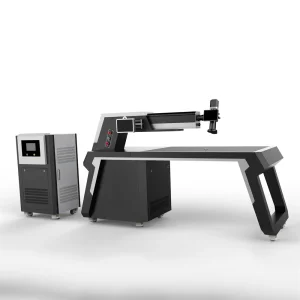
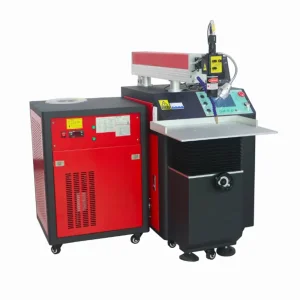
Class 1 Enclosed CNC
Get Quote & Specs
Precision-engineered continuous fiber, CNC enclosed multi-axis, and high-frequency galvanometer systems configured for immediate OEM integration and global delivery.

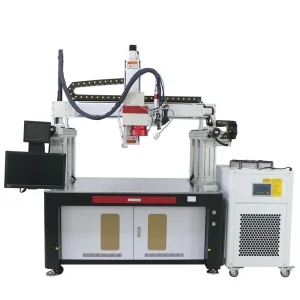
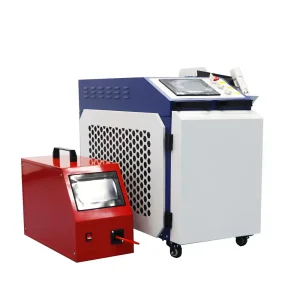
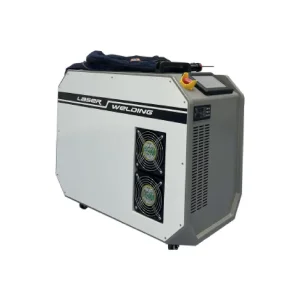


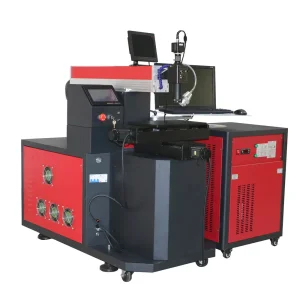
High-energy-density photonics are displacing traditional TIG and MIG technologies across global supply chains, slashing lifecycle production expenses, thermal warping, and skilled labor bottlenecks.
Traditional arc welding exhibits a broad Heat Affected Zone (HAZ), leading to post-weld angular distortion and mechanical property degradation in thin-wall metals. Industrial fiber lasers focus power density exceeding 10⁶ W/cm², producing deep-penetration keyhole welds with an 80% smaller HAZ and zero post-process cosmetic grinding.
With wall-plug electro-optical conversion efficiency exceeding 35% (compared to under 5% in legacy YAG flashlamp welders), continuous wave fiber laser sources dramatically slash electrical utility draws. Handheld units require zero consumables other than standard shielding gas and cost-effective sacrificial protective lenses.
Global manufacturing markets face an acute deficit of certified manual TIG/MIG operators. Fiber laser welding systems equipped with dual-axis oscillation (wobble heads) expand tolerance for joint fit-up gaps up to 1.5mm, enabling novice operators to execute ASME/AWS-grade hermetic seams within days of basic training.
Selecting the ideal laser configuration requires evaluating beam delivery thermodynamics, oscillator architectures, and integration interfaces for automated or manual operation.
Utilizing single-mode or multi-mode fiber resonators (typically 1070nm ±10nm), CW lasers maintain uninterrupted laser output ideal for high-speed continuous seam welding in sheet metal, pipe profiling, and structural enclosures. High single-pass penetration up to 8mm in stainless steel with low porosity.
Operating in long-pulse modes where peak power can exceed continuous average power by tenfold (e.g., 1500W peak from a 150W average system). QCW delivers low cumulative heat loads, making it the benchmark standard for micro-electronics, lithium pouch cells, and thermal-sensitive medical alloys.
High-speed galvo-scan heads guide laser beams via ultra-light mirrors mounted on high-torque servo galvos, producing scanning velocities up to 7,000 mm/s. When married with multi-axis CNC gantries or 6-axis cobots, manufacturers achieve complex weld geometries with sub-micron repeatability.
| System Architecture | Laser Source Type | Penetration Range (Steel) | Typical Beam Spot Size | Gap Bridging Capability | Primary Industrial Use-Case |
|---|---|---|---|---|---|
| Handheld Wobble Welder | 1kW – 3kW CW Fiber | 0.5 mm – 8.0 mm | 0.2 mm (Wobble to 5.0 mm) | Up to 1.5 mm with wire feeder | HVAC, metal fabrication, doors/windows |
| 3-Axis CNC Automation | 1.5kW – 6kW CW Fiber | 1.0 mm – 12.0 mm | 0.15 mm – 0.4 mm | ≤ 0.2 mm (requires tight clamping) | Pressure vessels, automotive stampings |
| Galvo Scanner Welder | 500W – 3kW CW / QCW | 0.1 mm – 3.0 mm | 0.03 mm – 0.08 mm | ≤ 0.05 mm (micro-tolerance) | EV battery tabs, hair-pin motors, relays |
| Precision Boom / Mold Repair | 200W – 400W Pulsed / Fiber | 0.1 mm – 2.0 mm | 0.1 mm – 1.2 mm | Manual filler rod deposition | Plastic injection dies, casting edge repairs |
| Desktop Precision Benchtop | 60W – 200W QCW / YAG | 0.05 mm – 1.2 mm | 0.05 mm – 0.5 mm | Direct contact / overlap | Precious jewelry, watchmaking, dental lab |
Engineering solutions adapted to demanding metallurgy—from high-reflectivity copper and aluminum alloys to dissimilar metal bonding in mission-critical environments.
Welding prismatic cell aluminum can lids, busbar interconnects (Copper-to-Aluminum), and cylindrical 4680 cell tabs. Dual-beam wobble heads suppress spatter and eliminate brittle intermetallic phase formations.
Titanium Grade 5 and Inconel 718 exhaust assemblies, sensor housing enclosures, and honeycombs. Argon trailing-shield assemblies prevent oxidation, meeting stringent AMS 2680/2681 electron-beam comparable specifications.
Stainless steel 304/316L commercial kitchen equipment, pharmaceutical mixer tanks, and architectural balustrades. Yields crevice-free sanitary joints preventing bacterial colonization without chemical pickling or passivation.
Deposition of H13, P20, and S136 tool steels onto worn injection tooling edges, gate erosions, and parting lines. Boom-mounted articulated optical heads permit in-press restoration without complex die de-rigging.
Procuring industrial machinery across borders requires ironclad adherence to laser radiation standards, local electrical codes, and immediate field service availability.
All systems conform to EN 60825-1 (Safety of Laser Products), CE-LVD/EMC machinery directives, and US FDA CDRH 21 CFR 1040.10. Automated lines incorporate redundant safety interlocks, OD 7+ laser safety viewing windows, and dual-channel optical interlock shut-off circuits.
Equipped with multi-tap industrial transformers supporting regional voltages (220V 1-phase 50/60Hz, 380V/480V 3-phase). Pneumatic circuits engineered for dual-gas toggling (Nitrogen for oxidation-free clean seams, Argon for reactive metals, CO2 blends for deep carbon steel penetration).
Immediate dispatch of optical quartz protective lenses, collimating/focusing optics, copper welding nozzles, and wire feed rollers. Online diagnostic telemetry connects directly to factory optical engineers via encrypted cloud links for immediate fault mitigation.
Transparent breakdown of factors influencing machine pricing—from optical power tiers and dual-axis wobble mechanisms to chiller capacity and automated multi-axis positioning stages.
The fiber source accounts for 35%–50% of machine bill-of-materials. Single-module CW sources (1kW–2kW) suit general fab shops. Multi-module 3kW–6kW sources require larger dual-circuit industrial water chillers and high-damage-threshold fused silica optics, altering baseline quotes.
Manual handheld configurations offer the lowest entry threshold ($3,500 – $9,000 depending on optical power and feeder). Custom multi-axis CNC gantry cells, rotary chuck indexing, and robot-mounted galvo systems range from $15,000 to over $75,000 based on stroke envelopes and vision guidance.
A standard 1.5kW handheld unit operating in a double-shift fabrication plant typically breaks even in 3 to 6 months. Savings stem from: 80% reduction in pre-weld beveling and post-weld abrasive flap-disc consumables; 400% increase in linear output; and zero need for master welders.
The next decade of laser manufacturing centers on blue/green hybrid wavelengths, machine-vision seam correction, and closed-loop acoustic process telemetry.
Pure copper absorbs less than 5% of conventional 1070nm infrared energy at room temperature, causing catastrophic back-reflection. Emerging 450nm (blue) and 532nm (green) wavelengths boast >40% room-temperature absorptance, enabling zero-spatter copper foils and busbar welds without porosity.
Integrating coaxial visual cameras, pyrometric spectrometers, and acoustic emission sensors directly within the laser delivery head. AI neural models evaluate keyhole depth, back-reflection, and plasma plumes in real time, auto-modulating power within 50 microseconds to eradicate blow-outs.
Handheld tools are transitioning to lightweight collaborative robotic arms with "hand-guiding" programming. Fabricators record a welding vector by tracing the joint manually once; the 6-axis cobot then repeats the exact oscillation frequency and feed speed across hundreds of production cycles.
In-depth engineering answers covering shielding gas flow dynamics, wire feeding limits, penetration parameters, and warranty logistics.
Explore our complete range of specialized equipment including 3-axis CNC workstations, heavy boom mold welders, benchtop jewelry systems, and sign-making welders.