Engineered for surgical precision on heat-sensitive precious alloys, palladium, titanium, and heirloom antique restorations with negligible thermal transfer.

How strict environmental regulations, high specialist labor costs, and a renaissance in Scandinavian minimalist design are accelerating the adoption of precision photonic joining.
The Swedish precious metals and jewelry manufacturing ecosystem represents an extraordinary confluence of time-honored artisanal silversmithing—deeply anchored in Dalarna, Småland, and Stockholm's historical districts—and hyper-modern, high-tech industrial micro-fabrication. Sweden’s jewelry design market, characterized globally by clean Nordic contours, organic geometry, and sustainable provenance, faces unprecedented macro-economic and operational realities. Swedish goldsmiths and horological micro-mechanics face skilled labor costs often exceeding 650 to 950 SEK per billable bench hour. In this high-wage environment, traditional torch brazing, gas flame soldering, and iterative chemical pickling introduce structural bottlenecks that limit competitive capacity.
Furthermore, Sweden's world-leading commitment to industrial decarbonization, circular economy principles, and stringent worker protection standards enforced by Arbetsmiljöverket (the Swedish Work Environment Authority) creates rigorous requirements for studio equipment. Traditional soldering with fluorinated chemical fluxes, cadmium-bearing brazing alloys, and acid pickling baths poses serious air-quality and hazardous waste compliance challenges in urban workshop settings from Gothenburg to Uppsala. Consequently, photonic micro-welding—specifically pulse-shaped Nd:YAG and Quasi-Continuous Wave (QCW) fiber laser technology—has transitioned from an optional luxury to an essential operational baseline for Swedish jewelry enterprises.
A distinctive dimension of the Swedish market is the massive consumer and commercial migration toward 100% certified recycled gold, fair-mined silver, and medical-grade titanium/palladium alloys. Recycled alloys frequently present micro-structural inconsistencies, trace secondary element inclusions, and modified surface tensions during melting phases. When subjected to diffuse flame brazing, recycled 18-karat white gold (heavily alloyed with nickel or palladium) exhibits high susceptibility to hot cracking, intergranular zinc boiling, and discolouration. Laser spot welding circumnavigates these metallurgical hazards through millisecond-level pulse management, creating high-density melt pools with an ultra-narrow Heat Affected Zone (HAZ) measuring less than 0.05 mm, preserving alloy integrity without compromising nearby precious stones.
Eliminates the need for aggressive borax fluxes and sulfuric acid pickling, achieving full alignment with Swedish environmental and workshop air regulations.
Complex multi-step ring sizing, prong re-tipping, and porosity filling procedures are compressed from 45-minute manual setups to sub-5-minute laser micro-joins.
Weld prongs immediately adjacent to heat-fragile emeralds, tanzanites, pearls, and opals without heat sink paste or stone de-mounting.
Evaluating the physical limits of Nd:YAG 1064nm, QCW Fiber, and Continuous Wave laser propagation across high-reflectivity precious and industrial metals.
Across the international jewelry, medical device, and horological industries, laser welding has supplanted micro-TIG (Tungsten Inert Gas), capacitive discharge micro-arc welding, and resistance spot-welding. The fundamental technological driver lies in energy density concentration and temporal pulse shaping. Highly reflective metals—specifically 24K and 18K yellow gold (which reflects over 95% of near-infrared light at room temperature), 925 sterling silver, and oxygen-free copper—present profound challenges for thermal beam coupling.
When an unmodulated laser beam hits pure silver or gold, the vast majority of photons are specularly reflected back into the optical delivery system, which risks damaging internal mirrors and fiber ends while failing to melt the workpiece. Achieving reliable joining in these demanding metals requires high peak power (typically 5 kW to 8 kW) delivering an instantaneous "burst" pulse during the first 0.2 to 0.5 milliseconds. This instantly forces the metal surface beyond its reflective phase into a phase-change ionization state, collapsing the reflection barrier and allowing subsequent lower-power trailing pulse energy to establish a stable, non-spattering keyhole melt pool.
| Technology Type | Peak Pulse Power | Wavelength / Delivery | Thermal Distortion (HAZ) | Reflective Metals (Au, Ag) | Operational Footprint |
|---|---|---|---|---|---|
| Flashlamp-Pumped Nd:YAG | Up to 8.0 kW (Instantaneous) | 1064 nm (Optical Crystal / Lens) | Minimal (< 0.10 mm) | Exceptional (High absorption spike) | Standard Benchtop / Studio |
| Quasi-Continuous Wave (QCW) | Up to 6.0 kW (Adjustable) | 1070 nm (Single-Mode Fiber) | Ultra-Low (< 0.04 mm) | Superior (Fine beam quality, BPP < 2) | Compact Industrial Enclosure |
| Micro-TIG / Arc Discharge | N/A (Continuous Current) | Electric Arc Propagation | Broad (> 1.20 mm) | Poor (Surface oxidation, pitting) | Benchtop / Electrodes required |
| Continuous Wave (CW) Fiber | Equal to rated wattage (e.g. 1.5kW) | 1080 nm (Multi-Mode Fiber) | Moderate (> 0.40 mm) | Risk of burn-through on thin filigree | Heavy Fabrication Floor |
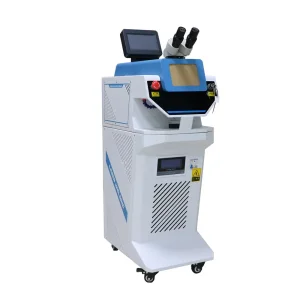
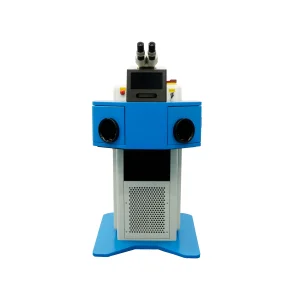
Our custom jewelry welding machine series specifically utilizes dual-cavity flashlamp Nd:YAG or state-of-the-art QCW fiber laser engines. By integrating multi-segment programmable pulse shaping (such as pre-heating slope, primary welding plateau, annealing decay ramp, and back-cooling taper), goldsmiths can work on 0.15mm platinum wires, cast 925 silver jewelry prone to micro-porosity, and dissimilar metal junctions (such as joining gold settings to titanium frameworks) with zero recrystallization embrittlement or post-weld joint cracking.
Unveiling the structural, supply-chain, and engineering advantages that deliver high-precision laser equipment at exceptional cost-to-performance ratios.
Shenzhen, China has evolved into the world's epicenter for advanced optoelectronics, industrial laser engineering, and precision micro-welding systems. Historically, Swedish and wider European jewelry manufacturers depended exclusively on legacy German or Italian laser brands. While technically proficient, these European solutions carry hefty brand premiums, long spare-part replenishment cycles (often taking 4 to 8 weeks for specialized optical crystals or flashlamps), and rigid software frameworks that cannot be easily tailored to bespoke workshop needs.
Shenzhen Youmir Laser Technology Co., Ltd. bridges this gap by combining complete in-house vertical manufacturing with European-grade components. By engineering our own optical beam expanders, ceramic reflection cavities, stereomicroscope protective shutter mechanisms, and embedded digital control software, we offer Swedish ateliers distinct advantages:
We do not merely assemble third-party modules; our Shenzhen facility manufactures and calibrates the core laser cavity, ensuring beam divergence and focal accuracy maintain surgical tolerances over millions of pulses.
We tailor external industrial chassis dimensions, workbench ergonomic depths, high-magnification microscope options (such as Leica or Motic optics), and localized language interfaces (Swedish/English) to exact buyer specifications.
Direct DDP/DAP shipments to Arlanda (Stockholm), Landvetter (Gothenburg), or Malmö. Machines are delivered fully calibrated, pre-filled with deionized coolant, and ready for 230V 50Hz single-phase plug-and-play operation.
Consult with our optoelectronic laser engineers for free metallographic sample evaluation, customized optical chamber design, and direct door-to-door export pricing to Sweden.
From delicate estate jewelry restoration to modern additive-assisted jewelry production and precision sensor manufacturing in Sweden's industrial sectors.
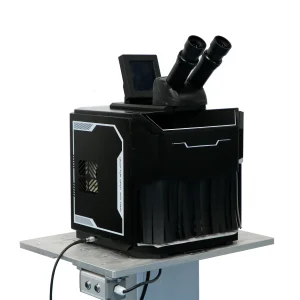
In high-end Scandinavian antique jewelry conservation, the most critical challenge is preserving historical hallmarks (such as the Swedish three-crown Kattfot mark and guild master stamps) during structural sizing or crack repairs. Traditional torch soldering requires heating the entire ring shank, which risks annealing the historical gold, melting adjacent zinc-bearing solder seams, and burning off centuries-old patina or master stamps. Using our compact 60W or 200W benchtop jewelry laser welder, a conservator projects a 0.2mm focal spot precisely onto the joint fissure, filling micro-fractures with homogeneous matching 18K alloy wire. The temperature 1.5 mm away from the weld zone remains under 45°C throughout the procedure, preserving ancient hallmarks and original metal temper without requiring subsequent electro-stripping or re-polishing.
Contemporary Swedish bridal design increasingly merges Grade 5 Titanium (Ti-6Al-4V) with 950 Platinum to produce lightweight, scratch-resistant bi-metal wedding bands. Welding titanium to precious metals with a torch is impossible due to extreme titanium oxidation when exposed to atmospheric oxygen above 400°C, producing brittle, crumbly intermetallic phases. Our jewelry welding machine series features an integrated, laminar-flow coaxial argon shielding chamber. By enveloping the micro-weld pool in a 99.999% pure argon environment with an instantaneous pre-flow and post-flow delay timer, Swedish fabricators create ductile, silver-bright, defect-free titanium-to-platinum fusion welds with zero oxidation discoloration.
Beyond traditional goldsmithing, Swedish precision engineering hubs in Gothenburg and Kista regularly utilize our vertical and compact laser welders for micro-mechanical assembly. Applications include joining 0.08mm Elinvar balance springs in high-end horological repairs, hermetically sealing miniature sensor housings, and fabricating custom medical stainless steel micro-cannulas (AISI 316L). The software provides ultra-fine parameter stepping in 0.1-Joule increments, giving micro-mechanics the precision control needed for delicate components.
AI machine vision targeting, shorter green/blue wavelengths, and green energy compliance are defining the next decade of precision fabrication.
Next-generation systems integrate neural network edge-processing into coaxial microscope cameras, automatically identifying joint seams, adjusting focal heights, and rejecting welds if misalignment exceeds 10 microns.
Development of hybrid 532nm (green) and 450nm (blue) laser engines allows for spatter-free, non-reflective micro-welding of pure 24K gold and copper without requiring extreme peak burst power.
In compliance with Swedish environmental regulations, our integrated closed-loop chillers use low-GWP refrigerants and smart variable-speed compressors, reducing workshop energy consumption by 42%.
Key technical specifications, regulatory standards, and electrical safety parameters required by Swedish industrial import authorities.
Importing industrial laser equipment into Sweden requires meeting strict safety standards. As an authorized original equipment manufacturer, Shenzhen Youmir Laser Technology Co., Ltd. builds and tests all export systems destined for Sweden in accordance with European Union harmonized standards:
Direct insights from our senior application engineers on equipment operation, maintenance, and international procurement for Sweden.
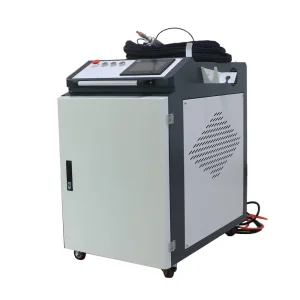
Complementary CNC automation, continuous fiber welding, and surface cleaning systems engineered for Swedish jewelry, mold manufacturing, and precision engineering sectors.





Connect directly with our engineering team for sample weld tests, metallographic cross-section reports, custom optical configurations, and complete DDP door-to-door delivery across Sweden.
