Engineered to satisfy stringent toolroom restoration criteria across Puget Sound's aerospace, composite molding, and precision tooling operations.
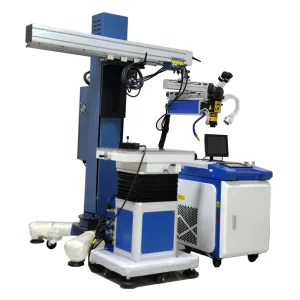
Ultra-narrow thermal footprint for microscopic mold edge building, heat-treated die restoration, and zero-undercut finishes.

High peak power delivery engineered specifically for thermally sensitive mold cavities, beryllium copper inserts, and high-spec injection dies.
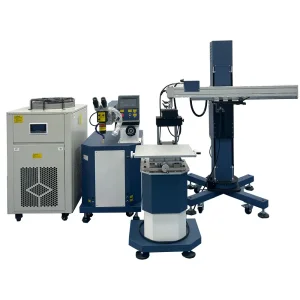
360-degree radial articulation allows seamless access directly into multi-ton press cavities without dismounting oversized stamping tools.
Custom Boom Mold Laser Welding Machine Manufacturers, Factory

Integrated stereomicroscope with anti-glare shutter protection for high-accuracy restoration of P20, H13, and S7 tool steels.
Greater Seattle—spanning the aerospace hubs of Everett and Renton, maritime fabrication on Puget Sound, and the advanced clean-tech corridors across Redmond and Kent—demands uncompromising operational precision. High-stress autoclave tooling, composite resin transfer molds (RTM), and large-scale structural aluminum stamping dies routinely encounter severe cyclic thermal fatigue and mechanical wear.
Traditional TIG welding and thermal spray techniques introduce excessive heat-affected zones (HAZ), warping dimensional tolerances and degrading parent-metal temper. Our Mold Laser Welding Machine Series introduces focused energy densities exceeding $10^6 \text{ W/cm}^2$, localizing energy to sub-millimeter points, enabling Puget Sound toolmakers to execute in-situ micro-welding with virtually zero distortion, eliminating post-weld annealing and heavy EDM re-machining.
Eliminates base-metal stress risers and dimensional sink on critical aerodynamic part lines.
Boom-mounted optical paths reach deep into stamping and injection equipment without tear-down.
A breakdown of optical physics, pulse shape programming, and metallurgical dynamics deployed across our factory-grade mold restoration systems.
Our proprietary laser controllers provide arbitrary multi-stage pulse shaping. By adjusting pre-heating ramps, peak holding energy, and deceleration cooling slopes, the unit mitigates solidification cracking in prone alloys such as NAK80, DIN 1.2344, and beryllium copper alloys widely employed in Pacific rim precision tooling.
Equipped with 360-degree rotating internal optics, stereoscopic binocular observation (10x–20x magnification), and co-axial crosshair targeting. Laser emissions coincide strictly with the focal intersection, enabling technicians to rebuild 0.1 mm shear edges on stamping dies without spillover.
Microprocessor-controlled synchronized wire feeder accommodates wire diameters from 0.2 mm to 0.8 mm. Stepper motors synchronize feed velocity with laser pulse initiation, guaranteeing pore-free deposition layers without stubbing, slippage, or excessive puddle buildup.
Combining world-class optical component manufacturing scale from Shenzhen with localized compliance, setup, and on-site support across King and Snohomish counties.
| Evaluation Parameter | Conventional Toolroom TIG / Micro-Arc | Standard Import Laser Systems | Youmir Seattle-Spec Mold Laser Series |
|---|---|---|---|
| Heat Affected Zone (HAZ) | 1.5 mm – 4.0 mm (high risk of sink) | 0.3 mm – 0.8 mm (moderate) | < 0.1 mm (imperceptible micro-transition) |
| Filler Wire Compatibility | Limited to > 0.8 mm rods | 0.3 mm – 0.6 mm manual feed | 0.15 mm – 0.8 mm fully automated synchronized feed |
| On-Press Reachability | Impossible for heavy tool blocks | Rigid bench setup only | Multi-axis cantilever boom arm with 1.8 m radius |
| Safety & US Compliance | Non-laser (standard PPE) | Uncertified optics/switchgear | FDA CDRH Class IV / Class I enclosures, UL/CE certified |
| Local Service Footprint | Local welders available | Remote email-only support | Regional engineering support, express parts inventory |
Targeted solutions developed for specific manufacturing sectors concentrated within the Pacific Northwest economic corridor.
Restoration of titanium forming blocks, carbon fiber layup mandrel tools, and extrusion die profiles. Preserves certified heat-treat temper on AMS-spec tool steels without compromising aerodynamic contour fidelity.
Propeller hub injection molds, cavitation-resistant bronze pump impellers, and maritime composite tooling. Rapid laser deposition of high-nickel and stellite alloys resists saltwater corrosion and abrasive wear.
Precision micro-fluidic molds and multi-cavity cleanroom injection tooling in the Bothell and Woodinville biopharma clusters. Rebuilds worn parting lines, shut-offs, and micro-pin gates to optical mirror finishes.
Deploying high-power laser equipment in North American manufacturing facilities requires strict compliance with ANSI Z136.1 Safe Use of Lasers, OSHA occupational radiation provisions, and FDA CDRH accession registration.
Every Youmir Mold Laser Series machine delivered to Seattle and US enterprise operators is pre-fitted with interlocked laser barriers, dual-channel E-stop circuits, laser-safe protective viewing windows (OD6+ at 1064nm), and integrated HEPA particulate fume extraction manifolds to capture toxic vaporized heavy metals.
Current R&D incorporates real-time vision-based seam tracking, closed-loop melt-pool pyrometry, and AI-driven predictive defect-recognition software designed to automate tool edge surfacing without operator fatigue.
Pre-certified interlocks, key-switch controls, and classified safety labeling for seamless shop floor commissioning.
Configured for standard US 208V / 240V / 480V 3-phase lines with industrial NEMA-rated enclosures.
Calibrated preset parameters for over 45 die materials including NAK80, H13, Stellite, Titanium, and Ampcoloy.
Explore complete specifications for our cantilever, automatic CNC, handheld QCW, and precision surface cleaning stations.
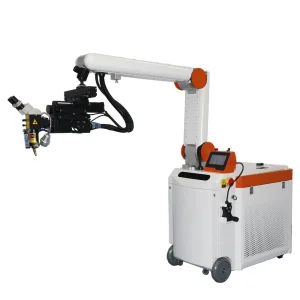
Telescopic multi-joint arm engineered to service multi-ton plastic injection molds and automotive bumper tooling.
Custom Cantilever Laser Welding Machine Pricelist, Factories
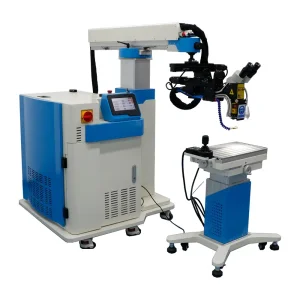
Compact floor footprint with all-in-one chiller, laser source, and articulating boom optics for agile shop layouts.
Custom Integrated Boom Mold Welding Machine Manufacturer, Quotes
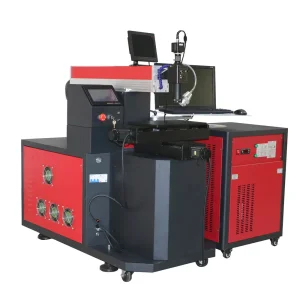
Programmable 4-axis motion platform suited for automated batch repairs, precision sensor capsules, and medical dies.
High-Quality Automatic Laser Welding Machine Pricelist, Factories
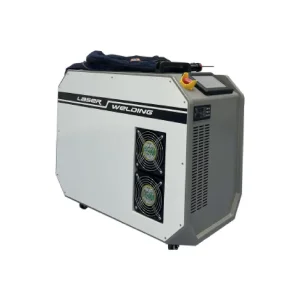
Portable handheld freedom with peak quasi-continuous precision for agile mold touch-ups and quick toolroom adjustments.
High-Quality QCW Handheld Laser Welding Machine Pricelist, Quotes
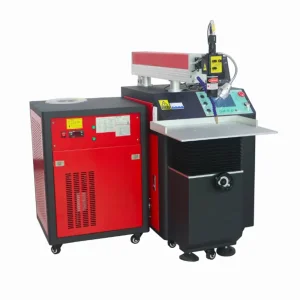
Unrestricted work zone for large mold core inserts, deep extrusion profiles, and bulky aerospace stamping blocks.
High-Quality Open Laser Welding Machine Pricelist, Factories

Zero-contact ablation for removing release agents, rust, and burnt polymer deposits without scratching mirror-finish cavities.

Class I certified safety enclosure featuring high-precision servo tables, fume filtration, and continuous production automation.
Custom Cnc Enclosed Automatic Fiber Laser Welding Machine Factories, Quotes
Heavy-duty motorized worktable designed to support workpieces up to 2,000 kg with smooth micron-level 3-axis feed control.
In-depth responses to operational, metallurgical, and shipping queries for factory owners across the Pacific Northwest.
Micro-TIG relies on electrical arc conductivity, producing a substantial heat-affected zone (often 2 mm to 4 mm), which precipitates thermal stresses, sink marks, and micro-cracking across hardened steels (50–60 HRC). Laser welding concentrates high energy onto spots as small as 0.2 mm within 1–20 milliseconds. The base material surrounding the weld pool remains virtually room temperature, preserving the original tempering, eliminating sink, and drastically cutting secondary EDM or manual benching labor.
Yes. For critical grades like H13, P20, S7, and NAK80, laser welding's instantaneous melt-solidification cycle enables cold repair in the majority of situations. By leveraging programmable pulse shaping (such as a gradual down-slope cooling pulse), thermal shock is avoided, allowing defect-free deposits without spending hours bringing massive mold blocks up to 300°C in an oven.
We supply comprehensive North American deployment packages. This includes complete setup documentation, pre-configured NEMA/US wiring compatibility, comprehensive video training tailored for toolmakers, and 24/7 direct remote video support from senior laser engineers. In addition, critical optical components, lenses, nozzles, and replacement modules can be expedited to Seattle, Everett, Tacoma, and surrounding facilities within 48 to 72 hours.
Absolutely. We operate an open application laboratory. Toolrooms and production plants are encouraged to air-freight sample mold inserts, worn stamping sections, or alloy coupons to our engineering center. Our metallurgists perform trial depositions, document wire feeds, verify hardness (Rockwell C), record micro-video loops of the process, and deliver an exhaustive metallurgical test report free of charge.
Consult with our laser application specialists to configure the optimal mold welding station, request parameter test reports, or receive a fast quotation tailored for your Seattle manufacturing operation.
