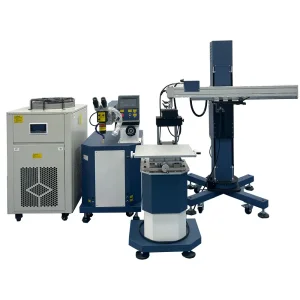
Industrial-Grade Precision Micro-Deposition Systems for Tooling, Injection Mold Refurbishment, and High-Tolerance Aerospace Dies Across Southern California.
Engineered for direct tool-room deployment, minimal heat dissipation, and micro-precision wire deposition across aerospace, medical, and packaging tooling.
The Greater Los Angeles manufacturing corridor represents one of the most technologically demanding manufacturing clusters globally, balancing legacy tool refurbishment with hyper-advanced rapid production.
Southern California—spanning El Segundo, Long Beach, and the Antelope Valley—demands absolute structural integrity in aerospace die castings, composite mold tooling, and titanium forming dies. Traditional TIG repair introduces thermal strain and structural deformation that violates aerospace geometric tolerances. Fiber laser mold welding delivers sub-millimeter deposition without base metal annealing.
Micro-molding operations in Irvine and San Clemente operate under cleanroom class tolerances where parting-line degradation causes flashing in high-volume bio-compatible injection components. Our QCW and pulsed mold welders perform metallurgical reconstruction on hardened steels (H13, S7, Stavax) without causing thermal sink depressions.
With industrial square footage costs in the City of Industry, Torrance, and Commerce rising, tool & die houses must minimize downtime. Rather than commissioning replacement core inserts requiring a 6-week lead time, in-house mold laser welding restores damaged edges, gates, and textured surfaces in under two hours.
Comprehensive process parameterization configured specifically for tool steel grades commonly deployed across California manufacturing plants.
| Tool Steel Grade | Primary Local Industry Application | Recommended Laser Source | Filler Wire Compatibility | Heat-Affected Zone (HAZ) |
|---|---|---|---|---|
| AISI H13 Tool Steel | Die Casting & Hot Forging Dies (Inland Empire) | Fiber Continuous / Pulsed (400W–500W) | H13, SKD61, Cr-Mo Alloys (Ø 0.2–0.6 mm) | < 0.12 mm (No Preheat Needed) |
| S7 Shock-Resisting | Impact Tooling & Heavy Stamping (Commerce/Vernon) | QCW Quasi-Continuous (300W–600W) | AISI S7, Tool-Weld 55 | < 0.15 mm (Controlled Tempering) |
| Beryllium Copper (BeCu) | High-Conductivity Injection Cores (Torrance) | High Peak-Power Fiber (Green/IR Hybrid) | Ampcoloy, Cu-Be matching wire | < 0.08 mm (Zero Core Softening) |
| Stavax / 420 Stainless | Optical & Medical Polymers (Irvine / Pasadena) | Fiber Microscope Precision Series | AISI 420, Corrax, 316L Micro-Wire | Negligible (Preserves Mirror Finish) |
| P20 Pre-hardened | Consumer Goods & Automotive Large Trim Tools | Cantilever / Boom Arm Extended Fiber | P20, 718, NAK80 Low-Alloy | < 0.18 mm (No Hard Cracking) |
From manual lamp-pumped Nd:YAG to AI-assisted adaptive galvanometer fiber optics: how modern mold manufacturing continues to advance.
Global tool maintenance operations have decisively shifted away from lamp-pumped YAG platforms. Fiber systems offer 30%+ wall-plug electrical efficiency (compared to YAG’s 2–3%), operate without routine xenon flashlamp replacements, and offer over 100,000 hours of pump source longevity, reducing total cost of ownership by 45% over 5 years.
Modern mold laser welders leverage high-speed dual-axis galvanometer wobble heads. Rather than delivering a static beam, the oscillating focal spot bridges gaps up to 1.5 mm while simultaneously providing fine puddle agitation, eliminating gas porosity and lack-of-fusion defects when depositing dissimilar alloy filler wire.
The next frontier in mold rebuilding integrates real-time machine vision profiling with closed-loop infrared pyrometry. Future systems will dynamically adjust laser pulse shape and energy density based on workpiece heat buildup, fully automating complex 3D contour rebuilding on critical tool surfaces.
Direct-from-manufacturer agility delivering industrial tier components, standardized modular assemblies, and complete factory support.
Unlike regional integrators who re-label third-party systems, our Shenzhen manufacturing facility controls optical assembly, PCB electronics engineering, and CNC control firmware development. This ensures deep hardware-software integration, rapid troubleshooting, and long-term modular firmware upgradability.
Every mold laser welding workstation is integrated with industry-verified laser engines (Raycus, MAX, IPG), precision motorized boom assemblies, Schneider electric relays, and dual-circuit industrial water chillers designed to run stably through peak Southern California summer facility loads.
Tool configurations are tailored around specific customer work envelopes. Whether mounting extended 360-degree cantilever arms for 10-ton automotive injection dies or compact desktop enclosures for precision micro-medical electronics, our design turnaround cycles operate on a strict 14-day CAD validation schedule.
Navigating rigorous American manufacturing and regulatory standards with certified hardware builds and localized technical assistance.
All laser equipment exported to the US complies with FDA Title 21 CFR Subchapter J safety performance standards and ANSI Z136.1 specifications for safe use of lasers. Integrated dual-channel interlocks, keyed master controls, and emergency shutoff circuitry ensure full plant safety audit readiness.
California facilities face rigorous workplace oversight under Cal/OSHA Title 8 industrial safety regulations. Our enclosures feature UL508A-aligned electrical wiring standards, standardized 208V/240V/480V 3-phase power drop configurations, and direct exhaust ports for Class 1 HEPA fume extractors.
With quick-turn stocking points and responsive technical support across Pacific Standard Time, California fabricators receive prompt delivery of replacement protective quartz windows, focus lenses, copper nozzles, and precision repair filler wire spools, backed by 24/7 direct remote video engineering assistance.
Practical metallurgical and operational insights addressing questions frequently posed by plant managers, moldmakers, and procurement directors.
A: Micro-TIG exposes the mold to a large thermal footprint, often causing base metal sinking, micro-cracking, and localized annealing that drops Rockwell hardness. Laser welding concentrates high energy onto a focused spot (0.1–2.0 mm), yielding a microscopic Heat-Affected Zone (< 0.15 mm). Hardness is maintained across the parent metal, completely avoiding sink marks or thermal distortion.
A: Yes. When the filler wire metallurgical composition matches the parent substrate (e.g., matching Stavax wire on a Stavax mold base) and shielding gas shielding purity (99.999% Argon) is maintained, the deposit solidifies with uniform grain structure. Post-weld EDM, diamond polishing (SPI A1), and chemical photo-etch texturing integrate seamlessly without visible weld boundaries.
A: Our Boom and Cantilever Mold Laser Welding series eliminate the need to load heavy dies onto a motorized X-Y stage. The articulated 360-degree motorized arm extends up to 1.5 meters directly inside the injection molding press or heavy tool cart, allowing mold repair directly in the machine room without tearing down whole tool assemblies.
A: A 300W to 500W pulsed or QCW fiber system is the industry standard for detailed plastic injection tool maintenance. This window provides the ideal balance between low heat input on razor-sharp shutoffs and sufficient power density to weld larger radius build-ups quickly with Ø 0.6 mm filler wire.
A: Yes. We engineer both hardware and software in-house. We provide customized CNC multi-axis synchronization, custom chucks, rotary indexers for cylindrical cores, and user-friendly interface languages aligned with your operators' standard procedures.
A: Standard machines ship within 10–14 business days from Shenzhen. Ocean freight to the Port of Los Angeles typically takes 14–18 days, with full customs clearing documentation, ISF filing, and delivery door-to-door directly to your dock.
Comprehensive manual, semi-automated, and fully CNC multi-axis laser welding machinery for precision engineering applications.
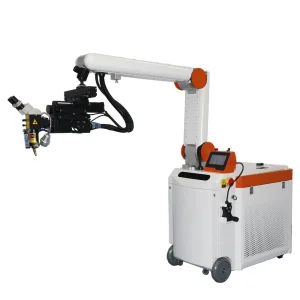
Custom Cantilever Laser Welding Machine Pricelist, Factories
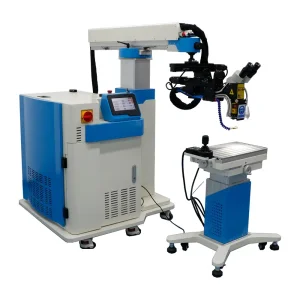
Custom Integrated Boom Mold Welding Machine Manufacturer, Quotes
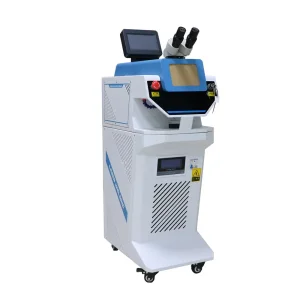
High-Quality YAG-Jewelry Laser Welding Machine Pricelist, Factories
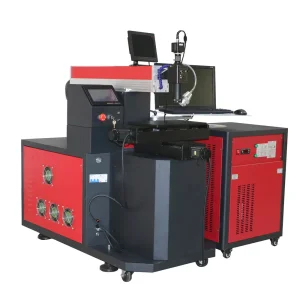
High-Quality Automatic Laser Welding Machine Pricelist, Factories

High-Quality 3 Axis Automatic Welding Machine Pricelist, Factory

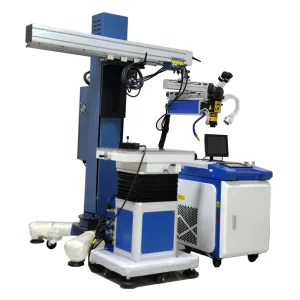
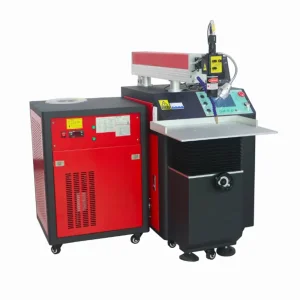
High-Quality Open Laser Welding Machine Pricelist, Factories
Eliminate tool-room bottlenecks and protect critical injection dies with industrial-tier precision laser welders built directly by our Shenzhen factory.
Send Inquiry Now →