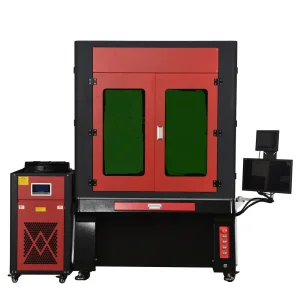
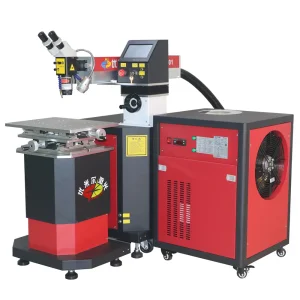
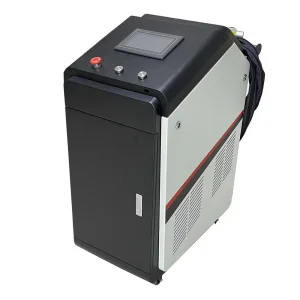
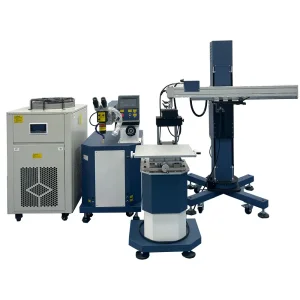
Explore our core continuous, pulsed, and fiber-automated laser workstations engineered for maximum duty cycles, repeatable weld morphology, and rapid integration.

A rigorous examination of 1064nm optical absorption, thermal dissipation mechanics, and molten pool dynamics in high-reflectivity precious alloys.
In the domain of high-precision goldsmithing and fine jewelry manufacturing, micro-laser welding has transitioned from an advanced luxury to an indispensable baseline technology. Unlike conventional gas-torch soldering that relies on macroscopic thermal conduction—heating the entire workpiece and jeopardizing delicate stones, enamel, and spring mechanisms—laser micro-welding leverages concentrated photon flux at a standard wavelength of 1064 nm (Nd:YAG) or quasi-continuous wave (QCW) fiber emissions. The spatial coherence and beam diameter (tunable from 0.1 mm to 3.0 mm) generate an instantaneous localized energy density exceeding 106 W/cm2. This produces a keyhole or melt pool within 0.1 to 20 milliseconds, confining the heat-affected zone (HAZ) strictly to the joint boundary.
Overcoming the Optical Reflectivity Barrier: Pure silver (Ag) and yellow gold (Au) absorb less than 5% to 8% of infrared radiation at room temperature under 1064nm wavelength. Shenzhen Youmir Laser implements dynamic pulse-shaping algorithms that fire an initial micro-spike (peak power up to 6.0 kW) within the first 0.5 milliseconds. This instantly overcomes surface reflectivity by collapsing the solid-state optical barrier, before dropping to a sustained plateau that maintains molten bath stability without explosive vapor expulsion or blowholes.
Sterling silver combines ultra-high thermal conductivity (406 W/m·K) with rapid surface oxidation. Our desktop jewelry systems integrate co-axial laminar argon shielding and rapid multi-pulse firing schedules that prevent copper-eutectic phase cracking while producing pristine, mirror-reflective weld beads.
Platinum melts at an elevated 1768°C but exhibits low thermal conductivity (71.6 W/m·K). This makes it the ideal substrate for laser joining. Our software pre-programs deep keyhole penetration routines with square waveforms, producing high tensile seams devoid of porosity or recrystallization brittleness.
Variable carat gold blends containing copper, zinc, nickel, or silver suffer from intermetallic embrittlement if thermal decay is too fast. Our systems feature 10-stage user-programmable pulse ramp-down decay profiles that anneal the solidification matrix in real time.
Why the world's leading jewelry houses, contract manufacturers, and laboratory distributors partner with Shenzhen Youmir Laser Technology Co., Ltd.
We do not operate as generic system assemblers. Shenzhen Youmir designs our own laser cavity reflectors, optical beam expanders, digital control boards, and firmware algorithms for granular process repeatability.
Every desktop jewelry welder undergoes a mandatory 72-hour continuous thermal chamber stress test, beam profile energy distribution analysis, and 100,000-shot pulse repeatability validation before crating.
Situated in the Guangming District photonics hub, we leverage direct access to precision CNC fabrication, optical lens polishing, and electronic component manufacturing, yielding a 40–55% lower capital cost vs. EU/US equivalents.
From custom sheet metal liveries, ergonomic hand-chamber modifications, private-label firmware interfaces, to automated rotary chuck additions—we build tailored machines for multi-location jewelry chains.
How miniaturization, fiber innovation, AI parameter adaptation, and closed-loop optical feedback are reshaping modern jewelry benches.
Modern goldsmiths no longer rely on manual trial and error. Our next-gen desktop welders integrate intelligent touchscreen controllers pre-loaded with over 150 material matrices (e.g., 18k Rose Gold, 925 Sterling, Titanium Grade 2). Selecting wire gauge and metal grade automatically optimizes pulse width, voltage, and frequency, cutting training time to under 4 hours.
Bulky, noisy external chillers are obsolete. Youmir desktop welders employ micro-channel closed-loop deionized liquid cooling paired with low-vibration German Peltier heat exchangers. This achieves an ultra-quiet working environment (<48 dB) right on retail counters, with stable continuous thermal equilibrium during heavy shifts.
Integrating high-magnification 10x/20x Leica-grade optics with real-time 4K CCD high-dynamic-range display output allows dual viewing. Master jewelers work through the binocular eyepiece protected by liquid crystal optical shutters, while apprentices or clients observe live operations on an external monitor.
Examining field-tested use cases across retail ateliers, custom bridal boutiques, antique restoration, and medical dental labs.
Traditional torch work demands unsetting diamonds, sapphires, or emeralds to avoid thermal shock and scorching. Our desktop welder pinpoints energy within a 0.2 mm focal spot just microns from the gemstone facet. The stone remains at room temperature throughout, eliminating setting risks and cutting labor by 80%.
Investment casting shrinkage inevitably leaves micro-pits and subsurface gas voids on ring shanks and watch cases. Using alloy-matched micro-welding wire (0.2 mm–0.5 mm), the welder fills defects at a microscopic scale, leaving zero seam evidence after final polish.
The rapid rise of welded 'forever jewelry' chains requires clean, sparkless, and instant closures on customers' wrists. Compact desktop systems provide instantaneous argon-shielded micro-welds on 14k gold, sterling silver, or stainless steel jump rings in under 1 second without skin sensation.
Beyond jewelry, these micro-welding systems handle cobalt-chromium (Co-Cr) and nickel-titanium (Ni-Ti) partial dentures, orthodontic clasps, and high-end titanium eyeglass bridges, delivering strong, biocompatible joints without flux or brazing alloys.
Comprehensive engineering parameters comparing standard 60W, 100W, and 200W models for custom manufacturing deployment.
| Performance Metric | YM-JW60 Compact | YM-JW100 Studio Pro | YM-JW200 Industrial Master |
|---|---|---|---|
| Laser Medium & Source | Pulsed Nd:YAG (Ceramic Cavity) | Pulsed Nd:YAG (Gold-Plated Cavity) | High-Peak Nd:YAG / QCW Option |
| Nominal Average Power | 60 Watts | 100 Watts | 200 Watts |
| Maximum Single Pulse Energy | 45 Joules | 80 Joules | 120 Joules |
| Peak Output Pulse Power | 3.5 kW | 5.5 kW | 7.0 kW |
| Pulse Width Range | 0.1 ms – 15.0 ms | 0.1 ms – 20.0 ms | 0.1 ms – 25.0 ms |
| Spot Diameter Range | 0.1 mm – 2.0 mm continuous | 0.15 mm – 2.5 mm continuous | 0.2 mm – 3.0 mm continuous |
| Observation Optical System | 10X Binocular + Crosshair reticle | 15X Leica-Type + HD CCD Cam | Stereo Microscope + 4K Digital HUD |
| Integrated Cooling Engine | Closed-Loop Deionized Water / Air | High-Cap Internal Water Chiller | Peltier Dual-Circuit Heat Exchanger |
| Shielding Gas Channel | Coaxial Single Argon Nozzle | Coaxial Dual Nozzle + Foot Valve | Synchronized Multi-Port Chamber Purge |
| Primary Application Scope | Retail Repair, Chains, 9K-18K Gold | Sterling Silver, 24K Gold, Platinum | High-Volume Batch Production, Cladding |
Quantifying ROI, regulatory adherence (CE, FDA CDRH), and cross-border after-sales logistics for corporate buyers.
Traditional torch soldering incurs ongoing costs: flux, pickling acids, pickling cleanups, solder sheets, and high gold polish loss (often 2–5% metal reduction per repair). Laser micro-welding uses matching wire without flux, eliminating acid disposal and cutting gold polish loss below 0.3%. For a mid-tier studio processing 40 repairs daily, equipment payback is typically achieved in 3.8 to 5.2 months.
Exporting to the European Union and North America requires strict adherence to laser safety standards. Youmir desktop welders are fully compliant with EN 60825-1:2014 (Safety of Laser Products), FDA CDRH 21 CFR 1040.10 Class 1 Laser Enclosure parameters, and the EU Machinery Directive 2006/42/EC. Interlocked access panels ensure laser emissions cease instantly if the chamber is opened during firing.
We deliver door-to-door worldwide using shock-isolated, vacuum-sealed industrial export crating. Every unit includes lifetime 24/7 cloud diagnostics, high-definition video walkthroughs, and guaranteed 48-hour air-dispatch for wear consumables (Xenon flashlamps, optical protection windows, and solenoid valves) from our Shenzhen central spares depot.
In-depth answers addressing thermal dynamics, alloy handling, consumable life, and custom ordering protocols.
Silver exhibits high thermal conductivity (~406 W/m·K) and reflects over 95% of 1064nm infrared laser light. When thermal energy hits the surface, it spreads rapidly throughout the item, requiring high peak power (5 kW+) to initiate the molten puddle. Once melting begins, silver's reflectivity drops sharply, creating a risk of over-penetration or blowholes. Youmir addresses this with specialized pulse-shaping firmware that fires an initial high-energy spike to break reflectivity, instantly tapering off to stabilize the weld puddle.
Yes. Diamonds, rubies, and sapphires handle temperatures up to 800°C–1000°C without issue and can be safely welded nearby when using micro-beam spots under 0.35 mm. For heat-sensitive gems like emeralds, opals, pearls, and tanzanites, the operator must angle the laser beam tangentially away from the stone face. Because laser heating is confined to a fraction of a millimeter over a few milliseconds, the bulk gemstone remains near ambient temperature.
Our premium xenon flashlamps, produced with doped quartz envelopes, provide between 5,000,000 and 8,000,000 shots depending on the operating voltages used. For an active jewelry studio firing roughly 3,000 to 5,000 pulses per business day, a lamp typically lasts 3 to 4 years. Replacement takes roughly 15 minutes, and our units feature quick-release modular mounting assemblies.
While gold itself does not readily oxidize at high temperatures, alloying elements (copper, zinc, nickel) react rapidly with atmospheric oxygen, causing dark soot and porous joint lines. Using 99.999% pure shielding argon at 3–5 liters per minute displaces ambient air, leaving a bright, oxide-free weld bead that requires minimal buffing or chemical cleanup.
Pulsed Nd:YAG systems excel at high single-pulse peak power (up to 7 kW), making them well-suited for reflective alloys like silver and yellow gold, as well as fine wire feeding and prong work. Fiber lasers offer higher wall-plug electrical efficiency and tighter beam focal spots, but their continuous or high-frequency characteristics can lead to aggressive heat accumulation unless carefully managed via pulsed QCW sources.
We invite prospective clients to send metal samples, chain sections, or custom casting components directly to our Shenzhen R&D application laboratory. Our engineers run test welds using recommended parameters, document the process via high-speed macro video, and provide cross-sectional metallurgical microscope reports before you finalize equipment specifications.
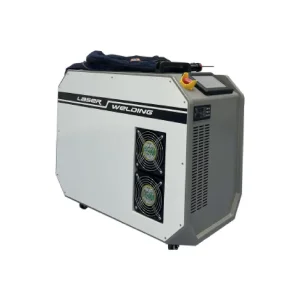
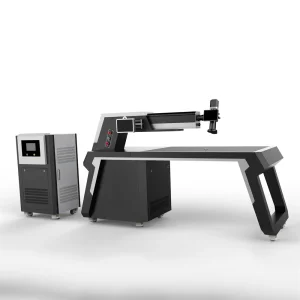
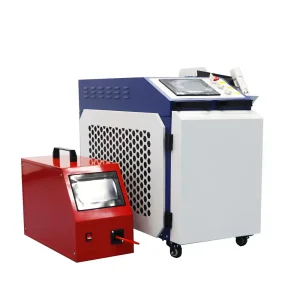
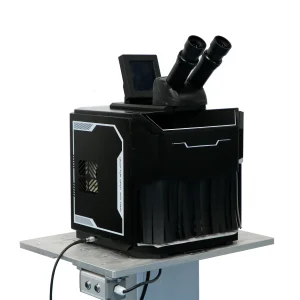
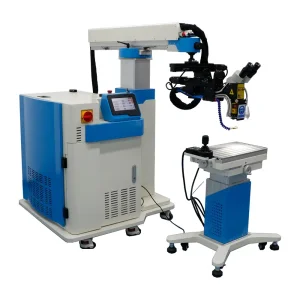
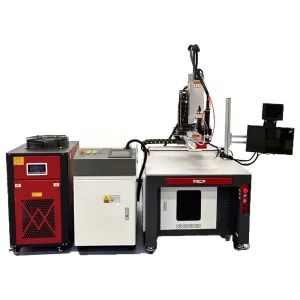
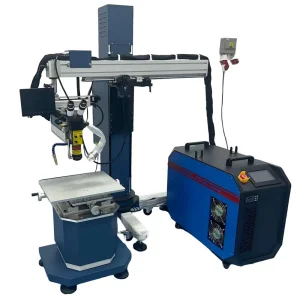
Explore our compact 60W jewelry welders, boom-arm repair stations, and vertical production systems designed for continuous operation.
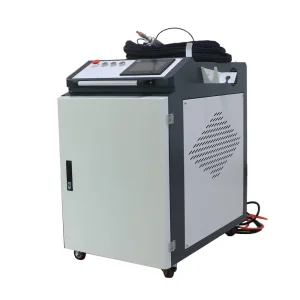
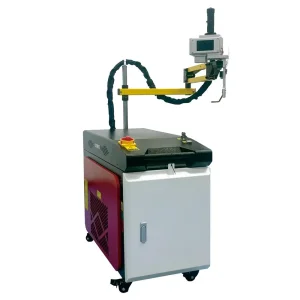
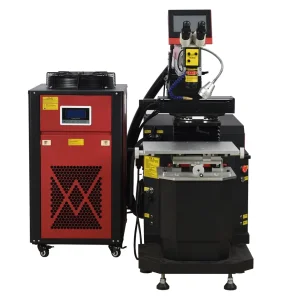
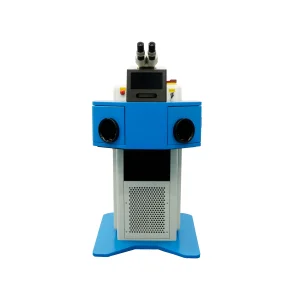
Connect directly with our Shenzhen optical applications team. Receive custom pulse parameters, cycle time estimates, and competitive direct-from-factory quotes within 12 hours.
