
Mumbai Injection Dies
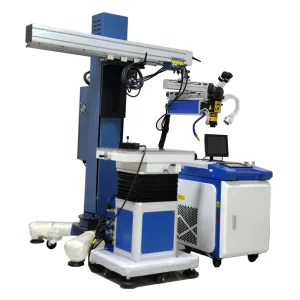
Engineered for High-Precision Die Repair, Sub-Millimeter Cavity Restoration, and Minimal Heat-Affected Zones Across Maharashtra’s Tooling & Automotive Corridors.
Discover top-tier optical precision, continuous wave and QCW fiber architectures engineered for tight-tolerance repairs in injection molds and automotive stamping dies.
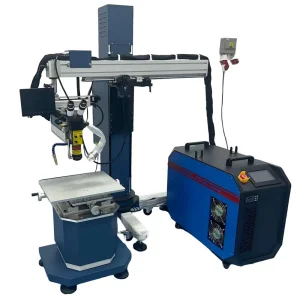
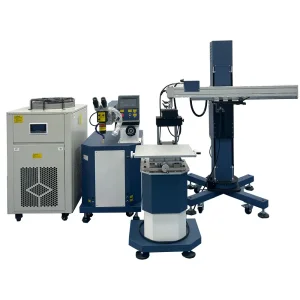
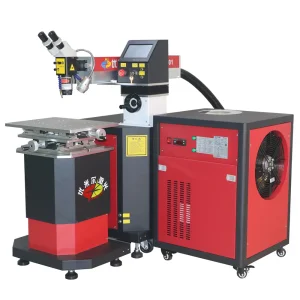
The Mumbai Metropolitan Region (MMR)—extending through Thane, Navi Mumbai, Belapur, and down the expressway to the massive Pimpri-Chinchwad manufacturing belt—represents the highest density of automotive component fabricators, polymer molders, and pharmaceutical packaging engineers in Western India.
Historically, toolrooms in Bhiwandi, Vasai, and Taloja relied on traditional TIG welding or submerged arc deposition to address mold cavitation and abrasive wear. However, standard micro-TIG methods inject excessive heat into H13, P20, and S136 tool steels, resulting in thermal sink sinking, base metal softening, and expensive downstream CNC re-machining.
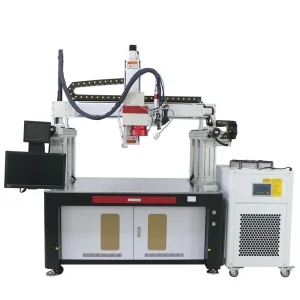
Our custom Mold Laser Welding Machine series addresses these regional pain points directly. With localized laser energy focal points down to 0.2mm, heat-affected zones (HAZ) are reduced by 92%, allowing operators to perform in-situ welding on production dies without preheating or extensive post-weld annealing.
Near-zero dimensional distortion on hardened tool steels (52-58 HRC).
Surgical beam delivery enables micro-welding on intricate parting lines.
Dies restored in toolrooms within 2 hours versus 2-3 days for EDM resurfacing.
Precise deposit profiles match adjacent contours, minimizing polish cycles.
Across tier-1 tooling suppliers in Germany, Japan, and North America, fiber laser deposition has replaced conventional arc welding. Here is how our architecture solves critical metallurgical degradation.
Rapid heating and cooling cycles inherent to high-frequency laser welding yield ultra-fine martensitic microstructure within deposit boundaries, ensuring tensile resilience equal to or greater than the original substrate.
Standard welding causes sink marks on surrounding polished surfaces due to differential expansion. Our high-coherence optics confine energy strictly to the filler wire pool, maintaining optical mirror finishes on adjacent cavities.
Tailored parameter libraries for premium tool alloys commonly used in Western India: NAK80, 1.2344, 1.2738, SKD11, beryllium copper inserts, and high-tensile titanium alloy die components.
A rigorous engineering comparison outlining heat input, structural stability, and operational efficiency for high-value toolroom environments.
| Evaluation Parameter | Fiber / QCW Laser Welding | Micro-TIG Welding | Cold Welding / ESD |
|---|---|---|---|
| Heat Input Profile | Ultra-Low (< 0.15 kJ/cm) | Moderate to High (> 1.2 kJ/cm) | Very Low (Impulse based) |
| Heat Affected Zone (HAZ) | 0.05 mm – 0.2 mm | 1.5 mm – 4.0 mm | Minimal (< 0.1 mm) |
| Deposit Hardness Uniformity | Consistent (Homogeneous grain) | Tempered / Variable softness | Brittle / High Porosity risk |
| Base Metal Deformation | Undetectable by CMM | Visible warping; requires rework | Negligible |
| Wire Diameter Precision | Ø 0.1 mm – 0.8 mm | Ø 0.8 mm – 2.4 mm | Ø 0.2 mm – 0.6 mm |
| Cycle Speed & Efficiency | High (Instantaneous fusion) | Slow (Preheat & cool cycles) | Extremely Slow (Layer-by-layer) |
Deploying sensitive optoelectronics across the Mumbai industrial cluster requires robust hardware conditioning. Ambient monsoonal humidity and power fluctuation across industrial estates like Turbhe, Rabale, and Bhosari demand rigorous machine preparation.
Our custom Mold Laser Welding Machines for Mumbai are supplied with integrated dual-circuit refrigeration systems designed for continuous 45°C ambient operational thresholds. Optical cavities are sealed with positive dry-air overpressure to prevent monsoonal moisture ingress.
Moreover, our internal power modules accept wide voltage fluctuations (415V ± 15% 3-phase or 220V ± 12% 1-phase) with integrated isolation transformers and fast transient suppression complying with BIS (Bureau of Indian Standards) factory codes.
Certified electrical cabinetry with low-voltage safety interlocks aligned with Indian electrical safety norms.
Sealed optomechanical housing with desiccant dry-air purging rated to withstand 95% relative humidity.
Stocked warehouse inventory in Mumbai for protective lenses, ceramic rings, quartz sleeves, and nozzles.
Rapid 24-48 hour on-site technical deployment and parameter calibration covering Maharashtra toolmakers.
From thin-wall medical packaging in Daman & Silvassa to high-tonnage sheet metal stamping in Chakan, our systems fulfill diverse manufacturing demands.
Repairing wear on trim edges, draw dies, and closure stamping tools made of GGG70L or nodular cast iron. Large boom welders allow toolmakers to weld without clearing dies from pressing lines.
Precision multi-cavity injection molds for caps, syringes, and vial seals. Welds inside 0.5mm ribs with zero sink mark formation, retaining clean parting line closure without flashing.
Rapid restoration of textured surfaces on molds for home appliances and white goods. Precise deposition avoids damaging surrounding acid-etched textures and EDM grain patterns.
How our ongoing research and development roadmap shapes intelligent, automated mold remanufacturing for industrial toolrooms worldwide.
Deploying advanced single-mode fiber and quasi-continuous architectures with sub-millimeter spot controls and programmable multi-waveform profiles.
Machine-vision-assisted edge detection algorithms that automatically track worn mold edges, dynamically adjusting wire feed rate and laser energy.
Real-time coaxial infrared thermal sensing providing millisecond-level closed-loop power modulation to eliminate any thermal buildup in critical areas.
Combining multi-axis CNC laser cladding deposition with high-speed milling in unified toolroom cells for automated mold restoration.
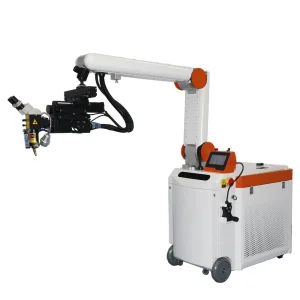
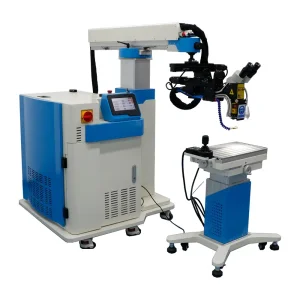
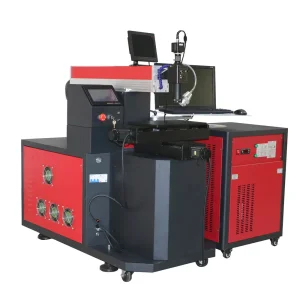
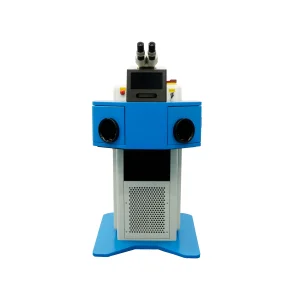
Explore our complete inventory of cantilever, integrated boom, automatic multi-axis, and galvanometer laser welding machines.

Expert insights regarding metallurgy, wire alloy selection, on-site commissioning, and cost recovery for toolroom directors.
TIG welding deposits excess energy across large areas, causing local tempering, micro-cracking, and sink marks on surrounding polished surfaces. Mold laser welders generate a micro-spot (0.2-1.5mm) with a tiny heat-affected zone, preventing metallurgical softening and eliminating the need for post-weld furnace stress relief.
High relative humidity can cause condensation on optical protective lenses and internal crystals. Our machines are built with IP54 sealed optical paths, continuous dry-air positive pressure, and dual-circuit chillers that maintain temperature above the dew point, preventing thermal shock and internal fogging.
Most commercial toolrooms in Vasai, Thane, or Chakan achieve complete ROI within 6 to 9 months. By eliminating third-party laser welding outsourcing, reducing mold turnaround times from 3 days to under 4 hours, and avoiding scrap on expensive dies, operational savings accumulate rapidly.
Yes. Our Cantilever and Boom Mold Laser Welding models feature an articulated optical arm that reaches up to 1.8 meters beyond the base. This enables operators to weld stamping dies, shear edges, and bolster plates directly on the shop floor or inside the stamping press without unmounting.
We supply and qualify a wide portfolio of laser-grade welding wires down to 0.2mm diameter, including DIN 1.2343, 1.2379, NAK80, Beryllium Copper, and corrosion-resistant martensitic stainless steels, ensuring hardness matches parent die specifications perfectly.
Every delivery to Mumbai, Pune, or Aurangabad includes on-site installation, voltage calibration, alignment verification, and a 3-day practical training program covering metallurgy, pulse parameter profiles, microscope ergonomics, and protective optic maintenance.