
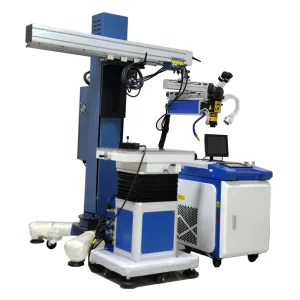
Direct manufacturer solutions engineered with fiber continuous and quasi-continuous wave (QCW) resonators, designed to resolve tool-steel thermal distortion and deliver micronic weld buildup.

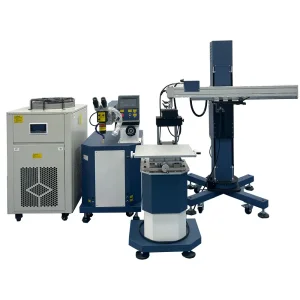

Strategic engineering analysis addressing local manufacturing shifts, automotive localisation mandates, plastic packaging demands, and foundry refurbishment protocols.
The industrial landscape in the People's Democratic Republic of Algeria is experiencing a profound structural transformation. Driven by government initiatives aimed at reducing import reliance and accelerating domestic value creation, industrial clusters in Algiers, Oran, Constantine, Sétif, and Batna are modernizing their manufacturing facilities. Central to this industrial re-tooling is the maintenance, reclamation, and micro-precision repair of expensive forming tools, injection molds, progressive stamping dies, and aluminum die-casting tools.
Historically, tooling houses and maintenance workshops across Algeria relied heavily on conventional Tungsten Inert Gas (TIG) welding or outsourced critical mold repairs to European contractors in France, Spain, or Italy. Traditional TIG repair suffers from excessive heat input, inducing wide Heat-Affected Zones (HAZ), base metal deformation, internal stresses, cracking in high-carbon tool steels (such as 1.2343, 1.2344, P20, and NAK80), and excessive post-weld electrical discharge machining (EDM) or hand-polishing. Mold Laser Welding Machines have emerged as the definitive industrial replacement, providing controlled micro-joule energy delivery that leaves metallurgical grain structures intact and restores parting lines, narrow gates, and mirror-finished cavities without thermal stress.
Algeria's re-emerging automotive manufacturing hub along the western coastline demands strict quality standards for chassis stamping and interior plastic molding. Laser mold welding enables instant in-press touch-ups on draw beads and cavity radii, eliminating days of plant downtime.
The plastics and polymer processing cluster in Sétif processes thousands of tons of polymers weekly for food packaging and consumer durables. Laser deposition restores worn shut-off surfaces and injection pin holes without tempering the pre-hardened core steel.
Algerian metallurgy facilities in Constantine and Annaba require long-reach cantilever and boom-arm laser heads to deposit cobalt- and nickel-based superalloys onto heavy aluminum extrusion mandrels and hot-forge dies subjected to intense thermal fatigue.
Selecting the optimal resonator type (Pulsed Nd:YAG, Continuous Fiber, or Quasi-Continuous Wave QCW) based on thermal absorption, metallurgy, and depth of deposition.
| Resonator Technology | Typical Laser Power | Peak Pulse Energy | Recommended Algerian Applications | Thermal HAZ Control | Status |
|---|---|---|---|---|---|
| Fiber Laser (CW / Wobble) | 1500W – 3000W | Continuous Output | Deep crack repairs, fast deposition, large blow molds & stamping dies | Controlled via high-speed galvanometer sweep | High Production |
| Quasi-Continuous Wave (QCW) | 150W / 1500W Peak – 300W / 3000W Peak | 15J – 30J per pulse | Mirror-polished injection inserts, medical packaging, Stellite/Titanium buildup | Near-Zero thermal distortion; cold welding characteristics | Ultra-Precision |
| Pulsed Nd:YAG | 200W – 400W | 70J – 100J per pulse | Traditional toolroom maintenance, manual wire feeding, beryllium copper cavities | Localized thermal pulse with microscope aiming | Standard Workshop |
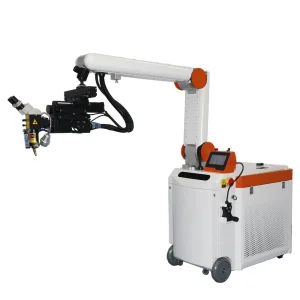
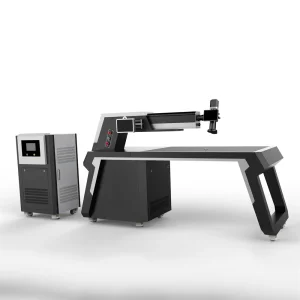
| Cantilever / Boom Arm Systems | Up to 3000W Integrated | Continuous / Modulated | Large 5-ton to 20-ton automotive dies; repair directly in stamping presses | Flexible 360-degree articulated optical delivery | Heavy Industry |
In mold maintenance, matching the thermal expansion coefficient and post-weld hardness of the deposited wire with the base substrate is essential. Our mold laser welding machines engineered for the Algerian industrial market support a comprehensive spectrum of filler wire alloys ranging from 0.2 mm to 1.2 mm in diameter:
Engineered to operate reliably under severe ambient temperatures, grid volatility, and local operational protocols across North Africa.
Algerian summers in interior industrial zones reach elevated ambient temperatures. Our machines feature oversized dual-circuit industrial water chillers with R410A eco-refrigerant, preventing laser cavity condensation and optical shutter overheat shutdowns.
Electrical fluctuations can damage optical control boards. Each Algerian export unit integrates industrial-grade isolation transformers, EMI filters, and wide-tolerance power supplies that absorb brownouts and surges common in expanding industrial parks.
Human-Machine Interfaces (HMI) are fully localized in French, Arabic, and English. Intuitive touch controls include stored weld schedules for P20, H13, and 718 tool steels, lowering the training threshold for Algerian technicians.
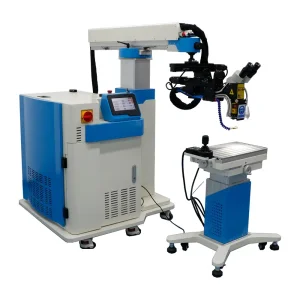
Explore our complete industrial portfolio engineered in Shenzhen, from cantilever mold repair welders to continuous fiber cutters and precision jewelry joining machines.




A streamlined procurement protocol compliant with Bank of Algeria foreign exchange regulations, certified consular documentation, and port handling.
We provide commercial invoices, packing lists, and pro-forma contracts structured for Documentary Credit (Crédit Documentaire / Credoc) and Cash Against Documents (Remise Documentaire) transactions approved under local financial laws.
Every shipment includes accredited Certificate of Free Marketing and Conformity issued through international inspection agencies (SGS, Bureau Veritas, or Intertek) as required by Algerian customs control.
Direct ocean freight routings from Shenzhen / Guangzhou to the Port of Algiers (Port d'Alger), Port of Oran, and Port of Skikda, securely crated in ISPM-15 export fumigated wooden enclosures with moisture desiccant barriers.
Practical engineering responses addressing power requirements, maintenance, optics, and technical training for Algerian enterprise buyers.
Connect directly with our laser application engineers in Shenzhen. We evaluate your workpiece drawings, calculate cycle times, provide metallurgical wire recommendations, and supply turn-key quotes tailored for Algerian industrial enterprises.