Explore our flagship industrial laser welding and surface processing machinery engineered for complex 3D joints, heavy mold remanufacturing, and high-speed production.







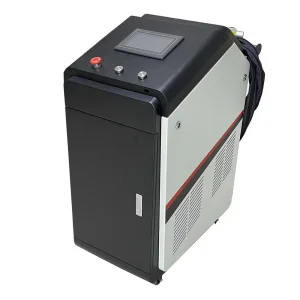
The manufacturing world has decisively transcended planar, two-dimensional fabrication. Contemporary industrial assemblies—from battery cooling channels and electric motor stator hairpin windings to high-bypass turbofan aero-engine components—exhibit intricate, free-form, non-planar 3D contours. In these demanding environments, conventional 3-axis (X-Y-Z) cartesian laser systems inevitably encounter beam angle degradation, focal length shifts, dynamic shadowing, and severe geometric constraints.
A true custom 5-axis laser welding machine synthesizes three orthogonal translational axes (X, Y, Z) with two continuous rotary and tilting axes (either an A/B swivel optical head or an A/C dual-axis rotary-tilt cradle). This architectural kinematics ensures the high-power laser beam maintains an uncompromising, normal, or optimized angle of attack along mathematically continuous, complex 3D curved weld seams. By maintaining precise rotational tool center point (RTCP) synchronization, the spot focal diameter remains constant within single-micron tolerances, eliminating spatter, underfill, and heat-affected zone (HAZ) enlargement.
Dynamic algorithms recalculate tool offsets in real-time under high-speed interpolated motion. When the swivel head angles across curved geometry, the laser focus spot adheres rigidly to the joint trajectory without manual focal reprogramming.
Dual-axis galvanometer wobble heads introduce circular, elliptical, or figure-8 beam oscillation modes. This bridges inter-component fit-up gaps up to 1.2 mm while actively stirring the molten pool to mitigate solidification crack formation.
Embedded CMOS machine vision paired with infrared seam-tracking telemetry tracks real-time thermal expansion, ensuring joint location correction within 20 milliseconds during continuous 100% duty cycle operations.
Evaluating multi-axis laser welding machinery demands a deep look into mechanical rigidity, structural harmonics, and kinematic reliability over five- to ten-year operational cycles.
Procurement teams from automotive Tier-1 suppliers, medical device corporations, and aerospace contractors evaluate laser equipment on total cost of ownership (TCO) and process capability indices (Cpk > 1.67). A recurring trade-off in modern plants involves choosing between an articulated 6-axis industrial robot arm versus a dedicated high-stiffness custom 5-axis CNC gantry laser machine. While robots offer spatial flexibility, their structural backlash, gear transmission compliance, and thermal path deviation make high-precision, sub-millimeter deep-penetration keyhole welding difficult on strict tolerances.
| Evaluation Parameter | Articulated 6-Axis Robotic Cell | Standard 3-Axis Flatbed Welder | Youmir Custom 5-Axis CNC Laser System |
|---|---|---|---|
| Repeatable Positioning | ±0.050 mm to ±0.100 mm | ±0.020 mm | ±0.010 mm to ±0.015 mm |
| Structural Rigidity / Harmonics | Cantilever arm vibration at high feed speeds | High rigidity (confined to Z-axis) | Cast mineral/iron bed with zero harmonic resonance |
| Complex 3D Surface Interpolation | Flexible, but suffers joint singularities | Zero capability (Planar/2D only) | Continuous 5-axis synchronized RTCP motion |
| Optical Protection & Gas Shielding | Bulky torch head; prone to clearance collisions | Standard fixed coaxial nozzle | Integrated multi-channel aerodynamic laminar shield |
| Enclosure & Laser Safety Class | Requires large safety perimeter fencing | Class 1 / Class 4 variations | Fully sealed Class 1 CDRH enclosure with safety interlocks |
| Industrial Protocol Integration | Proprietary robot controller (Fieldbus) | Basic I/O relays | Native EtherCAT, PROFINET, OPC UA (MES ready) |
Engineering Sourcing Note: While articulated robots excel at simple sheet metal joins over wide reaches, high-density hermetic joints (e.g., EV battery cooling plates, medical titanium housings, turbine injectors) demand the dynamic stiffness and optical axis stability found only in rigid 5-axis CNC frames.
The Pearl River Delta, anchored by Shenzhen's advanced manufacturing corridor, has transformed from an assembly hub into an epicenter of optoelectronic innovation, CNC precision engineering, and laser metallurgical development. Shenzhen Youmir Laser Technology Co., Ltd. (operating from its Guangming District manufacturing facility and regional R&D bases) leverages this localized supply chain resilience to offer technical responsiveness rarely matched by Western capital equipment suppliers.
Within a 30-kilometer radius, Youmir integrates high-purity single-mode and multi-mode fiber laser engines, precision optical glass fabrication, ultra-pure brass gas delivery manifolds, and direct-drive torque rotary motors. This vertical supply integration allows us to build bespoke, factory-tailored 5-axis laser welding cells—complete with customized stroke lengths, automated dual-station shuttle tables, pneumatic clamping fixtures, and cleanroom-ready exhaust manifolds—in 4 to 8 weeks, compared to 6 to 9 months typical elsewhere in the industry.
We design our own beam-delivery paths, protective collimation chambers, and proprietary CNC motion control software. Buyers communicate directly with the design engineers who build their machines—not sales resellers.
Before commissioning, overseas buyers can send actual workpieces to our Shenzhen laboratory. We generate complete metallographic cut-and-etch test reports, tensile test metrics, and process windows.
With machines running across more than 50 countries, Youmir provides secure remote telemetry diagnostics, cloud-assisted parameter updates, and overseas engineering dispatch for installation and training.
From automotive e-mobility systems to aerospace alloys and surgical implants, 5-axis laser welding delivers deep, clean penetration with minimal distortion.
Laser welding high-reflectivity or dissimilar alloys (such as electrolytic copper to aluminum, or titanium Grade 5 to Inconel 718) requires balancing laser peak power, pulse duration, and spatial beam dynamics. Operating in keyhole welding mode creates intense vapor recoil pressure, which can easily destabilize the melt pool if the beam incident angle drifts. Our custom 5-axis architecture uses dynamic focal length tracking to keep the keyhole stable across challenging 3D profiles.
| Material Alloy System | Application Component | Recommended Laser Source | Shielding Gas Strategy | Kinematic Complexity |
|---|---|---|---|---|
| 6061-T6 / 5083 Aluminum | EV Battery Tray Liquid Cold Plates | 3 kW – 6 kW Fiber (Adjustable Ring Mode) | 100% Ultra-Pure Argon @ 25 L/min | 3D Sinuous Seal; 5-Axis Surface Normal Tracking |
| C11000 ETP Copper to Aluminum | Power Distribution Busbars & Hairpins | 2 kW Green/Blue or Wobble IR Fiber | Nitrogen or Argon with Coaxial Trailing Cup | High-Acceleration Cornering; Non-Planar Overlap |
| AISI 316L / 304 Stainless Steel | Pharmaceutical Hermetic Pressure Vessels | 1.5 kW – 3 kW Continuous Fiber | Ar + 2% H2 or 100% Ar Backing Purge | Circumferential Saddle Seams; Multi-Axis Rotary |
| Ti-6Al-4V (Grade 5 Titanium) | Orthopedic Implants & Aero Ducting | 1 kW – 2 kW Single-Mode Fiber | 99.999% High-Purity Argon Leading/Trailing | Complex Freeform Curvature; High Rigidity RTCP |
| H13 / P20 / 1.2344 Tool Steel | Automotive Injection Mold Repair | 400W – 1000W QCW / Pulsed / Fiber | Direct Micro-Nozzle Argon Injection | Deep Cavity Reach; Multi-Axis Cantilever Boom |
Zero-porosity joining of prismatic battery modules, aluminum pack enclosures, motor hairpin stators, and pressurized high-voltage copper conductors without thermal damage to adjoining polymer separators.
Precision seam fusion on thin-gauge nickel-based superalloys, titanium environmental control ducting, and lightweight honeycomb structures requiring Class A weld geometry verification.
Restoration of high-value injection molds, die-casting cavities, and edge radiuses without annealing or distorting the underlying substrate, eliminating secondary heat-treating costs.
Direct technical answers from Youmir's laser optical and motion control engineers on 5-axis systems, tolerances, warranties, and deployment.
Browse our full lineup of industrial welding, mold repair, cleaning, and custom fabrication machines built for high-throughput production environments.

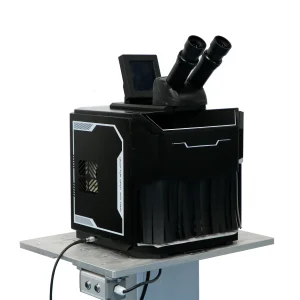
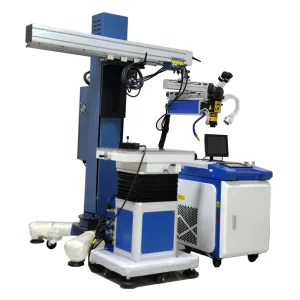


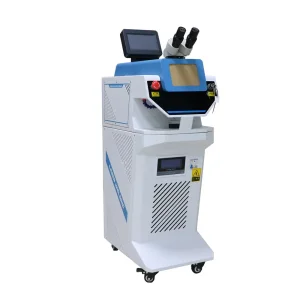


Send your CAD component models (STEP / IGES) and metallurgical joining specifications to our Shenzhen engineering team. We'll run a sample welding analysis, provide optical toolpath simulations, and return a tailored factory quotation within 24 hours.
