Explore our flagship automated configurations engineered for mold restoration, multi-axis micro-joining, and continuous industrial production lines. Every model supports full custom automation integration, customized tooling jigs, and digital fieldbus communication protocols.


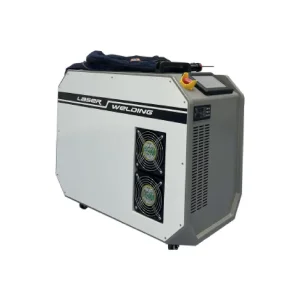
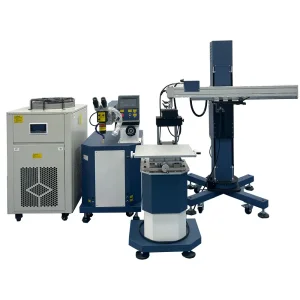
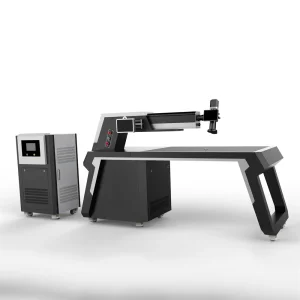
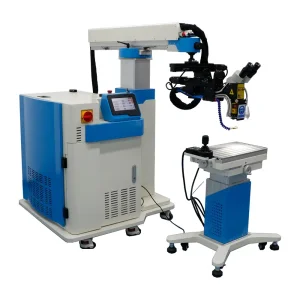
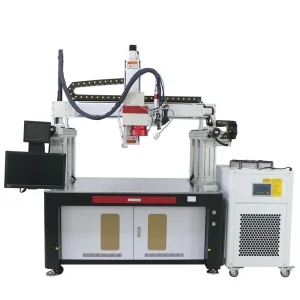

In modern automated manufacturing, structural integrity and cycle times depend entirely on the precision of the thermal input. Conventional welding techniques—such as Gas Tungsten Arc Welding (GTAW/TIG) and Metal Inert Gas (MIG)—rely on gross volumetric heat transfer, creating large Heat-Affected Zones (HAZ), severe metallurgical grain coarsening, and unavoidable thermal deformation. Automatic Fiber Laser Welding operates on an entirely distinct physical principle: high-power-density keyhole-mode plasma vapor ionization.
By delivering energy densities exceeding 10⁶ W/cm² at the focal point, Youmir Laser systems instantaneously vaporize base metals, forming a steady vapor keyhole surrounded by molten metal. This allows for aspect ratios reaching 10:1, providing full-depth penetration in structural plates with minimal peripheral heat conduction.
Because the heat-affected zone is reduced by up to 85% compared to TIG welding, sheet metals, heat-treated dies, and thin-gauge aerospace structures retain complete dimensional stability. Secondary CNC leveling, manual straightening, and abrasive surface refinishing are eliminated, reducing downstream fabrication overhead.
Youmir continuous and quasi-continuous (QCW) fiber laser resonators achieve wall-plug electrical conversion efficiencies exceeding 32% to 38%, vastly surpassing outdated Nd:YAG flashlamp systems (1.5% to 3%). This lowers ongoing utility costs and enables continuous 24/7 duty cycles under rigorous factory conditions.
Shenzhen Youmir Laser Technology Co., Ltd. (operating since 2010 and incorporated in 2012) sits at the center of the world's most dense optoelectronic, precision mechanical, and CNC software cluster in Guangming District, Shenzhen. Procuring directly from our production floor provides structural cost and integration advantages that traditional Western assemblers cannot replicate.
Within a 50-kilometer radius of our manufacturing campus, we source high-purity rare-earth double-clad active fibers, high-durability fused silica collimating lenses, high-torque direct-drive linear motors, and custom high-pressure water chillers. This vertical integration allows us to take a custom 5-axis automatic laser welding workstation from engineering schematics to functional factory testing within 15 to 25 business days, compared to the 16 to 24 weeks standard in Europe or North America.
By engineering our optical transmission heads, proprietary digital bus control cards, and 3-axis to 6-axis motion kinematic software in-house, Youmir cuts unnecessary licensing fees and distribution middle-layers. Global procurement officers acquire industrial-grade automated systems at 40% to 60% lower CAPEX than equivalent German, Swiss, or Japanese solutions, while maintaining comparable MTBF (Mean Time Between Failures) metrics exceeding 100,000 diode pump hours.
Automated laser welding is advancing beyond static optical focal points and hardcoded gantry paths. At Youmir Laser, our R&D focuses on intelligent adaptive beam manipulation, high-speed dual-axis galvanometer oscillation, and vision-guided closed-loop feedback systems designed for lights-out automated manufacturing.
Modern automated tooling cells integrate high-resolution coaxial CMOS cameras and structured-laser seam finders. Even when stampings, rolled tubing, or hydroformed components exhibit geometric variations of ±0.8 mm, the CNC controller dynamically adjusts the beam trajectory in sub-millisecond cycles, preventing miss-welds and undercuts.
Static focal spots are susceptible to joint fit-up gaps and hot cracking in difficult alloys like 6000-series aluminum and copper. Our dual-motor galvanometer oscillation heads create programmable spiral, circular, figure-eight, and linear oscillation profiles up to 300 Hz, bridging joint gaps up to 1.5 mm while degassing the melt pool.
Welding pure copper or high-conductivity alloys at infrared wavelengths (1070 nm) typically encounters high reflectivity (>95% at room temperature). Incorporating Adjustable Ring Mode beam delivery combines a central high-intensity core with a peripheral ring beam to pre-heat the substrate, eliminating spatter and stabilizing deep penetration.
Youmir Laser manufactures automated systems for precision-demanding production sectors worldwide. We tailor each machine's motion mechanics, optics, gas shielding setups, and software parameters to specific metallurgical challenges.
Hermetic micro-joining of power cell assemblies and busbar grids.
Joining critical engine components and thin-gauge structural enclosures.
Hermetic micro-welding for implantable devices and surgical tooling.
Restoring worn injection tooling and stamping dies without thermal sink.
Sub-millimeter micro-spot joining of conductive alloys and shielding cans.
High-speed cosmetic corner and flange joins on decorative metals.
Laser machinery pricing is determined by optical resonator output, motion axis kinematics, CNC interpolator capability, and beam delivery optics. Below is our baseline factory reference pricelist for standardized automated equipment (FOB Shenzhen / CIF Global Port options available).
| System Architecture | Laser Source / Power | Kinematic Platform | Target Material Thickness | Estimated Factory Price (USD) |
|---|---|---|---|---|
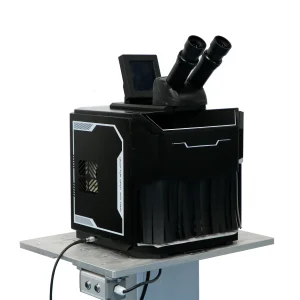
| Benchtop Precision Jewelry Welder | QCW / Nd:YAG 60W - 200W | Manual Crosshair Micro-stage + Stereo Microscope | 0.1 - 1.2 mm (Gold, Silver, Titanium) | $2,800 – $4,800 |
| Industrial Mold Repair Workstation | QCW / Fiber 200W - 400W | Motorized 3-Axis Boom Arm (Reach up to 1500mm) | 0.2 - 2.5 mm Deposition Wire | $5,500 – $9,800 |
| Cartesian 3-Axis CNC Laser Welder | CW Fiber 1000W - 2000W | X/Y/Z Precision Ballscrew + Rotary Chuck (C-Axis) | Up to 4.0 mm Stainless / 3.0 mm Aluminum | $8,500 – $14,500 |
| High-Speed Galvanometer Workstation | CW / QCW Fiber 1500W - 3000W | Dual-Axis Galvo Scanner + Coaxial Vision Positioning | 0.1 - 3.0 mm Spot/Seam Micro-joints | $12,000 – $21,000 |
| Multi-Axis Robotic Fusion Workcell | Continuous Fiber 2000W - 6000W | 6-Axis Articulated Robot Arm + 2-Axis Positioner | Up to 10.0 mm Carbon Steel / 8.0 mm Alloy | $24,000 – $48,000 |
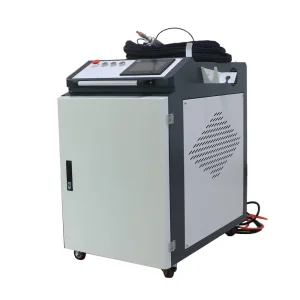
| Dual-Function Cleaning & Welding Setup | Continuous Fiber 1500W - 3000W | Handheld / 3-Axis Auto-Switch Optical Head | Surface ablation (15m²/hr) + 4mm weld depth | $4,200 – $7,800 |
Unlike resistance spot welding that requires regular electrode dressing, or TIG setups that consume thoriated tungsten rods, fiber laser welding is entirely non-contact. Routine consumables are limited to affordable quartz protective cover slides ($3–$6 each) and copper gas nozzles.
Automated fiber laser welding operates at speeds of 15 to 80 mm/second, outpacing manual arc welding by a factor of 4x to 10x. Transitioning from manual welders to a single multi-axis automatic workcell allows a single technician to oversee the output of three to five shifts, amortizing machinery CAPEX within six to nine months.
Every Youmir automatic workstation includes an international 2-year warranty on the fiber laser source, 24/7 direct remote video engineering assistance, and standardized, readily available replacement optics, avoiding vendor lock-in.
International procurement managers require verified manufacturing compliance, safe customs clearance, and seamless floor commissioning. Shenzhen Youmir Laser operates under rigorous quality controls, ensuring each machine complies with global industrial standards before export.
Full adherence to European Union Harmonized Standards (EN 60204-1 safety of machinery, EN 60825-1 laser radiation safety) with dual-channel emergency stop circuits and interlocked safety enclosures.
Accession registration with the United States Center for Devices and Radiological Health, featuring Class I/Class IV laser housings, protective optical viewports (OD6+), and key-operated master resets.
Prior to crating, we run uninterrupted 72-hour burn-in trials, beam caustic profile verification, power meter stability logs, and cross-sectional metallurgical etching of client sample joints.
We supply complete digital documentation, full schematics, parameter libraries, and provide on-site engineering installation or live dual-camera video guidance with our Shenzhen automation team.
Detailed answers to technical, operational, and commercial questions asked by factory engineers, plant managers, and procurement specialists.
Penetration depth and weld width depend on optical power density (W/cm²), focused spot diameter, beam Rayleigh length, kinematic travel speed, and protective shielding gas dynamics. To maximize penetration depth via the keyhole effect, the focal point is positioned slightly below the workpiece surface (typically -0.5 mm to -2.0 mm depending on material thickness). Faster feed rates yield narrower, deeper seams with minimal peripheral heat conduction. Adding high-speed transverse wobble oscillation broadens the fusion face, ideal for loose-tolerance joint gaps up to 1.5 mm.
Continuous Wave (CW) delivers constant optical energy, making it the standard choice for continuous seams, high-speed sheet metal joining, and structural welding where consistent penetration depth and rapid travel speeds are required. Quasi-Continuous Wave (QCW) lasers produce peak pulse powers up to ten times their average output (for example, a 150W average power QCW laser can deliver 1500W peak pulse energy). This makes QCW ideal for heat-sensitive electronics, jewelry fabrication, medical devices, and precision mold tooling where short, intense pulses melt the target spot without heating adjacent areas.
Argon (Ar): An economical, chemically inert gas suitable for stainless steel, mild steel, and titanium. Due to its relatively low ionization potential, it requires angled nozzle positioning to avoid plasma plume absorption at power levels over 4 kW.
Nitrogen (N2): An affordable option for standard austenitic stainless steels (304, 316), where slight nitrogen absorption can help stabilize the austenite phase and improve tensile strength. It should not be used on titanium alloys due to the formation of brittle titanium nitrides.
Helium (He): Possesses the highest ionization potential, effectively suppressing high-temperature plasma plumes during multi-kilowatt deep-penetration welding. Because of its cost, it is often blended with Argon (e.g., 70% Ar / 30% He) in aerospace applications.
Yes. Joining dissimilar metals like Copper (Cu) and Aluminum (Al)—common in EV battery busbars—presents metallurgical challenges due to the formation of brittle intermetallic compounds (such as CuAl2) and substantial differences in melting points and thermal expansion rates. By pairing high-frequency dual-axis wobble galvanometer optics with sub-millisecond power modulation, our systems shift the beam offset slightly toward the aluminum side. This melts the aluminum to wet the solid copper surface, creating a resilient, low-resistance braze-weld interface.
Solid-state fiber laser engines contain no internal moving parts or serviceable flashlamps. Maintenance involves three straightforward tasks: (1) Daily inspection and cleaning of the outer optical protective window using spectroscopic-grade lens tissue and anhydrous ethanol; (2) Bi-monthly replacement of deionized water and particulate filters in the closed-loop dual-temperature chiller; and (3) Periodic lubrication and backlash inspection of the linear motion axes and ballscrews according to operational hours.
All machinery ships with detailed English documentation, wiring diagrams, parameter lookup tables, and step-by-step setup videos. For turn-key integrations, our Shenzhen engineers provide direct remote commissioning via secure video link. On-site engineer dispatch is also available through our regional integration partners across North America, Europe, and Southeast Asia. Warranty components are expedited internationally via DHL/FedEx Express directly from our Shenzhen headquarters.
Explore our specialized industrial solutions, including micro-jewelry welding units, high-throughput galvanometer scanners, high-power surface cleaning equipment, and industrial-gauge fiber cutting platforms.






Avoid production guesswork. Ship your sample workpieces to our Shenzhen R&D application laboratory. Our engineers will perform comprehensive parameter trials, cross-section metallurgical microscopy, tensile strength testing, and return a complete report alongside process videos.
