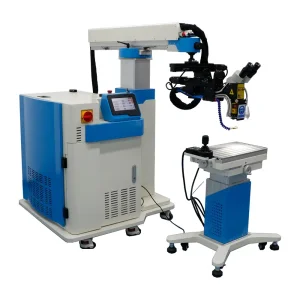
Explore our core industrial laser processing series, integrating high-coherence fiber oscillators, galvanometer wobble optical heads, and programmable multi-axis robotic kinematics engineered directly within our Shenzhen manufacturing facility.
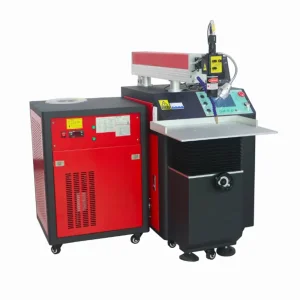
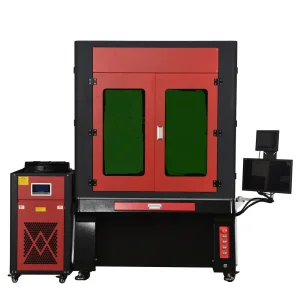
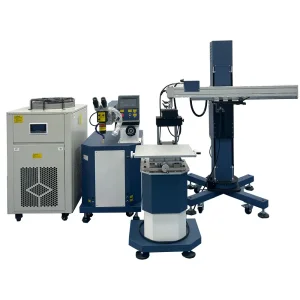

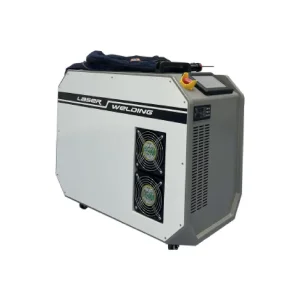

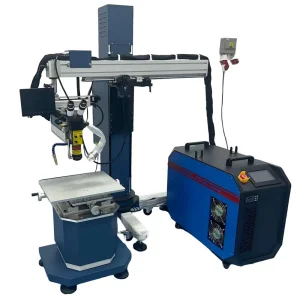

A strategic overview of how high-power solid-state fiber lasers, automated keyhole joining systems, and digital beam oscillations are systematically dismantling conventional tungsten inert gas (TIG) and metal active gas (MAG) fabrication bottlenecks.
The manufacturing sector across Europe, North America, and Developed Asia faces a critical demographic drought of certified welder craftsmen. Conventional TIG/MIG welding requires years of artisanal hand-eye coordination to mitigate thermal warpage, undercutting, and gas porosity.
Global net-zero emission mandates have placed heavy energy-consuming arc welders under regulatory scrutiny. Continuous-wave (CW) ytterbium fiber laser systems convert up to 35% to 42% of electrical wall-plug energy into active coherent photons at the 1070nm wavelength.
Modern structural transport engineering requires joining dissimilar materials: 6000-series aluminum to copper, or titanium to precipitation-hardened steels. Arc processes trigger brittle intermetallic compound (IMC) crystal precipitation, leading to catastrophic weld failure.
Shenzhen Youmir Laser Technology Co., Ltd. designs specialized opto-mechanical cells configured around specific alloy metallurgies, cycle time tolerances, and defect classification limits across high-consequence industries.
Engineered for prismatic cell cap sealing, copper-to-aluminum busbars, and liquid cooling tray manifold seams. Custom galvo continuous welders execute zero-spatter hermetic sealing at speeds up to 300mm/s without thermal damage to delicate polymer separators.
Designed for titanium honeycomb panels, Inconel 718 shroud repairs, and thin-gauge 321 stainless hydraulic lines. Vacuum-assist or argon-purged multi-axis CNC chambers ensure heat-tint-free, void-free deep penetration conforming to AWS D17.1 specifications.
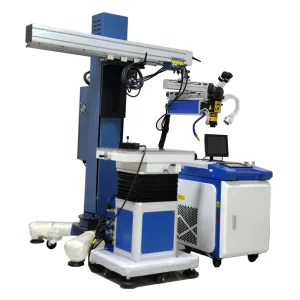
Heavy injection molds, hot-stamping dies, and casting tool restoration via our cantilever and boom mold welding series. Direct micro-wire deposit cladding on worn edges using P20, NAK80, H13, and S136 wire grades with zero base-block sink or softening.
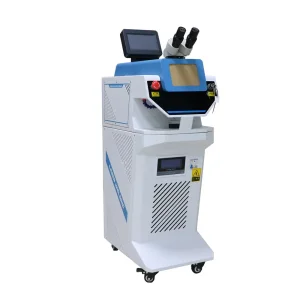
Specialized desktop YAG and fiber micro-welders featuring high-definition stereo microscopes with crosshair reticles and CCD coaxial monitoring. Perfect for platinum prong re-tipping, medical pacemakers, surgical hypodermic tubes, and delicate relay leads.
Founded in Shenzhen in 2012 with laser R&D origins spanning back to 2010, Youmir Laser has expanded across multiple advanced manufacturing centers, including our specialized Zhongshan branch established in 2017 and our large-scale Hunan Youmir Laser Technology Co., Ltd. facility launched in 2018.
Unlike assemblers who purchase generic third-party enclosures and ready-made handpieces, Youmir designs its own collimating optical paths, proprietary multi-wave wobble galvanometer firmware, dual-circuit thermodynamic water chillers, and CNC multi-axis synchronization boards under rigorous ISO 9001:2015 quality control.
Every standard model and custom OEM/ODM turn-key station passes an exhaustive photonic and metallurgical validation protocol before overseas export dispatch:
A rigorous metallurgical comparison of continuous wave (CW) fiber, quasi-continuous wave (QCW), and pulsed Nd:YAG technologies to empower equipment procurement teams and system integrators.
| Performance Dimension | Continuous Wave (CW) Fiber | Quasi-Continuous Wave (QCW) | Pulsed Nd:YAG (Flashlamp) | Conventional TIG Welding |
|---|---|---|---|---|
| Operating Wavelength | 1070 nm ± 10 nm | 1070 nm ± 10 nm | 1064 nm | N/A (Electric Arc Discharge) |
| Power Output Range | 1000 W – 3000 W (Continuous) | 150 W – 600 W (Peak 1.5–6 kW) | 200 W – 600 W (Peak Up to 10 kW) | 50 A – 350 A |
| Beam Quality (M²) | 1.1 – 1.3 (Single-Mode Option) | < 2.0 (High Focusability) | > 10.0 (High Divergence) | N/A (Broad Diffuse Plasma) |
| Heat Affected Zone (HAZ) | 0.1 mm – 0.3 mm (Minimal) | < 0.1 mm (Near-Zero Distortion) | 0.3 mm – 0.8 mm | 2.5 mm – 8.0 mm (Extensive) |
| Typical Applications | Sheet metal, automated chassis, pipelines | Micro-electronics, lithium tabs, medical | Die repair, jewelry, dental crowns | Structural construction, thick plate joints |
| Consumable Demands | Shielding gas (Argon/N2), cover glass | Shielding gas, protective lens | Xenon flashlamps, deionizer resin | Tungsten electrodes, filler rod, gas cups |
| Maintenance Cycle | > 50,000 hrs (Virtually Maintenance-Free) | > 50,000 hrs | 500 – 1,000 hrs (Lamp replacement) | Daily grinding & collet re-sharpening |
From flexible manual handheld units to complete automated factory cells, Youmir equipment is configured to accommodate factory physical footprints, electrical grid variations, and specialized workflow demands.
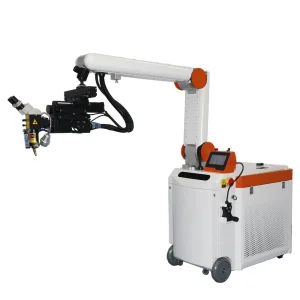
Configured for high-mix, low-to-medium-volume production facilities. Features pneumatic automatic interlock doors, rotary indexers (A-axis / C-axis), and programmable servo linear drives. Enclosed to laser safety Class 1 standards, allowing safe floor operation alongside workers.
Designed for tooling workshops handling plastic injection or stamping dies weighing up to 20 metric tons. Instead of crane-rigging oversized mold blocks onto machine tables, the articulated 360-degree boom arm reaches deep inside machine cavities directly on the shop floor.
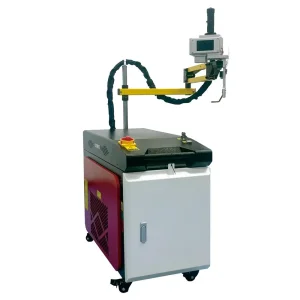
Equipped with ultra-flexible fiber cables up to 15 meters in length, these all-in-one mobile chassis units combine the laser oscillator, dual-circuit water chiller, and wire feeder in a compact footprint. Designed for stainless architectural railings, HVAC ducting, and commercial kitchens.
Cross-border industrial procurement requires complete adherence to local workplace safety laws, electrical regulations, and dependable post-commissioning technical field service.
Youmir machinery is fully certified to global safety directives. Our equipment meets European CE-LVD and CE-EMC requirements under EN 60825-1:2014 laser product safety standards, and is fully registered with the US FDA CDRH for international commercial clearance.
We build our power management enclosures to match regional industrial three-phase and single-phase voltages. Whether your plant operates at 110V/220V 60Hz (USA/Canada), 380V/400V 50Hz (Europe), or 480V (Heavy US Industrial), your unit arrives wired and tested for drop-in installation.
Exporting to over 50 nations across the Americas, Europe, Middle East, and Southeast Asia, Youmir Laser delivers localized onboarding, remote diagnostics via encrypted IoT gateways, and regional spare-part dispatch to eliminate costly manufacturing downtime.
Shenzhen Youmir Laser Technology Co., Ltd. continues to commit over 12% of annual capital into forward-looking photonics research. Here is where the industrial laser welding paradigm is heading over the next five years.
Pure copper absorbs less than 5% of conventional 1070nm infrared laser light at room temperature. Integrating a high-power 450nm blue diode laser brings ambient copper absorption over 40%, creating a molten conduction bridge that enables the infrared beam to join copper spatter-free.
Future automated cells integrate interferometric OCT scanning directly into the welding laser delivery head. This technology measures real-time keyhole vapor cavity depth with micron precision, detecting lack of penetration and undercuts microseconds before the melt pool solidifies.
Convolutional neural networks (CNN) coupled with laser line scanners track irregular seam gaps in real time, automatically modulating laser power, oscillation amplitude, and wire feed speed to bridge gaps up to 1.5mm without manual human intervention.
Comprehensive technical guidance compiled by Youmir's senior opto-mechanical engineers to assist manufacturing specialists in choosing the ideal laser machine configuration.
Single-pass full penetration depends on laser power and thermal conductivity. For stainless steel: 1000W yields ≤3mm, 1500W achieves ≤4mm, 2000W reaches ≤5mm, and 3000W achieves ≤8mm. For structural aluminum, subtract ~25% due to high thermal reflectivity. Dual-sided butt welding doubles these penetration thresholds.
Fiber laser welding introduces roughly 80% to 90% less net heat input than TIG. This completely mitigates sheet deformation, burn-through, and thermal warping on sheets under 2mm thickness. Welding speed is typically 2× to 4× faster, and post-weld surface grinding or pickling is almost completely eliminated.
For stainless steel and titanium, high-purity Argon (>99.99%) is mandatory to prevent chromium oxidation and embrittlement. For carbon steels, Nitrogen can be utilized as a cost-effective alternative that elevates surface hardness. For copper and aluminum alloys, Argon provides the most stable plasma suppression and cleanest bead appearance.
Yes. As a primary manufacturer with proprietary software and electronics R&D, our automated laser welding machines natively support industrial fieldbus protocols, including Profinet, EtherNet/IP, Modbus TCP, and discrete digital I/O for robotic arm handshake commands (FANUC, KUKA, ABB, Yaskawa).
Our solid-state continuous-wave fiber laser oscillators feature an engineering MTBF (Mean Time Between Failures) exceeding 100,000 operational hours under rated ambient conditions. This equals over 10 years of multi-shift industrial service with only periodic water chiller maintenance and protective lens changes.
Prospective customers can courier their actual production workpieces directly to our Shenzhen application laboratory. Our photonics team evaluates joint geometry, conducts weld tests across varied power and wobble modes, and delivers an exhaustive metallurgical test report, cross-sectional photos, and cycle time analyses free of charge.
Explore our high-power continuous fiber welders, mold restoration systems, desktop jewelry micro-welding stations, and industrial CNC cutting systems configured for demanding continuous production cycles.