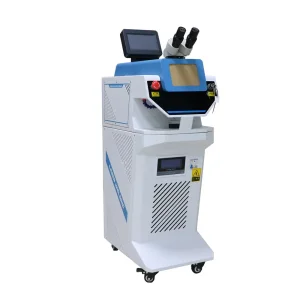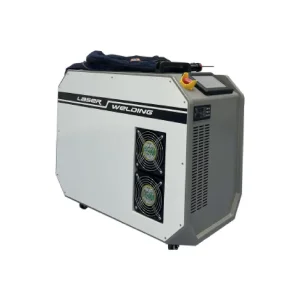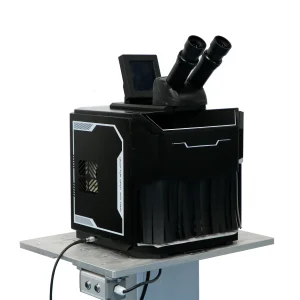
Custom Compact 60W Jewelry Laser Welder for Gold & Silver Crafting Manufacturers, Quotes
View Equipment Details
Explore our engineered equipment catalog optimized for rapid tooling deposition, mold edge reconstruction, micro-welding, and surface treatment.
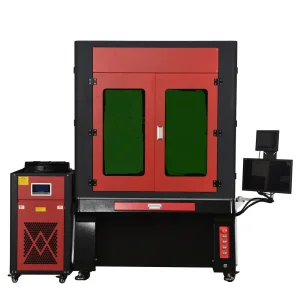



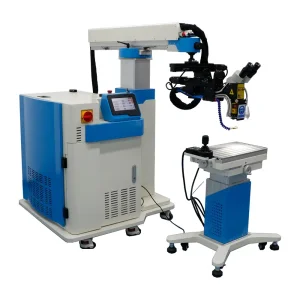

Analyzing tooling lifecycle optimization, downtime reduction, and circular manufacturing economics across high-stakes precision manufacturing sectors.
Modern automotive stamping dies and high-cavitation medical injection molds represent single investments often exceeding $250,000. Premature wear or tool fracture cannot be resolved through scrapping without catastrophic supply chain delays. High-precision YAG laser welding enables microscopic metallurgical reconstitution directly within tool shops.
Traditional TIG/MIG welding techniques introduce massive heat input exceeding 1,200°C across wide radii, creating catastrophic structural distortion, annealing, or micro-cracks in pre-hardened H13, P20, and S136 tool steels. Pulsed Nd:YAG lasers localize heat energy, restricting the Heat-Affected Zone (HAZ) to fractions of a millimeter.
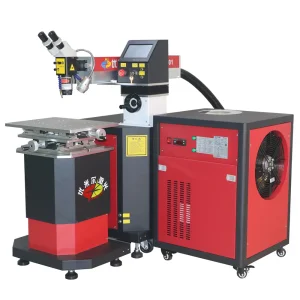
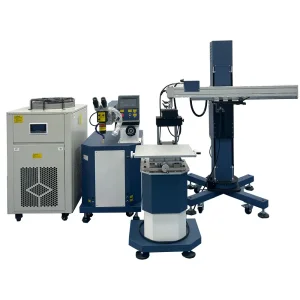
Transporting a 15-ton mold block to an external EDM repair workshop demands crane rigging, logistics clearances, and press downtime lasting days. Our cantilever boom and multi-axis articulated optical heads allow in-press tooling maintenance, executing pinpoint weld deposits without unbolting mold halves.
A technical assessment across thermal diffusion, metallurgical bonding, and post-weld micro-finishing requirements.
| Evaluation Parameter | Pulsed Nd:YAG Laser (Youmir Spec) | Continuous CW Fiber Laser | Micro-TIG Welding |
|---|---|---|---|
| Operating Wavelength | 1064 nm (Pulsed Crystal) | 1070–1080 nm (Fiber Laser Source) | N/A (Electric Arc Discharge) |
| Pulse Energy Peak Profile | High Peak Power (Up to 15 kW / 40–110 Joules) | Continuous Constant Power Flow | Sustained continuous arc current |
| Heat-Affected Zone (HAZ) | < 0.10 mm – 0.25 mm (Negligible) | 0.30 mm – 0.80 mm (Moderate) | 1.50 mm – 4.00 mm (Severe Warpage Risk) |
| Filler Wire Precision Limit | Ø 0.10 mm to 0.80 mm wire feed | Ø 0.80 mm to 1.60 mm wire feed | Ø 0.80 mm minimum wire diameter |
| Substrate Crack Proneness | Extremely Low (Adjustable Pulse Shaping Waveforms) | Medium (Requires careful pulse modulation) | Very High on alloyed tool steels without preheating |
| Microscopic Polishing & Texture | Pore-free deposition, mirror polishable (SPI A1 standard) | Good, requires high-precision grinding pass | High porosity rate, requires extensive re-milling |
| Field Accessibility | Integrated boom arm, 1.5m outreach radius | Handheld gun or rigid gantry setup | Manual electrode clamp |
Custom-engineered solutions aligned with tier-1 automotive, medical device, aerospace, and semiconductor tooling criteria.
Aluminum die-casting tooling faces extreme thermal fatigue, leading to heat checking, erosion, and cracking along runner gates. Our 400W–600W YAG systems deliver tailored pulse shapes with dual-channel shielding gas (Argon/Helium mix), depositing identical-alloy wires (1.2343, 1.2344, Maraging 300) without post-weld micro-fissuring.
Multi-cavity injection molds for optical lenses, syringes, and fluidic housings rely on micro-parting edges with dimensional tolerances tighter than ±0.005mm. The stereomicroscope with cross-hair reticle and high-magnification CCD imaging allows toolmakers to rebuild worn 0.05mm shut-off lips without refacing adjacent core plates.
Bottle cap threads, blow mold pinch-offs, and thin-walled container molds run millions of cycles annually under severe impact. Youmir's boom cantilever mold welders feature motorized XYZ stages and micro-stepping motor drivers, ensuring rapid semi-automated circumferential weld tracks directly inside tool maintenance shops.
Youmir Laser's continuous R&D trajectory integrates artificial intelligence, hybrid beam optics, and autonomous spatial scanning.
Integrating structured-light 3D scanning directly onto the optical boom head. The system automatically measures wear profiles on complex contoured surfaces, generates adaptive CNC welding paths, and calculates optimum wire feed speeds in real-time to eliminate operator fatigue on multi-cavity repairs.
Engineered for maximum metallurgical flexibility, our upcoming generation supports dual-swappable laser optical paths. Users can alternate between pulsed Nd:YAG's exceptional peak thermal control for tool steel edges and high-repetition QCW fiber sources for deep filling operations on massive dies.
Real-time infrared pyrometers measure pool molten temperatures at 2,000 Hz, instantly adjusting flashlamp pumping voltage. This ensures uniform crystalline solidification, preventing micro-segregation, martensitic embrittlement, and grain boundary separation across temper-sensitive beryllium copper inserts.
Turnkey international shipping infrastructure backed by comprehensive safety certifications and cross-border engineering support.
Every custom YAG mold welder incorporates dual-channel safety interlocks, optical beam shutters, protective enclosures, and OD7+ Nd:YAG filtering viewing ports. All electrical systems comply with EN 60825-1 laser safety and EN 60204-1 machinery electrical directives, ensuring seamless compliance across Europe, North America, and Australia.
Configured with heavy-duty dual-cycle water chillers (compressor refrigeration) adapted to local grid standards: 380V 3-Phase, 220V Single-Phase, 50Hz, or 60Hz. Laser cavities are vacuum-sealed and temperature-regulated, guaranteeing stable optical resonance output under harsh ambient shop environments ranging from -5°C to 45°C.
Machines are wrapped in anti-static moisture barriers and vacuum-sealed inside ISPM-15 export fumigation wooden crates. With remote video diagnostics, step-by-step process parameter libraries for 40+ tool steels, and global spare parts dispatch via DHL/FedEx, Youmir ensures maximum tooling uptime worldwide.
Comprehensive engineering insights regarding mold repair YAG laser welding capabilities, metallurgy, warranties, and deployment.
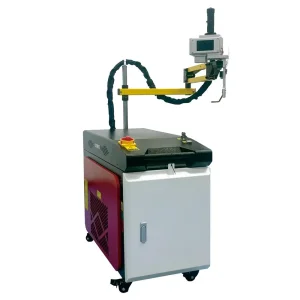
Review additional field-tested machines from our Shenzhen engineering facility designed for end-to-end metal fabrication and surface conditioning.