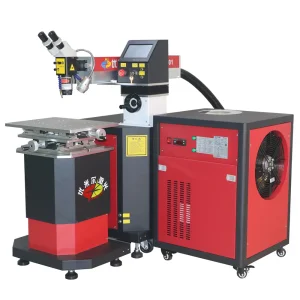
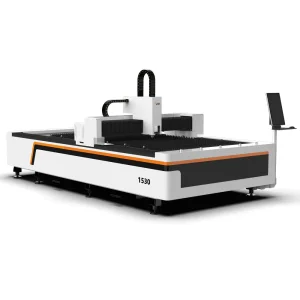
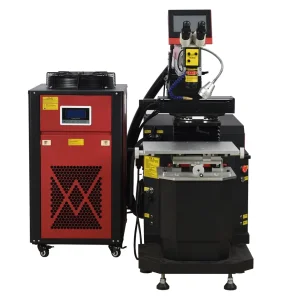
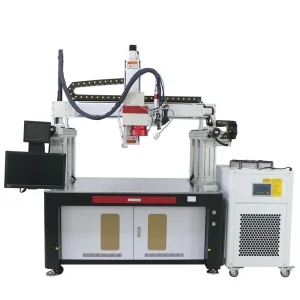
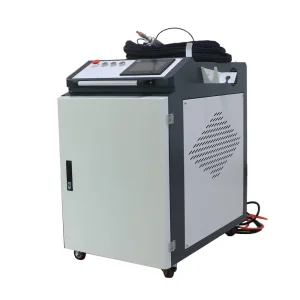
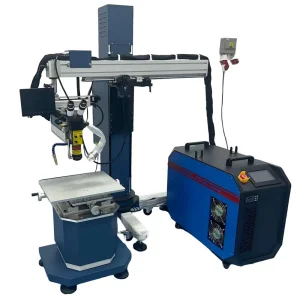
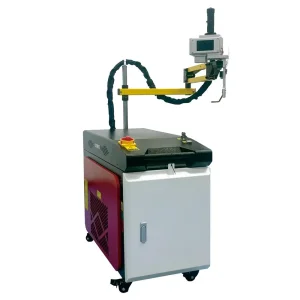
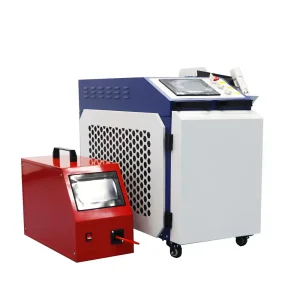
Factory-direct configurations engineered for micro-repair, continuous production lines, and high-precision restorative fabrication.
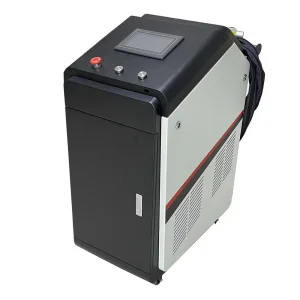
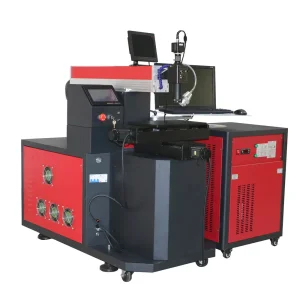
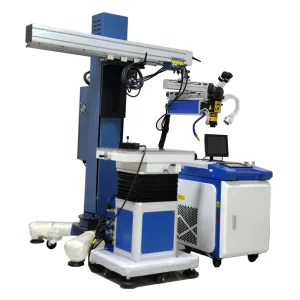

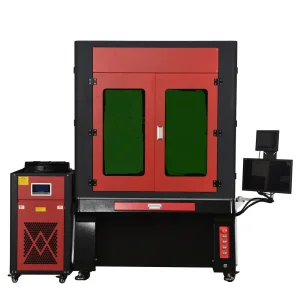
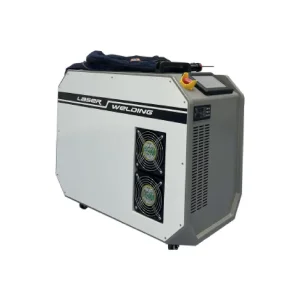
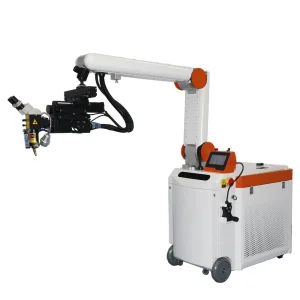
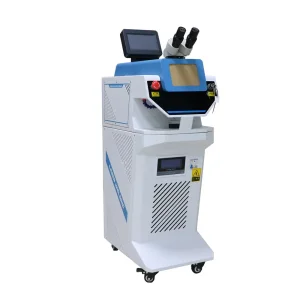
Precision laser welding in precious metal jewelry manufacturing fundamentally diverges from macro-industrial welding. Success relies on conquering severe optical reflectivity, controlling localized thermal dissipation, and mitigating micro-porosity.
Pure yellow gold (Au) and silver (Ag) demonstrate optical reflection exceeding 94% at standard 1064 nm Nd:YAG wavelengths. Initiating the weld pool demands extreme peak pulse energy (up to 4.5–6 kW for fractions of a millisecond) to trigger instantaneous surface breakdown. Once molten, absorption surges dramatically to over 60%, necessitating immediate pulse modulation to avert material vaporization.
Traditional torch soldering distributes caloric energy conductively across entire workpieces, frequently degrading emeralds, pearls, opals, and tension settings. Micro-pulse laser processing constrains the Heat-Affected Zone (HAZ) within a radius of 0.05 mm to 0.25 mm. High-energy spot durations between 0.2 ms and 20 ms permit structural prong re-tipping directly adjacent to heat-sensitive stones without unsetting.
Atmospheric nitrogen and oxygen dissolve rapidly into molten titanium, platinum, and karat gold, causing embrittlement and pinhole voids. Integrated laminar coaxial nozzle designs introduce high-purity Argon (≥ 99.999% Grade 5.0) at regulated flow rates of 4 to 8 L/min. This prevents micro-spattering, terminates surface oxidation, and yields smooth, mirror-polishable weld seams without flux.
| Joining Technology | Thermal Distribution (HAZ) | Precious Metal Loss Rate | Shielding Gas Medium | Filler Alloy Requirements | Gemstone De-mounting |
|---|---|---|---|---|---|
| Nd:YAG Flashlamp Laser (1064nm) | Ultra-Localized (0.1–0.3 mm) | < 0.01% (Zero Burn-off) | Argon (4–6 L/min) | Exact Parent Metal Wire (0.2–0.5 mm) | Unnecessary for >95% of cases |
| QCW Fiber Laser (1070nm) | Extremely Narrow (< 0.1 mm) | < 0.005% (Near Perfect) | Argon / Nitrogen Mix | Micro-Wire / Autogenous Fusion | Completely Unnecessary |
| Micro-Plasma / TIG Inverter | Moderate (0.8–2.0 mm) | 0.5% – 1.2% Loss | Argon (8–12 L/min) | Low-melting Rods Required | Mandatory for Fragile Gems |
| Traditional Oxy-Gas Torch | Dispersed / Entire Workpiece | 2.0% – 5.0% (Oxidation + Grinding) | None (Borax/Boric Flux) | Cadmium/Zinc Soldering Alloys | Strictly Mandatory |
Procurement decisions necessitate an exhaustive evaluation of CapEx, source lifecycle expenditures, and consumable schedules. The following pricing matrices reflect current direct-from-factory production benchmarks.
| Equipment Category & Architecture | Average Power / Pulse Energy | Indicative Price Range (USD) | Primary Source Mechanism | Routine Maintenance Cycle | Typical Investment Amortization |
|---|---|---|---|---|---|
| Desktop Nd:YAG Compact Jeweler | 60W / 40–50 Joules | $3,200 – $4,600 | Pulsed Xenon + Nd:YAG Rod | Flashlamp replacement at 5M shots | 3 – 5 Months (Bespoke Studio) |
| Heavy-Duty Industrial Stand-Alone YAG | 100W – 150W / 70–90 Joules | $4,800 – $7,200 | Dual-Cavity Nd:YAG Optical Chamber | Deionized water & flashlamp annually | 4 – 7 Months (Repair Workshops) |
| High-Yield Ergonomic Cabinet YAG | 200W / 100–120 Joules | $6,800 – $9,800 | High-Capacitance Optical Cavity | Cooling fluid, filter cartridges | 6 – 9 Months (Volume Manufacturers) |
| Quasi-Continuous Wave (QCW) Fiber Welder | 150W (1.5kW Peak) – 300W (3kW Peak) | $8,900 – $15,500 | Solid-State Fiber Laser Module | Zero optical cavity consumables (100k hrs) | 8 – 12 Months (24/7 Operations) |
| Multi-Axis Automatic Jewelry Laser Cell | 200W – 500W Multi-axis CNC | $16,500 – $34,000 | Fiber / Galvo Integration | Collet checks & optic cleaning | 10 – 14 Months (Chain/Watchmakers) |
From micro-repair retail studios in historic districts to large-scale investment casting foundries, laser parameters adapt dynamically to workpieces, metallurgical properties, and volume demands.
Historic estate jewelry frequently features thin platinum-iridium wires (0.10–0.20 mm) and unknown soft solders. High-frequency pulse tuning allows operators to rebuild eroded claw prongs, bridge sheared filigree lattices, and repair porous Victorian hollowware without inducing thermal collapse or burning legacy hallmarks.
Centrifugal and vacuum casting often encounter gas entrapment, leaving subsurface shrink voids on polished faces of 18K white gold or platinum master bands. Rather than recasting, operators deploy identical parent alloy filler wire (0.2–0.4 mm) to micro-weld cavities flush, preserving metallurgical uniformity and eliminating pits before final high-polish.
Luxury Swiss watchmaking demands zero-distortion laser metal deposition (LMD) to repair deep gouges, bevel denting, and lug degradation in 904L stainless steel, grade 5 titanium, and 18K solid gold cases. Pulsed laser deposition rebuilds sharp chamfers with parent-matched metallurgical hardness, preserving authentic case lines.
Integrating high-intensity laser systems into artisanal workshops mandates adherence to strict international safety mandates, fume extraction directives, and electrical safety codes.
Systems feature Class 1 completely enclosed optical pathways during operation. Inspection microscopes incorporate OD6+ active liquid crystal shutters alongside certified optical interference filters, shielding operator retinas from 1064 nm specular back-reflections during continuous welding.
Vaporized precious alloys, silver oxides, and trace copper produce micro-fumes hazardous under prolonged inhalation. Integrated multi-stage HEPA filters (H14 grade ≥ 99.995%) and active carbon canisters capture particulates directly at the nozzle chamber, recovering noble metal dust.
Equipped with isolated galvanic transformer systems, emergency physical interlocks, and dual-channel safety relays. Systems dynamically detect coolant temperature, reservoir levels, and chiller pressure, auto-shutting down within 15 milliseconds upon any thermal or electrical threshold breach.
Our worldwide support infrastructure maintains regionally localized inventories of flashlamps, Nd:YAG crystals, protective quartz cover slides, and coaxial gas nozzles across distribution hubs in North America, Europe, the UAE, and Southeast Asia to minimize downtime.
Technological convergence is transforming jewelry laser micro-machining through artificial intelligence, direct-diode blue wavelength lasers, and high-frequency automated seam-tracking.
Noble metal absorption surges exponentially at shorter wavelengths: pure gold absorbs nearly 65% of 450 nm blue laser radiation at room temperature compared to only 5% of standard 1064 nm infrared. Emerging multi-wavelength hybrid lasers pair a blue diode for pre-heating and reflection suppression with an infrared pulse for deep penetration, eradicating weld spatter completely.
Integrated high-speed coaxial CMOS cameras with real-time neural edge processing monitor the molten pool at 10,000 frames per second. Advanced algorithmic vision detects micro-gaps down to 10 microns, automatically adjusting laser spot diameter, duty cycle, and pulse modulation on-the-fly to ensure flawless weld crowns along complex geometry rings.
Transitioning from standard wire-fed methods, next-generation jewelry welders incorporate precision micro-powder nozzles. Delivering sub-15-micron spherical alloy powders directly into the focal zone, ateliers can perform additive micro-sculpting, selectively building lost prongs, custom bezels, or artistic filigree relief with zero porosity and unmatched density.
Authoritative technical resolutions compiled by senior laser application engineers, addressing parameter optimization, shielding dynamics, and procurement validation.
Complete manufacturing line systems covering large mold tooling, high-throughput continuous galvanometer welding, and sheet-metal fabrication.