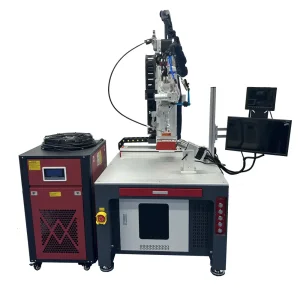
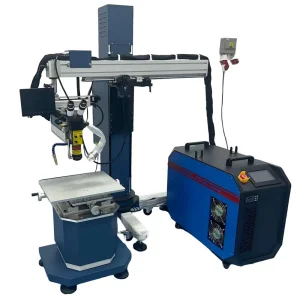
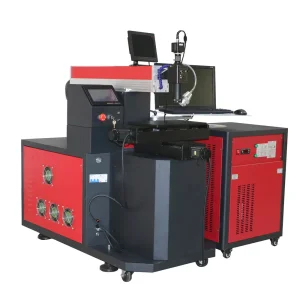
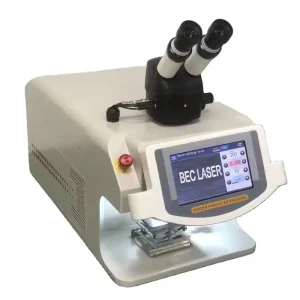
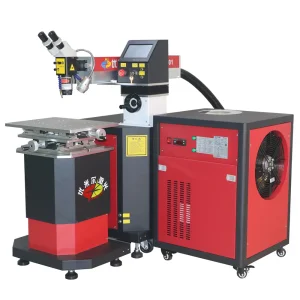
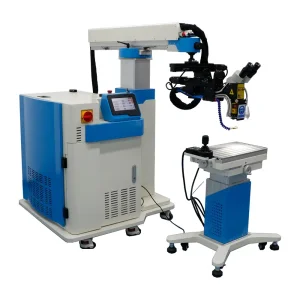
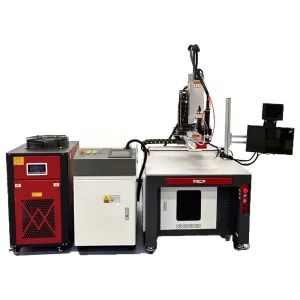
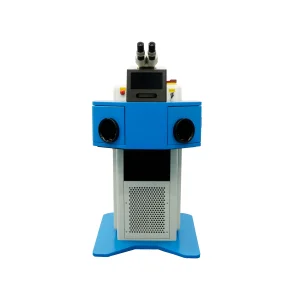
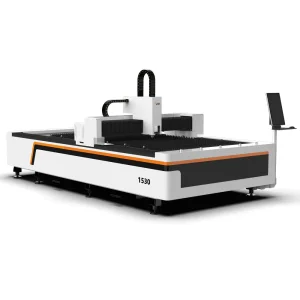
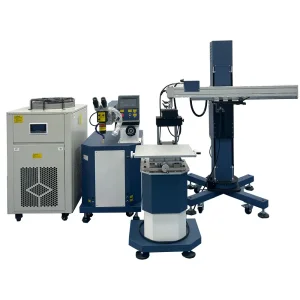
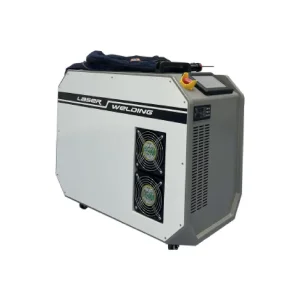
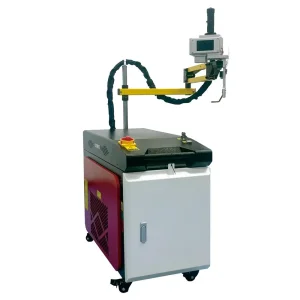
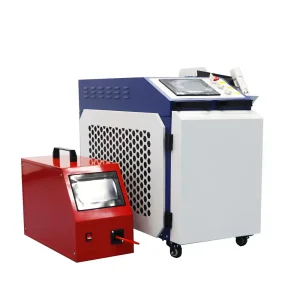
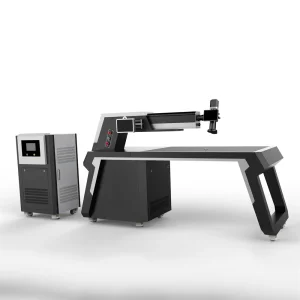
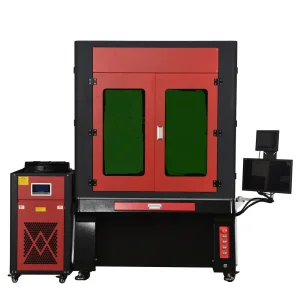
Explore production-tested YAG and high-peak QCW continuous optical systems deployed across tier-one manufacturing cells.
Strategic balance between solid-state pulsed Nd:YAG resonators and quasi-continuous fiber architectures across modern industrial manufacturing ecosystems.
Flashlamp-pumped and diode-pumped solid-state Nd:YAG (Neodymium-doped Yttrium Aluminum Garnet) lasers deliver unmatched pulse-shaping versatility at 1064 nm. Unlike continuous-wave fiber lasers, pulsed YAG machines offer microsecond-level temporal control, preventing microscopic hot cracking during metallurgical solidification.
In high-tonnage stamping, plastic injection molding, and aluminum die casting, YAG boom systems enable in-situ deposition of specialized tool steels (H13, P20, NAK80, S136). The localized pulse prevents baseline thermal warping, safeguarding tooling assets valued up to $500,000 without requiring furnace post-heat treatment.
Jewelry and high-reliability luxury horology rely heavily on pulsed YAG optical configurations. The initial 1064 nm optical burst breaks the surface reflectivity of reflective alloys such as sterling silver, 24K gold, and grade-950 platinum, yielding gas-free, structurally dense micro-welds without gemstone thermal shock.
The global marketplace is rapidly transitioning legacy flashlamp cavities into Quasi-Continuous Wave (QCW) fiber laser modules. Delivering 10x electrical-to-optical wall-plug efficiency (up to 35% vs. 3%), QCW engines preserve standard YAG peak pulsing while eliminating consumable xenon flashlamp replacements.
Delivers high penetration on high-reflectivity copper & gold matrices.
Minimizes residual mechanical stresses and metallurgical distortion.
Configurable across micro-jewelry joins and industrial heavy mold repair.
MTBF rating on state-of-the-art solid-state diode-pumped systems.
How concentrated vertical integration across Guangdong enables top-tier laser manufacturing quality at structurally sustainable capital outlays.
Within a 50-kilometer radius in the Pearl River Delta (Shenzhen-Dongguan-Zhongshan), manufacturers access certified precision quartz crystal growers, high-voltage pulse power supply designers, and CNC gantry machinists. Component lead times drop from weeks to single days.
Every industrial laser system undergoes a mandatory 72-hour continuous thermal and optical power stability test using Ophir calorimeters. Beam pointing stability, focal drift, and cooling water closed-circuit pressures are documented in factory pre-shipment inspection records.
Procuring directly from specialized Shenzhen production lines yields a 40% to 60% CAPEX savings compared to Western or Japanese equivalents. This margin allows manufacturing shops to deploy multiple dedicated repair cells rather than bottlenecking work through a single unit.
Empirical market reference pricing spanning standard configurations, automation options, and lifecycle consumable outlays.
| System Architecture | Optical Resonator | Power Output (Avg / Peak) | Target Applications | Typical FOB Price (USD) |
|---|---|---|---|---|
| Desktop Mini Jeweler | Nd:YAG Flashlamp Cavity | 60W / 3.5 kW | Jewelry studio, eye wear, dental crowns | $2,800 – $4,200 |
| Standard Vertical Jeweler | Nd:YAG Double Lamp | 200W / 9.0 kW | High-throughput goldsmithing, chains, micro-sensors | $4,500 – $6,800 |
| Cantilever Boom Mold Welder | Nd:YAG Ceramic Cavity | 200W – 400W / 12 kW | Injection molds, casting repair, tool recovery | $6,200 – $9,500 |
| Integrated Heavy Mold System | Nd:YAG High-Repetition | 400W – 500W / 15 kW | Automotive stamping dies, large extrusion dies | $8,900 – $14,000 |
| Multi-Axis Automatic CNC | Nd:YAG / Fiber Combined | 300W – 600W / 12 kW | Batteries, medical devices, relays, automotive parts | $12,500 – $22,000 |
| Next-Gen QCW Fiber Welder | Air/Water-Cooled QCW Module | 150W / 1500W Peak | Zero-maintenance micro electronics, aerospace repair | $7,800 – $13,500 |
Real-world integration showing how laser welding solves critical tolerances where conventional MIG/TIG processes fall short.
Challenge: Chipped cutting edges on 12-ton automotive stamping dies require on-press rebuilds without dismounting.
Solution: A 400W cantilever boom YAG system moves directly to the stamping bed. Using 0.4mm Cr-Mo filler wire, the damaged radius is built up within 45 minutes, saving over 14 hours of press downtime.
Challenge: Joining Grade 5 Titanium (Ti-6Al-4V) endoscope components without thermal oxidation or grain embrittlement.
Solution: Enclosed nitrogen-purged YAG glovebox systems run square-wave pulse sequences, maintaining hermetic joints below 120°C across the outer tool boundary.
Challenge: Resizing hollow 18K white gold bands set with emeralds vulnerable to thermal fractures above 140°C.
Solution: A 60W desktop YAG welder set to a 0.2mm focal spot and 1.2ms pulse duration confines heating to the seam, completing the weld just 1.5mm away from intact gemstones.
Challenge: Joining dissimilar metals (copper to aluminum) without forming brittle intermetallic phases.
Solution: High-repetition pulsed energy shapes melting dynamics, producing smooth lap joints with tensile pull strengths exceeding 850 N and stable electrical conductivity.
How plant engineers and procurement teams evaluate optical beam quality, operating automation, and compliance certification.
Modern YAG architectures integrate coaxial high-definition microscopes with automated optical crosshairs and AI-assisted edge tracking, eliminating operator eye strain while maintaining positioning precision down to ±5 microns across micro-welding tasks.
Microcontroller boards now monitor deionized water conductivity, flashlamp ignition voltage curves, and cavity reflective degradation. Preventive alerts signal lamp changes before pulse energy variances compromise critical weld batches.
Global buyers require CE Machinery Directive (2006/42/EC), Class 4 Laser Safety housing compliance, and dual-channel safety interlocks (ISO 13849-1), allowing immediate factory-floor integration across North America and the European Union.
Detailed engineering answers covering operating parameters, upkeep intervals, and technology selection.
Review additional automated systems, heavy cantilever tool-room workstations, and multi-axis CNC machines.