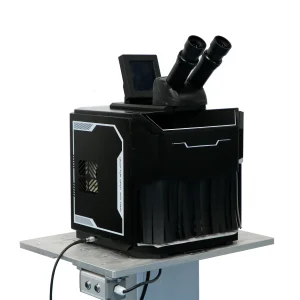
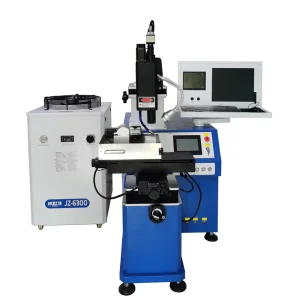
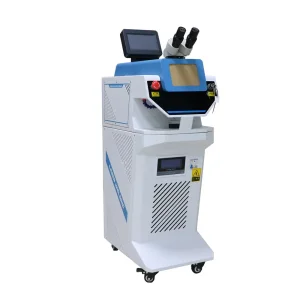
Direct factory production models configured for tool-room mold renovation, precision jewelry fabrication, continuous sheet-metal fabrication, and multi-axis CNC automation.






Analyzing why the 1000W continuous wave (CW) fiber laser architecture represents the optimal thermodynamic equilibrium for global metal fabricators.
The 1000-watt fiber laser operates at a nominal emission wavelength of 1070nm ±10nm. At this optical bandwidth, photon absorption rates in carbon steel and austenitic stainless steel peak dramatically compared to traditional infrared CO2 sources. A 1kW laser concentrated through a 100mm focal assembly generates power densities surpassing 1.5 × 10^6 W/cm², enabling instantaneous transition into deep keyhole welding without massive conduction loss. The resulting Heat-Affected Zone (HAZ) is reduced by up to 82% compared to conventional GTAW (TIG), preserving parent metal mechanical properties.
Older solid-state Nd:YAG flashlamp welders exhibited wall-plug electrical-to-optical conversion efficiencies of merely 1.5% to 2.5%, requiring massive multi-kilowatt external water chillers. Modern 1000W ytterbium-doped double-clad fiber laser engines engineered by Shenzhen Youmir Laser achieve Wall-Plug Efficiency (WPE) exceeding 38% to 42%. Total operational energy draws for a complete 1kW workstation—inclusive of dual-circuit chilling, control boards, and wire-feeding servos—remain below 3.5 kW/hour under sustained 100% duty-cycle production.
Structural shortage of certified ASME and ISO 9606 manual TIG/MIG welders in North America and Western Europe has driven labor costs to historical highs. A skilled artisan requires 3 to 5 years to master heat-input manipulation for clean fillet seams on 1.5mm stainless steel. In contrast, an operator utilizing a 1000W wobble laser welder with dynamic oscillating optics and automated parameter presets can achieve radiographic-grade, spatter-free, aesthetic mirror-welds within 4 to 8 hours of training, slashing workshop onboarding bottlenecks.
A transparent B2B pricing model separating bare hardware manufacturing, laser source tiers, automation integration, and localized landing costs.
Pricing for commercial industrial equipment varies depending on the optical source brand (e.g., Raycus, Maxphotonics, RECI, or IPG Photonics), galvanometer wobble head configuration, wire feeder inclusion, and shipping Incoterms (EXW, FOB Shenzhen, CIF, or DDP). Below is our certified 2026 factory pricing baseline for industrial procurement officers and equipment distributors.
| System Architecture / Model | Core Laser Source Spec | Primary Industrial Application | FOB Shenzhen Unit Price (USD) | OEM Fleet Tier (5+ Units) |
|---|---|---|---|---|
| Handheld 1000W Standard Fabricator | 1kW CW Fiber (Single-Mode, 50μm) | Sheet metal fabrication ≤ 3.0mm, ductwork, cabinets | $2,850 – $3,600 | $2,450 – $2,900 / unit |
| 3-in-1 Multifunction (Weld / Cut / Clean) | 1kW CW High-Peak Modulation Source | Weld seam rust stripping, weld bead ablation, cutting | $3,400 – $4,200 | $2,950 – $3,450 / unit |
| Enclosed Benchtop Tool & Mold Welder | 1000W QCW / Pulsed / CW Micro-Beam | Injection molds, stamping die edge rebuilds | $4,800 – $6,500 | $4,200 – $5,400 / unit |
| 3-Axis Precision CNC Automated Workcell | 1kW CW Dual-Wavelength Option | High-throughput batch sensors, electronics, relays | $7,500 – $11,800 | $6,800 – $9,900 / unit |
| Galvo Continuous High-Speed Welder | 1kW Fiber + Dynamic High-Speed Scanner | Lithium battery tab welding, automotive busbars | $9,200 – $14,500 | $8,300 – $12,600 / unit |
| Articulated Boom Mold Laser Welder | 1000W Long-Focal Optical Delivery | In-press die maintenance without machine teardown | $5,600 – $7,800 | $4,900 – $6,700 / unit |
In our Guangming District factory in Shenzhen, the cost of a 1000W system breaks down into distinct engineering layers: The fiber source represents 42-48% of gross hardware cost; the dual-circuit compressor refrigeration unit accounts for 16%; the proprietary dual-motor wobble torch and F-theta optics comprise 14%; the digital wire feed synchronization unit and CNC logic control board represent 12%; and heavy structural sheet metal, interlocks, and CE/UL cabling make up the remaining 10%.
Real-world operational costs dictate profitability. Consumables on a Youmir 1000W welder are minimal: Quartz protective cover lenses ($1.50 - $3.00, lasting 120-200 arc hours under proper gas flow); brass gas nozzles ($2.00 - $4.00, lasting 300+ hours); and shielding gas consumption (Argon or Nitrogen at 12 to 18 L/min, yielding an approximate hourly gas cost of $1.80 - $2.50). Total operating cost typically averages under $4.20 per operating hour.
We provide clear harmonized tariff classification: Laser welding equipment classifies internationally under HS Code 8456.11.00. When exporting to the United States, EU, or Australia, our logistics division coordinates comprehensive fumigated export crating, marine moisture-barrier sealing, Certificate of Origin (COO) documentation to minimize regional tariffs, and door-to-door DDP transit solutions.
How tier-1 metal fabrication contractors, defense suppliers, and contract manufacturers audit laser welding production equipment prior to issuing purchase orders.
A primary technical divergence in 1000W procurement is fiber core diameter. A 50μm single-mode fiber concentrates the beam into an exceptionally high-density Gaussian profile, optimal for deep penetration on 2-3mm stainless steel and high-speed narrow seams. Conversely, a 100μm core fiber provides a wider top-hat profile, which, when coupled with an oscillating wobble torch (0-5mm beam weave), bridges joint gaps up to 1.5mm without blow-through on thin galvanized automotive stampings.
Low-tier market machines utilize single-axis galvo motors that produce simple linear oscillation, leading to uneven sidewall wetting. Youmir Laser’s standard 1000W systems integrate proprietary dual-axis DSP galvanometers capable of generating six distinct wave patterns: Circle, Line, Triangle, Figure-8, Ellipse, and C-Arc. Dynamic frequency controls up to 300Hz prevent molten puddle slump, even in vertical-up and overhead positions.
Fiber laser diodes will rapidly experience thermal runaway or beam mode hopping if coolant water fluctuates beyond ±1°C. Our custom 1000W machines incorporate an industrial dual-temperature compression chiller that isolates optical QBH connector cooling (preventing internal dew condensation) from the lower-temperature laser module cooling loop, ensuring 24/7 continuous operation in 45°C ambient environments.
Before commissioning, our Shenzhen testing laboratory validates single-pass butt weld penetration limits on standardized metal test coupons: Austenitic Stainless Steel (304/316): 3.0 mm; Carbon/Mild Steel (Q235/A36): 2.5 mm; Galvanized Sheet: 2.0 mm; Marine Aluminum (5052/6061): 1.5 mm; Brass (H62): 1.2 mm. For joints requiring continuous wire-fill on bevels greater than 3mm, multi-pass workflows are programmed via Youmir’s digital process library.
Field-proven deployment blueprints detailing how 1kW fiber systems replace legacy arc infrastructure across major industrial sectors.
In high-end commercial refrigeration and food processing tables, TIG welding induces significant buckling on thin 0.8-1.5mm stainless steel sheets, demanding hours of labor-intensive planar flattening and abrasive grain-restoration polishing. A 1000W fiber laser welder with argon shielding creates narrow, shiny, sanitary welds that require zero post-weld grinding, reducing fabrication time per cabinet from 45 minutes to under 8 minutes.
Injection mold cavities constructed from pre-hardened steels (P20, NAK80, H13, S136) frequently suffer parting-line wear, chipping, or engineering design revisions. Traditional micro-TIG introduces excessive thermal mass, leading to anneal-softening, undercut, or localized stress cracking. Youmir's boom and cantilever mold laser welders deposit identical-metallurgy filler wires down to ∅0.2mm with near-zero heat dissipation, preserving surrounding Rockwell hardness.
Electromobility modules require joining dissimilar, highly reflective non-ferrous metals such as copper busbars to nickel-plated aluminum terminals. Using 1000W high-speed galvanometer continuous systems with specialized wobble-oscillation paths, the intense initial photon shock disrupts native aluminum surface oxides (Al2O3) without spattering or pore generation, ensuring low electrical resistance across connections.
Operating Class 4 fiber lasers demands comprehensive safety systems, international regulatory accreditations, and rapid-dispatch parts ecosystems.
Every Youmir Laser machine shipped internationally is engineered in compliance with European Machinery Directive 2006/42/EC, Low Voltage Directive 2014/35/EU, and Electromagnetic Compatibility Directive 2014/30/EU. For the North American market, our systems comply with FDA Center for Devices and Radiological Health (CDRH) 21 CFR 1040.10 and 1040.11 accession registries and integrate dual-channel certified safety interlocks that comply with ANSI Z136.1 and OSHA regulations.
Personal safety is integrated into the torch hardware. The laser trigger is non-operational until a dedicated micro-amperage grounding circuit confirms electrical continuity between the conductive copper nozzle and the earthed metal workpiece. Furthermore, dual mechanical emergency stops, protective earth (PE) copper grounding posts, laser emission strobe beacons, and redundant laser shutter relays prevent stray accidental emissions.
To safeguard commercial manufacturing continuity, Youmir Laser maintains a comprehensive technical support network. We provide 24/7 video-guided diagnostics by fluent laser systems engineers, next-business-day emergency dispatch for mission-critical optical replacement components (QBH blocks, protective collimating lenses, digital controllers), and established regional distributor partnerships across 50+ countries.
Shenzhen Youmir Laser's ongoing R&D directions shaping the next generation of industrial high-density joining tools.
We are pioneering the integration of solid-state GaN semiconductors within our next-generation 1000W pump modules. Operating at tenfold higher switching frequencies than silicon IGBTs, GaN architectures reduce total machine power-supply volume by 35% and weight by 40%, enabling ultra-portable 1kW "backpack-style" field-repair welders that operate off single-phase domestic current without sacrificing beam quality.
Automated workcells are transitioning toward closed-loop optical intelligence. By incorporating high-speed 500 FPS CMOS image sensors aligned coaxially through the central dichroic mirror, embedded machine-learning neural networks detect joint gap deviation, surface oxidation, and gap misalignments in real-time (<2ms latency), automatically modulating wobble amplitude, wire feed velocity, and laser power dynamically.
Modern factory floors reject single-purpose machines. The technological trajectory favors Youmir's unified 4-in-1 tool platforms. With a single tool-less twist of the proprietary copper front nozzle and instant digital profile selection via the intuitive 10-inch capacitive touch screen, an operative shifts between narrow 1kW continuous deep-weld mode, optical rust stripping mode (up to 80mm swath), seam ablation, and sheet-metal air cutting.
Precise answers compiled by Shenzhen Youmir Laser's lead optical systems and manufacturing engineers.
Explore our complementary catalog covering automated QCW systems, high-speed fiber cutting tables, channel letter welders, and heavy-duty enclosed workcells.





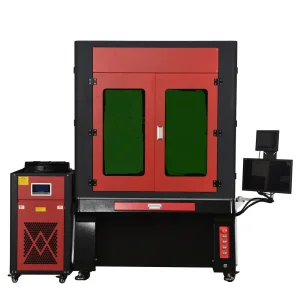

Verify metallurgical results prior to capital commitment. Send your raw stamped parts, extrusion profiles, or mold samples directly to our Shenzhen optical engineering laboratory for comprehensive penetration testing, weld cross-section micro-etching, and process parameter optimization reports.
