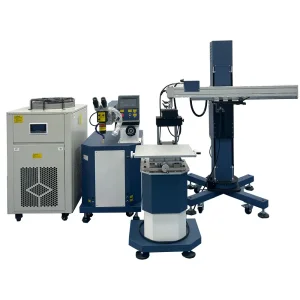
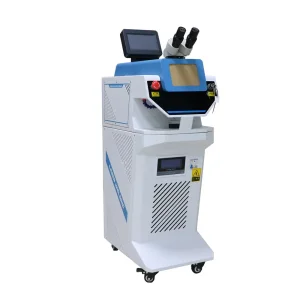
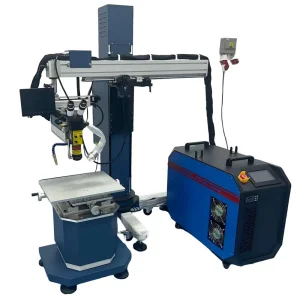
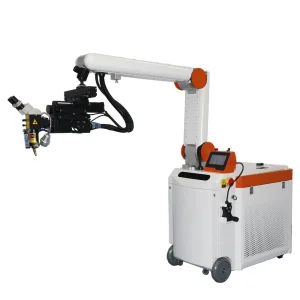
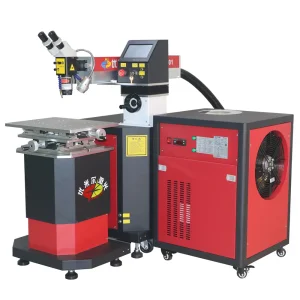
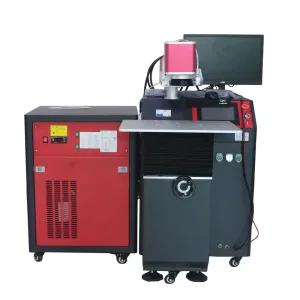
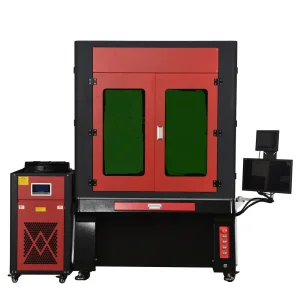
Explore our top-tier industrial product lineup. Each system incorporates specialized optical cavities, high-stability beam modulation, and modular chassis designed for demanding manufacturing cycles.
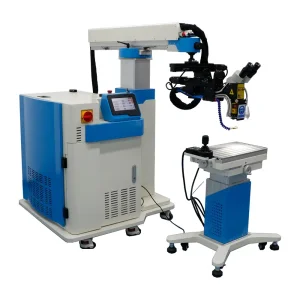


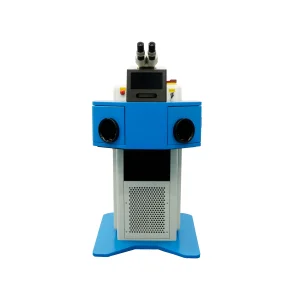
As precision metalworking paradigms shift from traditional arc and resistance methods toward photonic keyhole joining, industrial procurement demands deep transparency into beam-matter physics, optical transmission integrity, and metallurgical heat dissipation.
Fiber laser processing fundamentally relies on continuous-wave (CW) near-infrared photon emission at 1064nm to 1080nm. By varying the energy flux density ($>10^6 \text{ W/cm}^2$), the process transitions instantly from conduction-limited shallow fusion to vapor-cavity keyhole penetration.
Modern industrial fiber welding eliminates classic laser joint gap sensitivity through advanced dual-axis oscillating wobble heads. By dynamically driving the focal spot across linear, circular, continuous figure-8, or transverse elliptical paths, molten pool fluid dynamics are radically stabilized.
Shenzhen Youmir Laser Technology integrates internal design controls covering collimating and focusing optics, specialized protective mirror cartridges with capacitive interlocks, and synchronous CNC motion controls that preserve focal positioning across complex spatial contours.
When global production engineering teams audit a custom laser welding manufacturer, capital expenditure (CapEx) represents merely the threshold metric. Comprehensive operational risk assessments evaluate electrical-optical conversion efficiency, diode pump mean-time-between-failure (MTBF), gas consumption economics, and factory floor integration.
| Evaluation Parameter | Industrial CW Fiber Laser | Precision Pulsed Nd:YAG | TIG (GTAW) Robotic Arc | MIG / GMAW Semi-Auto |
|---|---|---|---|---|
| Wall-Plug Electrical Efficiency | 35% – 42% | 2% – 4% | 30% – 50% (Arc) | 40% – 60% (Arc) |
| Heat Input per Unit Length | Ultra-Low (~0.1 – 0.3 kJ/mm) | Low (~0.2 – 0.5 kJ/mm) | Very High (>1.5 kJ/mm) | Extremely High (>2.0 kJ/mm) |
| Welding Velocity (1.5mm SS) | 2.0 – 5.0 m/min | 0.2 – 0.4 m/min | 0.3 – 0.6 m/min | 0.5 – 1.0 m/min |
| Consumables / Wear Parts | Protective lens, copper nozzle | Flashlamps, deionizer resin | Tungsten, gas cups, collets | Contact tips, liners, drive rolls |
| Post-Weld Surface Grinding | Zero to Negligible | Negligible | Frequent buffing & pickling | Mandatory heavy grinding |
| Diode / Source MTBF | >100,000 Operating Hours | ~1,000 hrs (Flashlamp replacement) | Transformer dependent | Wire feeder wear frequent |
Global buyers must demand Tier-1 continuous-wave laser engines (IPG Photonics, Raycus, or Maxphotonics). A custom builder must provide verifiable serial tracking, fiber delivery cables with standard QBH/QCS termination, and redundant back-reflection isolation mechanisms for processing highly reflective alloys (pure copper, gold, polished brass, and 6000-series aluminum).
Laser power stability directly correlates with water chilling efficiency. Dual-circuit water chillers must control both the optical fiber output head and the main laser cavity independently within $\pm 0.5^\circ\text{C}$. Integrated flow sensors and electronic deionization filters safeguard pump modules against cavitation, micro-scaling, and condensation during humid manufacturing shifts.
Enterprise laser welding systems do not operate in isolation. Custom machine designs must natively feature industrial bus protocols (Profinet, EtherCAT, DeviceNet, Modbus TCP) to communicate seamlessly with multi-axis articulated robots (Fanuc, ABB, KUKA, Yaskawa), external rotary indexers, pneumatic clamping fixtures, and factory Manufacturing Execution Systems (MES).
From automotive powertrain lightweighting to micro-electronic hermetic sealing, fiber laser systems deliver bespoke thermal and mechanical profiles tailored to specialized alloy chemistry and mechanical stress requirements.
The electric vehicle transition demands ultra-reliable joining of highly conductive materials. Custom fiber welding cells resolve zero-spatter copper busbar joining, pouch-to-prismatic battery interconnects, and hairpin stator coils using high-frequency wobble motion and beam-shaping optics.
Processing aerospace-grade superalloys demands strict metallurgical homogeneity and zero micro-fissuring. Custom CNC gantry fiber welders weld thin-gauge titanium (Ti-6Al-4V) skins, Inconel 718 hot-gas ducts, and aluminum honeycomb acoustic liners within ultra-clean inert gas environments.
Hermetic enclosure of implantable devices and miniature surgical tools relies on precise energy deposition. Our specialized micro-fiber systems execute ultra-fine seam welds on pacemakers, surgical endoscopes, and nitinol cardiovascular stents without thermal transfer to internal electronics.
Injection mold tooling and stamping dies undergo extreme surface wear. Traditional TIG deposition induces thermal sink marks and matrix distortion. Integrated boom and cantilever mold welders allow operators to re-deposit tool steel (H13, P20, NAK80) precisely on worn parting lines without preheating.
Micro-welding of high-frequency connectors, hermetic relay housings, and automotive pressure sensors requires ultra-short laser pulses or localized CW bursts. Our QCW and galvanometer fiber welders achieve millisecond-level joints, preventing thermal shock to sensitive internal ASIC silicon chips.
Custom stainless steel sanitary vessels, HVAC architectural ducting, and commercial food equipment demand clean cosmetic weld beads. Handheld and automatic fiber welders replace manual TIG, boosting production output by 400% while eliminating labor-intensive abrasive finishing steps.
As advanced manufacturing environments transition toward autonomous lights-out factories, custom laser machine builders are aggressively integrating adaptive real-time sensing, hybrid multi-wavelength synthesis, and self-optimizing neural network parameter controls.
Pure copper exhibits an absorption rate of barely 5% at standard 1064nm infrared wavelengths, leading to unstable keyholes and spatter ejection. Next-generation systems co-axially combine a 450nm direct blue diode laser (absorbing at $>40\%$) to melt the surface instantly, followed by a 1070nm fiber laser to drive deep keyhole penetration. This configuration achieves spatter-free copper joining at minimal energy input.
Optical Coherence Tomography (OCT) is revolutionizing in-line quality assurance. By embedding an interferometer scanning beam co-axially with the welding laser, the system captures 3D joint topography 100 times per millisecond before welding, measures real-time keyhole vapor depth during welding, and inspects surface concavity post-weld, creating a digital audit record for every part.
Deploying high-speed CMOS visual sensors and photodiode spectrometers, custom workcells analyze plasma plume intensity and molten pool surface area in real time. Embedded FPGA edge processors continuously adjust laser power, wobble frequency, and shield gas flow rates in under 5 milliseconds to correct for variable alloy coating thicknesses, part fit-up variances, or thermal build-up.
Economic pressures, skilled labor shortages, and aggressive carbon emission mandates are driving divergent procurement methodologies across regional industrial epicenters.
Driven by the Inflation Reduction Act (IRA) and domestic reshoring of advanced manufacturing, North American fabricators face an acute shortage of certified AWS TIG/MIG welders. Custom handheld and robotic fiber laser cells enable Tier-1 and Tier-2 suppliers to achieve immediate productivity gains, allowing operators to match expert weld quality with minimal training.
European buyers prioritize energy efficiency, ecological footprints, and rigid machinery safety. Replacing energy-intensive arc processes with 40%-efficient fiber laser cells lowers direct scope-2 factory emissions. German automotive and Italian precision machinery manufacturers demand fully automated workcells integrated with EN 60825-1 safety interlocks.
Representing the world’s highest manufacturing velocity, APAC centers (China, Vietnam, Thailand, Malaysia) prioritize rapid production scalability, high duty-cycle resilience, and cost efficiency. The focus centers on high-speed continuous galvanometer welding systems for consumer electronics, 3C hardware, and high-volume solar panel junction boxes.
Industrial fiber lasers operate as Class 4 high-radiance radiation emitters. Sourcing machinery from Shenzhen Youmir Laser ensures complete regulatory compliance across major international markets.
Every exported system is manufactured in accordance with strict international laser safety criteria. Workcells feature dual-channel safety circuit interlocks (ISO 13849-1), OD6+ optical viewing safety windows (absorbing 1060nm–1080nm and 450nm bands), emergency laser dump shutters, and integrated fume extraction ports engineered to capture sub-micron airborne metal particulates.
Operational downtime carries significant cost in mass manufacturing. We support our international client base with encrypted 4G/IoT remote diagnostics modules. Our Shenzhen engineering team provides live optical telemetry, remote firmware calibrations, and process parameter reviews, backed by local agency stocking hubs across 50+ countries for critical spare parts dispatch.
To de-risk capital investment, our dedicated application laboratory performs comprehensive sample validation before equipment final assembly. Clients supply custom alloy components, and our process engineers return comprehensive cross-sectional metallographic analyses, tensile shear test charts, weld penetration micrographs, and recommended operational parameter windows.
Direct answers to core technical inquiries from chief engineers, factory operations directors, and international procurement managers.
Complete your factory setup with our specialized machines. Covering cantilever heavy mold rebuilding, high-speed signage manufacturing, pulsed jewelry repair, and large-format fiber sheet cutting.