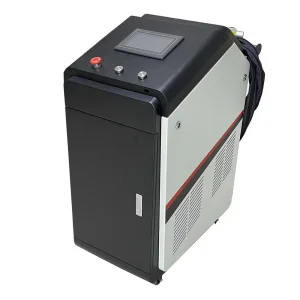
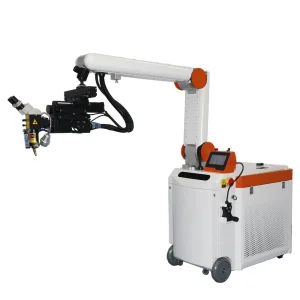
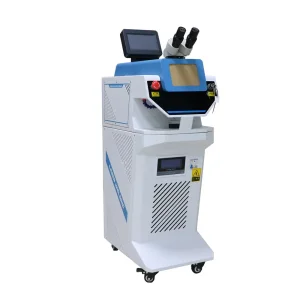
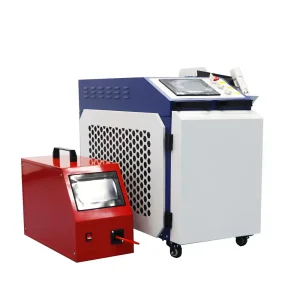
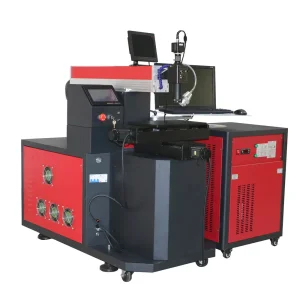
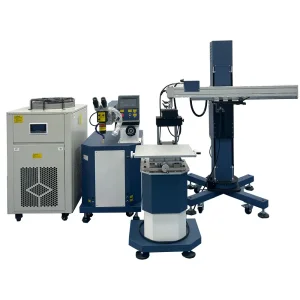
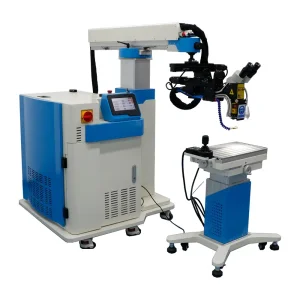
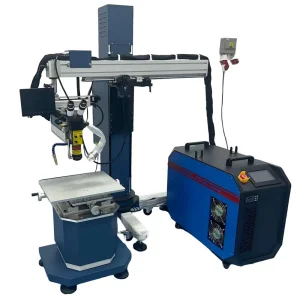
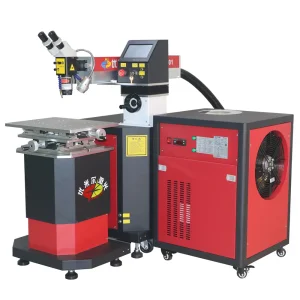
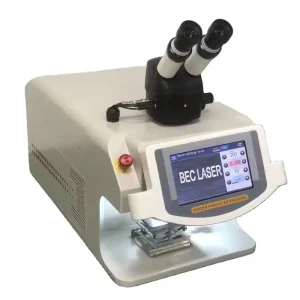
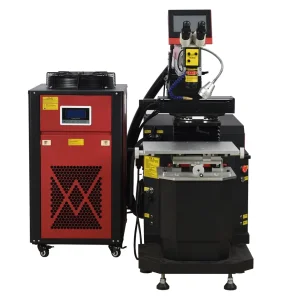
Explore our engineering line of pulse laser cleaners, precision galvanometer setups, cantilever mold welders, and dedicated goldsmith YAG workstations ready for turnkey atelier deployment.
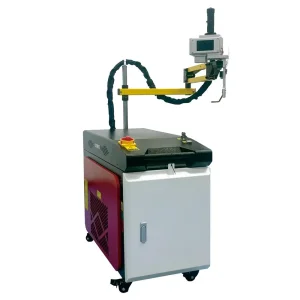
A rigorous examination of optical absorption coefficients, thermal dissipation gradients, and pulse-shape tuning required to join gold, platinum, and silver alloys without heat sink cracking or thermal gem damage.
In high-end jewelry manufacturing and repair, welding precious metals presents complex metallurgical challenges. Pure gold (24K) and sterling silver (Ag 925) display optical reflectivity exceeding 95% to 98% at room temperature when exposed to the standard 1064 nm infrared wavelength of industrial lasers. This intense optical reflectance, combined with gold's exceptionally high thermal conductivity (approximately 318 W/m·K), causes standard continuous-wave lasers to fail or cause catastrophic burn-through.
Shenzhen Youmir Laser Technology Co., Ltd. resolves this fundamental limitation by engineering dedicated pulsed Nd:YAG (Neodymium-doped Yttrium Aluminum Garnet) and Quasi-Continuous Wave (QCW) fiber laser architectures. By concentrating high energy into ultra-short microsecond pulses (0.1 to 20 ms), our machines produce an instantaneous peak power of up to 6.0 kW to 9.0 kW. This transient photon flux breaks down the surface reflectivity barrier instantly, initiating keyhole melting before conduction draws the heat into delicate adjacent gemstones, enamels, or intricate filigree settings.
Our control software allows goldsmiths to divide each individual laser shot into multi-stage waveforms: an initial spike to penetrate the reflective gold crust, followed by a sustained plateau for molten pool coalescence, and a ramp-down slope to prevent solidification shrinkage cracking in 18K white and rose gold alloys.
Equipped with 10X/15X Leica or specialized optical microscope heads integrated with high-speed liquid crystal optical shutters (response time <1 ms). This provides the jeweler with clear viewing, 0.1 mm to 3.0 mm continuously adjustable spot sizes, and eye protection without shutter lag or optical fatigue.
Oxidation on molten gold or silver leads to surface blackening, brittleness, and porosity. Youmir machines integrate coaxial laminar gas nozzles with pre-purge and post-purge timer logic, creating an inert, oxygen-free micro-environment that ensures mirror-finish, porosity-free welds that need minimal final polishing.
| Alloy Specification | Reflectivity (1064nm) | Thermal Conductivity | Optimal Peak Pulse Power | Recommended Pulse Shape | Oxidation Sensitivity |
|---|---|---|---|---|---|
| 24K Pure Gold (Au 999) | 98.4% (Extremely High) | 318 W/m·K | 4.5 kW – 6.5 kW | Sharp initial spike + Rapid quench | Very Low |
| 18K Rose Gold (Au-Cu-Ag) | 88.2% (Moderate) | 175 W/m·K | 3.2 kW – 4.8 kW | Pre-heat ramp + Slow down-slope | High (Copper Oxidation) |
| 18K White Gold (Au-Ni / Au-Pd) | 82.0% (Lower) | 140 W/m·K | 2.8 kW – 4.2 kW | Extended smooth plateau | Moderate Cracking Risk |
| Sterling Silver (Ag 925) | 97.8% (Extremely High) | 429 W/m·K | 5.0 kW – 7.5 kW | Maximum peak + Dual-pulse mode | Extreme Fire-Scale Risk |
| Platinum (Pt 950 / Pt 900) | 70.5% (Favorable) | 71.6 W/m·K | 2.0 kW – 3.5 kW | Low-peak, long pulse duration | Negligible Oxidation |
Combining the Pearl River Delta's optoelectronic industrial base with the Luohu jewelry fabrication cluster to deliver custom laser engineering at unmatched price-to-performance ratios.
For decades, Western luxury ateliers relied on European benchtop welders priced with substantial middleman markups and high maintenance contracts. Today, over 70% of the world’s precision jewelry laser systems are manufactured in Shenzhen, China. This transformation is driven by a deep, localized industrial supply chain that pairs cutting-edge optoelectronics with specialized manufacturing scale.
Shenzhen Youmir Laser does not merely assemble off-the-shelf parts. We design the laser resonant cavities, select precision Nd:YAG crystals, program proprietary digital DSP boards, and mill structural chassis in-house. This complete vertical integration eliminates distributor markups and guarantees rapid customization for specialized atelier requirements.
Operating adjacent to Shenzhen’s Shuibei jewelry market—the largest precious metal trade hub in Asia—our engineers test prototypes directly on real jewelry production floors. Every software iteration, foot-pedal response, and gas-shroud angle is validated by master jewelers working with 18K and 24K gold daily.
Whether an importer needs private-label sheet metal enclosures matching corporate aesthetics, proprietary PLC integration for robotic pick-and-place lines, or multilingual operating interfaces in 15+ languages, our engineering department converts functional requirements into production models within 14 business days.
Discover how localized spot thermal management replaces traditional gas torches, eliminates gemstone unsetting, and seals micro-defects in cast jewelry assemblies.
Traditional torch soldering transfers heat across the entire setting, threatening heat-sensitive stones like emeralds, opals, and tanzanites. Youmir's pinpoint 0.2 mm laser spot allows jewelers to build up worn prongs directly adjacent to gems safely, saving hours of delicate stone unmounting and resetting labor.
Investment casting in gold and silver frequently yields subsurface shrinkage micro-porosity and blowholes. Using fine matching filler wire (0.2 mm – 0.5 mm), the laser melts defect zones instantly, producing an unblemished, structurally sound grain matrix that polishes to an immaculate mirror finish.
Rope, Cuban, Figaro, and micro-mesh chains require thousands of minute, clean joints. Torch solder flows unpredictably and can stiffen neighboring links. Pulsed laser welding fuses link joints without solder paste, maintaining pristine joint flexibility and matching metal purities precisely.
Modern electroformed 3D/5D hollow gold jewelry features walls as thin as 0.10 mm to 0.18 mm. Conventional torch heat burns through these thin profiles instantly. Our low-heat, high-frequency micro-pulse technology joins and seals evacuation pinholes safely without structural distortion.
In high-end watchmaking, restoring deep dings and scratches on 18K gold, platinum, or grade 5 titanium cases requires exact material matching. Laser deposition allows watchmakers to fill dings using identical parent metal wires without compromising factory bevels or case water resistance.
Antique heirlooms and titanium spectacle frames frequently feature complex multi-alloy assemblies, delicate enamel work, or aged solder joints. Focused laser spot welding provides isolated localized heat, protecting fragile historic patinas and temperature-sensitive enamels.
A systematic procurement guide analyzing Total Cost of Ownership (TCO), laser source durability, international regulatory safety compliance, and OEM line automation.
Pulsed Nd:YAG remains the benchmark standard for custom jewelers due to its broad beam profile flexibility, natural energy absorption curve in yellow/rose gold, and low initial investment. Xenon flashlamps provide a typical lifespan of 3.0 to 5.0 million pulses and can be replaced in 15 minutes at minimal expense.
Quasi-Continuous Wave (QCW) Fiber Laser represents the newer high-throughput automated standard. With an electro-optical conversion efficiency exceeding 30%, maintenance-free diode lifespans over 100,000 hours, and a near-diffraction-limited beam quality ($M^2 < 1.2$), QCW setups provide continuous operation for 24/7 CNC chain-welding factories.
Switching an active jewelry atelier from oxy-gas torch stations to Youmir laser welding typically yields a full investment recovery within 3 to 6 months. Operational savings are achieved across four primary areas:
All Youmir export machines are engineered to CE, FDA CDRH Class 1 and Class 4 standards. Workchambers feature dual-channel interlock microswitches, high-density laser safety protective glass (OD6+ at 1064 nm), and integrated fume evacuation manifolds to clear airborne alloy micro-particles.
Our systems support universal international voltage setups, including single-phase 110V/60Hz for North American workshops, 220V/50Hz for Europe and the Middle East, and integrated high-efficiency water chillers rated for continuous operation in ambient temperatures up to 45°C.
Overseas procurement teams are invited to ship difficult jewelry alloy workpieces directly to our Shenzhen laboratories. Our engineers conduct microscopic welding trials, returning detailed metallurgical reports, microscopic seam imagery, and high-definition video documentation before order placement.
In-depth engineering answers addressing pulse shaping, reflective alloy processing, maintenance protocols, and international factory logistics.
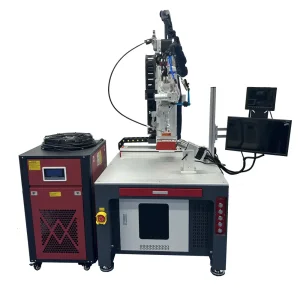
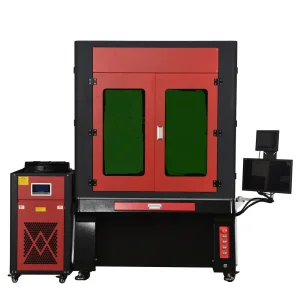
Complete your production setup with automated 3-axis CNC workstations, QCW mold restorers, integrated boom assemblies, and enclosed continuous fiber welding cells.
Accelerate your precious metal processing capabilities. Speak with our optical and metallurgical applications engineers to schedule material testing, custom chassis development, or factory-direct quotation analysis.