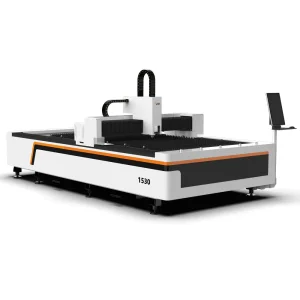
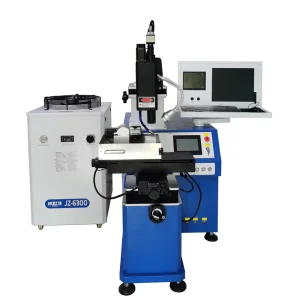
Direct manufacturer supply of galvanometer continuous welders, cantilever frames, and automated high-peak pulse units optimized for tooling maintenance.
Tooling downtime in high-cavitation injection molding and automotive stamping represents immense capital loss. Here is how modern precision laser deposition mitigates tooling wear.
Traditional TIG and micro-arc deposition induce steep thermal gradients, causing micro-cracking and heat-affected zone (HAZ) warping on tool steels like H13, P20, and S136. Mold laser welding limits heat input to micro-joules, preserving metallurgical substrate integrity.
Moving multi-ton stamping dies from press beds to repair centers requires cranes, trucks, and days of setup. Modern cantilever and mobile boom laser welders allow tooling technicians to perform localized edge reconstruction directly on the shop floor.
Spot sizes ranging down to 0.15 mm enable metallurgical bonding of fine matching wire (0.2 mm–0.8 mm) on precision parting lines and shut-offs, reducing post-process spark erosion (EDM) and high-speed CNC milling cycles by up to 75%.
Tested configurations by Youmir Laser's R&D department. The data below outlines typical operational thresholds to avoid micro-porosity and retain original core hardness.
| Base Die Material | Hardness Spec | Recommended Laser Source | Filler Wire Matrix | Deposition Strategy |
|---|---|---|---|---|
| AISI H13 / 1.2344 Hot Work Steel |
48–52 HRC | QCW Fiber / YAG Pulsed (300W–500W Peak) | Cr-Mo-V alloy wire (0.3–0.6 mm) | Preheating to 150°C optional; overlapping spot pulses at 70% to neutralize cooling micro-fissures on high-stress draw dies. |
| AISI P20 / 1.2311 Plastic Mold Steel |
28–32 HRC | Continuous Fiber Wobble / QCW | Low-alloy Ni-Cr wire (0.4–0.8 mm) | Zero preheating; fast linear weld path with dual-wobble optics to match baseline polishing and grain etching behavior. |
| AISI S136 / 1.2083 Corrosion Resistant |
50–54 HRC | High Peak Pulse Fiber (QCW) | High-Cr stainless matching wire | Argon shielding >99.999% to prevent chromium carbide precipitation; low-pulse repetition for optical mirror finish compatibility. |
| Beryllium Copper (BeCu) High Thermal Transfer |
36–42 HRC | Continuous Fiber / Green Wavelength Hybrid | Cu-Ni-Si or matching BeCu | Requires narrow beam waist with high initial energy ramp to overcome copper's high thermal dissipation and natural reflectivity. |
| NAK80 / Pre-hardened Mirror Finish Grade |
37–43 HRC | QCW Mold Repair Laser | Age-hardening Ni-Al wire | Fine 0.2 mm focal spot. Uniform laser overlap guarantees micro-structure consistency after subsequent hand lapping and optical polishing. |
Youmir Laser leverages the world-class electronics, optical integration, and precision machining ecosystem of Guangdong to deliver robust, industrial-grade equipment on tight delivery timelines.
Continuous technical innovation across fiber delivery, custom beam steering, and CNC motion software.
Equipped with interferometers, beam profilers, and stress chambers for continuous burn-in testing.
Machines working daily across Tier-1 automotive mold shops, electronic stamping rooms, and tool centers.
In-house development of control boards, optics path design, and proprietary laser tuning firmware.
Explore how mold repair laser welders resolve mission-critical wear in various manufacturing sub-sectors.
Restoring trimmed stamping edges, flange radii, and deep drawing dies subjected to cyclic gouging, preserving tool line dimensions without stress relief annealing.
Micro-cavity repairs on multifold syringe barrel and pipet tooling made of S136 stainless steel, eliminating the risk of pitting or fluid boundary drag.
Restoring 0.05 mm tolerances on ultra-thin terminal punching dies, carbide-backed inserts, and multi-pin connector lead frame tooling.
Filling thermal fatigue checking (heat checking) and erosion washes on structural aluminum casting blocks without degrading the underlying cooling lines.
How Youmir Laser integrates smart feedback sensors, AI vision, and multi-wavelength architectures into our next-generation product roadmap.
Real-time optical line scanners detect tool edge wear directly against initial STEP/IGES CAD geometry, automatically calculating deposition wire feed paths and focal offsets.
Embedded coaxial infrared pyrometers read pool temperature at 10 kHz, continuously throttling laser wattage to guarantee uniform microstructure and eliminate sink marks.
Combining 450 nm blue lasers with 1064 nm fiber sources enables spatter-free, near-100% absorption welding on pure copper, bronze, and conductive aluminum cooling inserts.
Boom-mounted arms, jewelry mini-welders, open processing beds, and multi-functional maintenance stations built for export to over 50 industrial regions.
Procuring capital equipment from overseas requires clear alignment on safety directives, electrical configurations, and lifecycle spare part availability.
Youmir Laser machines meet EN 60825-1 laser safety specifications, equipped with optical interlocks, dual safety contactors, and automated safety shutter doors for class-compliant operation across EU and North American plant floors.
Factory-built with options for single-phase 110V/220V or industrial three-phase 380V/480V lines. Built-in line filter chokes and isolated transformer packages insulate sensitive optics from electrical noise and voltage fluctuations.
We keep dedicated global inventory pools of protective focus windows, specialized coaxial nozzles, ceramic rings, and fiber conduits to ensure prompt delivery and eliminate operational line stops.
Detailed technical explanations to help procurement leads, tool room supervisors, and plant managers make informed equipment decisions.