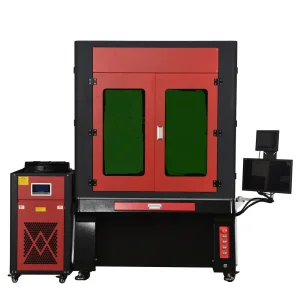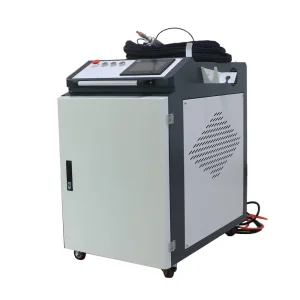
Explore our heavy-duty cantilever, boom-mounted, and precision manual systems engineered for edge restoration, gate rebuilds, and cavity revision.



Analyzing metallurgical bonding, minimal heat affected zone (HAZ), and structural integrity shifts across global high-tolerance injection molding and casting facilities.
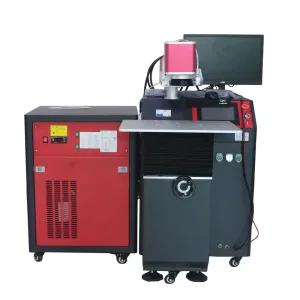
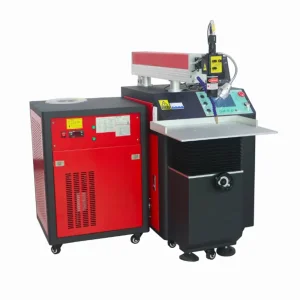
Traditional flash-lamp-pumped Nd:YAG laser mold welders (typically 200W–400W) long served as the cornerstone for micro-welding tool steels such as H13, P20, and NAK80. While possessing precise single-pulse energy, lamp decay requires maintenance cycles every 800-1200 operating hours with continuous crystal alignment.
Quasi-Continuous Wave (QCW) fiber lasers have revolutionized precision tool room welding by delivering multi-kilowatt peak pulse power alongside sub-millisecond durations. Delivering electric-optical conversion efficiency exceeding 30%, QCW eliminates periodic lamp swapping and produces localized energy spots down to 0.15mm.
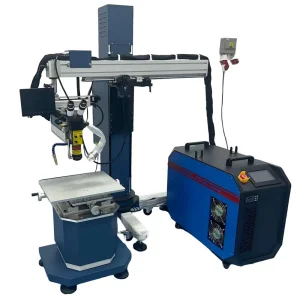
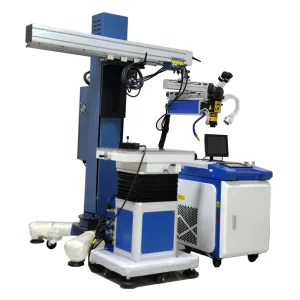
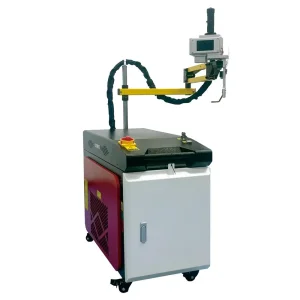
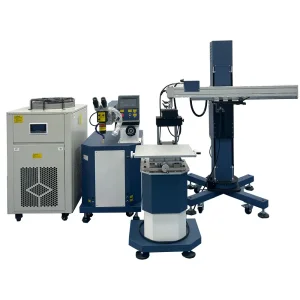
Modern progressive stamping dies and multi-ton automotive fascia molds cannot be disassembled easily. Cantilevered, high-articulation 360-degree boom arm architectures integrated with high-speed fiber feeds allow on-machine, in-press cavity repair, reducing assembly strip downtime from 72 hours down to 4 hours.
Comprehensive cost breakdown incorporating laser source topologies, optoelectronic positioning systems, automated wire feeders, and multi-axis manipulator assemblies.
| System Configuration | Laser Source & Optics | Working Envelope / Payload | Target Applications | Est. Factory Quote (USD) |
|---|---|---|---|---|
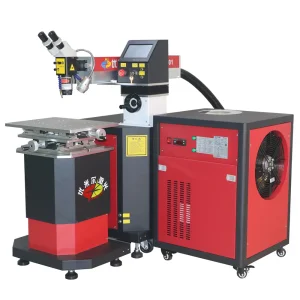
| Benchtop Precision Mold Welder | 200W - 300W Nd:YAG / Stereo Microscope with Crosshair Reticle | Manual X/Y/Z Precision Stage (Max 50kg) | Micro-connectors, medical injection tips, optical molds | $5,800 - $8,500 |
| Universal Cantilever Boom Mold Welder | 400W - 500W Pulsed YAG or 150W QCW Fiber / 1064nm | Motorized Telescopic Boom (1500mm Reach, Floor/Pallet Loading) | Automotive plastic tooling, blow molds, stamping dies | $9,500 - $14,800 |
| High-Power Continuous Fiber Welder (1.5kW-3kW) | 1500W - 3000W CW Fiber / Wobble Optic Head with Vision Alignment | Heavy-duty Arm / Integrated Mobile Track System | Large casting defect filling, structural die forging repairs | $11,200 - $18,900 |
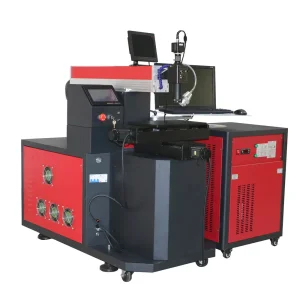
| Fully Enclosed 3/4-Axis CNC Laser Cladding/Welder | 1000W - 2000W QCW/CW / Multi-Axis Galvo Head + CNC Sync | Enclosed Class 1 Enclosure (X:600 Y:400 Z:400mm, 500kg table) | Automated aerospace turbine repair, complex geometry rebuilds | $22,000 - $38,500 |
How precise photon energy regulation resolves the fundamental engineering trade-offs inherent in micro-TIG, brazing, and submerged arc methods.
Traditional TIG repair introduces extensive thermal cycles that temper pre-hardened tool steels (e.g., 718, S136, SKD61) down to soft martensite, prompting sink marks during polish. Laser welding maintains localized pulse times under 15ms, confining heat to an area narrower than 0.3mm and preserving base hardness.
Our custom setups accommodate wire diameters from 0.2mm to 1.6mm across tool steel compositions: BeCu (Beryllium Copper), Ampco bronze, Stellite, Inconel 625, and maraging steels. Precision Argon shielding nozzles eliminate oxide inclusion and hydrogen-induced micro-cracking.
Because laser deposition creates fully dense, void-free fusion with minimal oxidation, welded repairs can be EDM machined, CNC milled, and textured (Mold-Tech/VDI) without visual parting line artifacts or porosity rejection during high-gloss SPI Class A1 polishing.
Integrated Leica/Motik high-definition stereo microscopes equipped with liquid crystal light valves (LCCVs) protect operator retinas while delivering 10x-40x magnification with ring LED illumination and crosshair guidance for sub-millimeter tooling ribs.
Built under stringent global conformity guidelines to ensure seamless plug-and-play field commission across global fabrication plants.
Our equipment strictly adheres to IEC 60825-1 international laser safety norms, featuring double-loop safety interlocking, emergency stop circuits, shielded optical paths, laser emission warning lights, and automated dual-circuit chiller interlocks.
Custom power supply modules configured for North America (208V/220V/240V Single & 3-Phase 60Hz), Europe/UK/Australia (230V/400V 50Hz), and industrial plant grids with integrated step-up/down isolation transformers and surge protection.
Direct factory stocking of critical field optics: protective cover glasses, focusing lenses, xenon flash lamps, flow tubes, and gas nozzles with guaranteed 48-hour global air dispatch alongside 24/7 direct remote video engineering assistance.
Strategic advancements shaping the next five years of automated mold lifecycle extension and robotic hybrid restoration.
Emerging automated setups integrate blue-light laser 3D profile scanners into the deposition head. The system automatically digitizes damaged parting lines, compares point clouds against golden CAD files, computes volumetric material deficits, and auto-generates multi-layer laser cladding toolpaths without operator manual intervention.
Progressing beyond manual wire feeding, high-efficiency coaxial powder nozzles are entering large-format mold maintenance stations. This transition empowers tooling shops to deposit functionally graded materials (e.g., tough nickel-base substrate with high-hardness tungsten carbide skin) in a single unified operation.
Programmable high-frequency galvanometer mirrors inside the welding head oscillate the laser focus at up to 1500 Hz. Adjusting beam shapes (circular, infinity, triangular) dynamically expands weld seams, eliminates micro-voids, and reduces porosity when bonding difficult high-carbon dies.
In-depth responses covering process parameters, payback calculations, and operational considerations.
Laser welding delivers a heat-affected zone (HAZ) roughly 90% smaller than micro-TIG. While micro-TIG induces thermal distortion, base metal softening, and subsequent sink marks, laser welding introduces minimal heat, completely eliminating the need for post-weld stress relieving or re-hardening.
For mid-sized plastic injection molding shops outsourcing 4-6 mold repairs a month, an in-house laser mold welder (typically costing $8,000–$14,000) achieves full payback in 3 to 6 months by eliminating third-party contractor markups and cutting multi-day downtime down to mere hours.
Yes. By utilizing matching wire alloys (such as S136 or NAK80) and precision pulsed energy under pure argon shielding, the repaired area matches base metal density and hardness, allowing for seamless EDM machining, texturing, and diamond mirror polish matching SPI A1 standards.
High-purity industrial Argon (99.999%) is strictly recommended. Maintaining a regulated gas flow of 8-12 L/min through a dedicated micro-nozzle completely envelops the melt pool, preventing nitrogen pickup and oxide slag formation inside delicate weld beads.
Industrial solutions featuring automated wire feeders, CNC galvo tracking, multi-kilowatt fiber sources, and enclosed manufacturing safety enclosures.