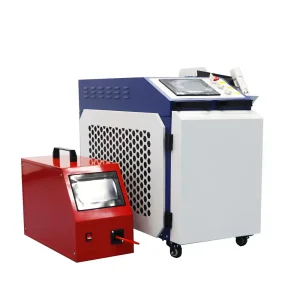
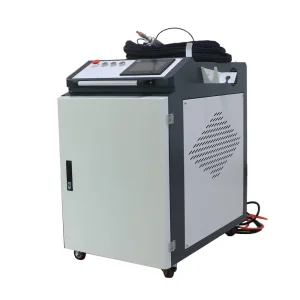
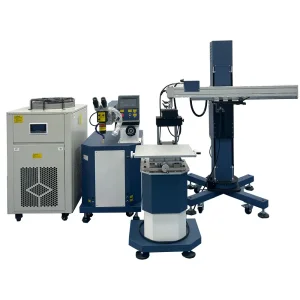
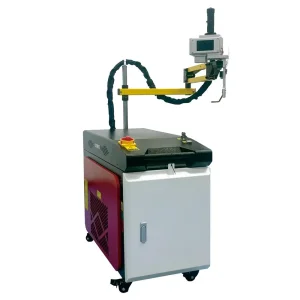
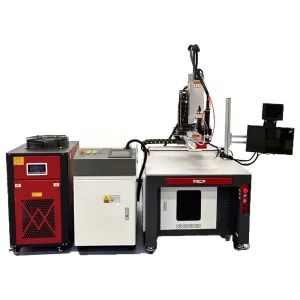
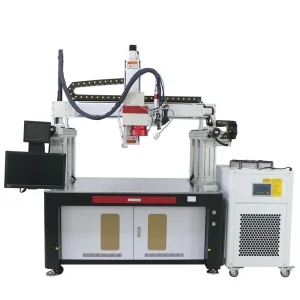
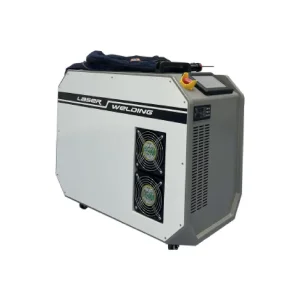
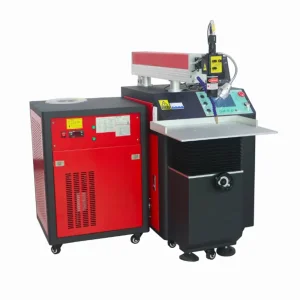
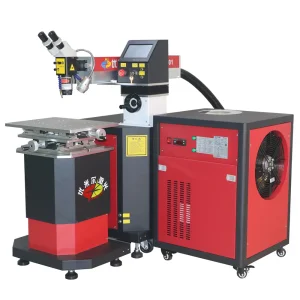
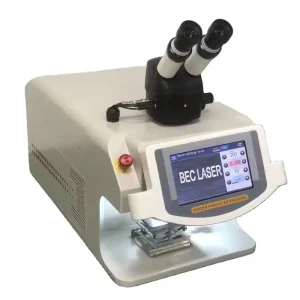
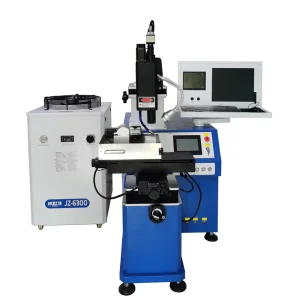
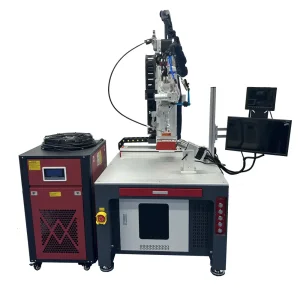
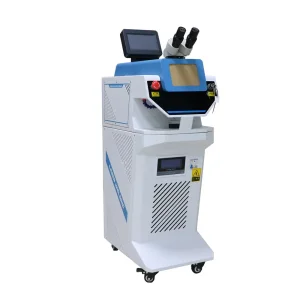
Engineered by Shenzhen Youmir Laser Technology Co., Ltd. for rapid tooling maintenance, micro-deposition, seam precision, and automated high-throughput manufacturing.
Why modern high-precision tool steel reconstruction is phasing out flashlamp-pumped Nd:YAG resonators in favor of high-peak-power, low-heat-input QCW fiber laser architecture.
Unlike standard continuous wave (CW) lasers which continuously heat the substrate, a QCW fiber source outputs massive peak power (e.g., 1500W to 6000W peak from a 150W to 600W average power source). This instantaneous energy vaporizes surface oxides and achieves keyhole or conduction-mode fusion within microseconds, preventing bulk substrate soaking.
Peak: 1.5kW – 6.0kW Pulse: 0.2ms – 50msTool steels such as DIN 1.2344 (H13), 1.2311 (P20), and 1.2083 (S136) are exceptionally prone to martensitic thermal cracking, micro-fissures, and temper softening. QCW pulses limit thermal diffusion to less than 0.05 mm from the fusion line, eliminating internal thermal stresses and mold geometry warping without tedious furnace preheating.
HAZ < 0.05 mm No Temper SofteningTraditional solid-state YAG mold welders rely on xenon flashlamps that degrade every 500 to 1,000 hours, causing power dropouts, irregular spot diameters, and expensive downtime. Youmir QCW fiber sources use high-reliability telecom-grade pump diodes boasting 30%+ wall-plug electrical efficiency and zero routine optical alignment.
Wall-Plug Eff: >30% Maintenance-FreeWhen repairing parting lines, sharp ribs, or EDM mirror-polished cavities on automotive mold dies, QCW laser deposit wire matching the base alloy (e.g., SKD61, NAK80, Beryllium-Copper) maintains equivalent hardness (48–56 HRC) without sink marks, undercut porosity, or subsequent EDM spark discoloration.
Transparent OEM/ODM pricing benchmarks based on optical resonator wattage, kinematic boom articulation, automation payload, and machine vision targeting integration.
| Model Category / Tier | Avg / Peak Power | Kinematic Axis & Reach | Vision & Targeting | Typical Factory FOB Price Range | Target Applications |
|---|---|---|---|---|---|
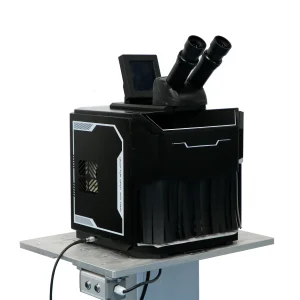
| Benchtop Precision QCW-150 | 150W Avg / 1500W Peak | Manual 3-Axis Worktable (200x200mm) | 10x Leica/Olympus Optical Microscope + Crosshair | $9,800 – $14,200 USD | Jewelry, medical microsurgical instruments, micro-mold inserts, precision sensor cladding |
| Cantilever Toolroom QCW-300 | 300W Avg / 3000W Peak | 360° Manual Articulated Cantilever Boom (R: 1200mm) | HD Color CCD Screen + Laser Red-Pointer Alignment | $14,500 – $19,800 USD | Small-to-medium plastic injection molds (up to 2 tons), stamping die edge build-up, toolroom repair |
| Industrial Heavy Boom QCW-450 | 450W Avg / 4500W Peak | Motorized 4-Axis Boom (X/Y/Z/R, Reach: 1800mm) | Coaxial CCD Industrial Monitor with Digital Cross-Graticule | $21,000 – $28,500 USD | Automotive bumper & dashboard molds, die-casting dies (up to 15 tons), large extrusion heads |
| Robotic/Open-Gantry QCW-600 | 600W Avg / 6000W Peak | CNC 5-Axis Simultaneous or 6-Axis Industrial Robot Arm | AI Coaxial Vision Edge Tracking + Auto Seam Finder | $32,000 – $48,000 USD | Automated aerospace turbine repair, heavy forging die cladding, continuous mass-production mold cells |
The primary cost variance stems from the fiber laser engine brand (IPG Photonics vs. Maxphotonics/Raycus custom-tuned QCW units), motorized vs manual heavy-counterbalanced boom kinematics, and Japanese THK ball-screw/linear rail integration.
Configurations featuring motorized zoom beam expanders, German-made galvanometer scanheads, and high-resolution coaxial camera systems with automated weld wire feeder modules add $1,800 to $4,500 to base configurations.
Compared to legacy YAG welders requiring $1,200/year in flashlamps, deionizing filters, and quarterly optics alignment, Youmir QCW systems save an estimated $4,200 annually in consumables and reduce electricity consumption by up to 68%.
Operating from the global epicentre of laser optoelectronics in Shenzhen with multi-facility scale in Zhongshan and Hunan to ensure unmatched delivery velocity, modular customization, and strict ISO9001 quality audits.
Since 2010, Youmir Laser has developed proprietary optical delivery paths, motorized anti-splatter nozzle cones, and custom PLC software. By maintaining control over source-to-head fiber integration, we eliminate supplier markups and pass 25–40% price savings directly to global brand partners.
Every mold welding machine undergoes a rigorous 48-hour continuous pulse test across fluctuating thermal ambients (10°C to 45°C), optical energy stabilization analysis via Ophir power meters, and high-voltage dielectric safety screening prior to seaworthy export crating.
Our Guangming District, Shenzhen headquarters is located within a 30-minute radius of tier-1 optoelectronic, precision CNC milling, and sheet metal fabrication clusters. This geographic density compresses rapid prototyping cycles and guarantees spare parts dispatches within 24 hours.
From micro-cavity flashing in medical molding to heavy thermal fatigue cracking in aluminum die-casting, custom QCW mold laser welders drastically compress mold overhaul turnaround times from days to mere hours.
Automotive Class-A exterior panels (bumpers, grilles, light guides) cannot tolerate micro-porosity or sink marks. Our 360° boom systems maneuver directly into injection molding machines without removing heavy 20-ton mold bases from the press platens.
P20 / 718H / NAK80Aluminum and magnesium casting tools endure brutal thermal cycling causing heat checks and gate erosion. QCW deposition using premium Maraging or Stellite wire restores runner surfaces without causing parent metal thermal shock.
H13 / 1.2343 / DievarHigh-speed carbide or D2 shearing edges experience chipping and burr creation over millions of strokes. Micro-spot QCW deposition enables pinpoint weld bead build-up within 0.1mm tolerance, minimizing subsequent grinding steps.
D2 / SKD11 / High-Speed SteelPrecision multi-cavity liquid silicone rubber (LSR) and optical lens molds require sub-millimeter repair without spatter or carbon contamination. QCW shielding gas delivery guarantees zero-oxidation, mirror-compatible surfaces.
S136 / 420 StainlessInternational factory safety standards, electrical harmonization, and a systematic framework for evaluating factory proposals before signing supply contracts.
All Youmir laser systems ship with full international compliance documentation: CE Machinery Directive 2006/42/EC, Low Voltage Directive 2014/35/EU, Laser Radiation Safety EN 60825-1 (Class 4 / Class 1 enclosures), and US FDA / CDRH accession filings for seamless customs clearance.
Engineered for global factories: multi-tap internal transformers accommodate 208V/220V/240V/380V/415V (50/60Hz) grids. Pneumatic manifolds are equipped with standard ISO quick-connects supporting Argon, Nitrogen, or compressed dry air purge.
We provide remote telemetry diagnostics, real-time video guidance for complex metallurgical recipes, overseas distributor inventory hubs in Southeast Asia, Europe, and the Americas, and on-site factory commissioning on demand.
Before choosing a QCW laser mold welding supplier, factory technical procurement managers must verify the following five parameters:
Where mold laser repair engineering is heading over the next five years: AI-driven autonomous tool reconstruction, blue-diode hybrid welding, and smart additive metallurgical deposition.
By pairing 3D structured-light optical scanners directly with 6-axis robot arms, upcoming Youmir systems will automatically digitize damaged mold corners, calculate the volumetric defect cloud, generate multi-pass deposition toolpaths, and weld without human manual wire feeding.
For highly reflective copper alloys (MoldMAX, Ampcoloy, Beryllium-Copper cores), hybrid blue laser (450nm) + infrared QCW (1070nm) combining heads overcome initial reflectivity barriers, cutting energy consumption by 40% while eliminating weld spatter.
Closed-loop coaxial pyrometers measuring melt-pool temperature at 10kHz intervals automatically throttle QCW pulse energy dynamically, preventing local overheating on razor-thin cooling channel ribs and shut-off lands.
Everything factory owners, mold engineers, and procurement directors need to know about custom QCW mold laser repair machinery.
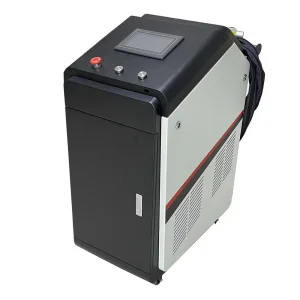
Broaden your facility capabilities with specialized jewelry micro-welders, 3-axis CNC workstations, multi-kilowatt continuous fiber machines, and portable tooling repair units.
Send your mold alloy specifications, repair drawings, or damaged workpiece samples directly to our Shenzhen R&D application laboratory for a complimentary metallurgical process test and video trial report.