Explore our top-tier precision laser systems manufactured in-house with micro-focal optics and robust CNC interfaces.



Strategic market analysis of micro-joining, fiber consolidation, and real-time process monitoring.
The transition from bulky water chiller cabinets to compact air-cooled fiber systems has reduced physical footprints by over 45%. This enables small laser welding machines to integrate effortlessly into cleanrooms, modular cell benches, and flexible assembly stations without bulky auxiliary utilities.
Small QCW and pulsed fiber lasers are replacing traditional TIG and resistance welding in heat-sensitive electronics. With peak pulse powers reaching several kilowatts at tiny pulse durations, heat-affected zones (HAZ) are localized down to mere microns, preserving the mechanical properties of thin alloys.
Integration of high-speed galvo scanning heads with coaxial vision and AI depth tracking algorithms allows real-time seam tracking and automated power correction. Manufacturers achieve zero-defect repeatability across reflective non-ferrous joints such as copper-to-aluminum transitions.
Technical Assessment: Modern micro-joining requirements no longer accept bulk thermal deformation. The contemporary small laser welding machine is characterized by high beam quality (M² < 1.2), single-mode stability, and high pulse frequency up to 50 kHz, establishing a new baseline for high-mix low-volume precision manufacturing.
How tier-1 manufacturers in North America, the EU, and East Asia specify micro-laser welding hardware.
Strict biocompatibility mandates clean, hermetic welds on stainless steel 316LVM, titanium grade 5, and Nitinol without toxic fluxes or oxide scale. Small footprint units guarantee Class 10,000 cleanroom compliance.
Procurement teams prioritize low-stress joins across pressure sensors, diaphragm capsules, and thermocouples. Invar and Kovar encapsulation demand minimal heat conduction to sensitive sensor ICs.
Demands are shifting toward micro-wobble spot systems capable of joining foil-thin nickel tabs to cylindrical battery casings (18650/21700/4680) at high cycle rates with minimal internal spatter.
Workshops require benchtop ergonomic stations featuring high-magnification stereomicroscopes, argon shield gas micro-nozzles, and flexible motorized multi-axis staging for intricate tool repairs.
| Technology Metric | Traditional Micro-TIG | Small Nd:YAG Laser | Fiber / QCW Small Laser |
|---|---|---|---|
| Heat-Affected Zone (HAZ) | Wide (> 1.5 mm); high warp risk | Medium (0.4 – 0.8 mm) | Ultra-Narrow (< 0.15 mm) |
| Minimum Joint Thickness | 0.5 mm | 0.15 mm | 0.03 mm (ultra-thin foils) |
| Wall-Plug Electrical Efficiency | < 15% | < 3% (Flashlamp pumped) | 30% – 40% (Fiber diode pumped) |
| Maintenance Interval | Electrode dressing every shift | Flashlamp & deionizer service ~1,000 hrs | Maintenance-free source (> 100,000 hrs) |
| Automation Readiness | Low (Electrode wear drift) | Moderate (Bulky optics) | High (Digital fieldbus / 24V I/O ready) |
Shenzhen Youmir Laser Technology Co., Ltd. leverages a clustered supply ecosystem to ensure engineering agility and competitive cost dynamics.
Unlike assemblers reliant on third-party integration, Youmir engineers machine frames, optical delivery systems, galvo boards, and firmware logic in-house. This lowers bill-of-materials costs while ensuring rapid OEM/ODM design cycles within 10 business days.
Laser source modules undergo 72-hour burn-in stress tests. Beam collimators, protective quartz windows, and galvanometric mirror coatings are vetted through optical interferometry to guarantee zero focal shift under continuous multi-shift production.
Operating from Guangming District, Shenzhen, our facility connects directly with precision CNC machine shops, electronic component houses, and optical lens fabricators within a 30-minute radius, insulating global buyers from geopolitical supply chain chokepoints.
Proven engineering implementations spanning global precision tooling, electronics, and micro-fabrication sectors.
Challenge: Parting-line wear and chipping on P20 and NAK80 core pins caused injection flash and production halts.
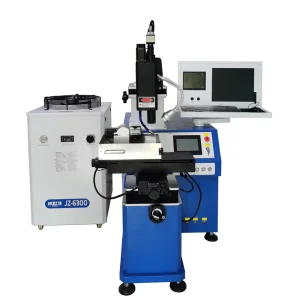
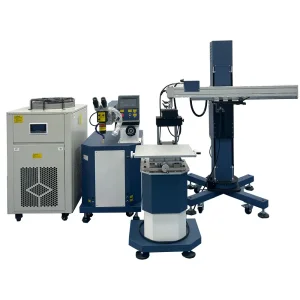
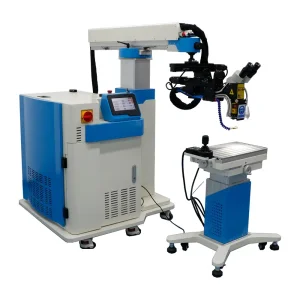
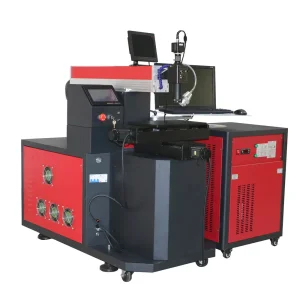
Solution: Implementation of the Integrated Boom Mold Welding Machine with wire feeder and microscope. Micro-deposition of matching HRC50 wire restored critical edges without thermal annealing or base metal sinkage.
Challenge: Sealing stainless steel watch cases and wireless audio transducers without thermal damage to internal lithium-polymer batteries.
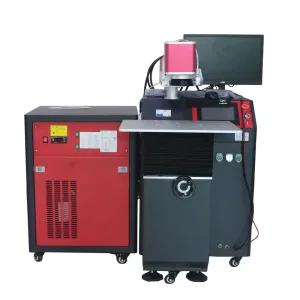
Solution: High-speed Galvanometer Continuous Laser Welder delivering 1070 nm fiber energy at 250 mm/s. Achieved hermetic IP68 seals with surface temperatures below 55°C at 1.2 mm distance from the seam.
Challenge: Securing fragile claws around heat-sensitive emeralds, opals, and pearls without unsetting the stones.
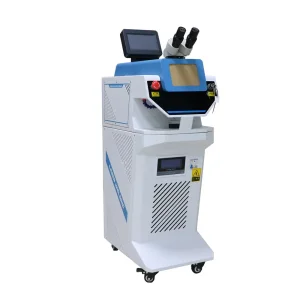
Solution: Desktop 60W Jewelry Laser Welder with crosshair stereomicroscope and pulse shaping. Operators localized 0.2 mm spot pulses adjacent to gem facets with zero stone discoloration or micro-cracking.
In-depth technical answers addressing setup, maintenance, optical safety, and cross-border delivery.
We design, engineer, and manufacture handheld and CNC automatic fiber laser welding machines, YAG laser welders, pulsed and continuous laser cleaning systems, sheet metal fiber laser cutting tables, cantilever/boom mold repair welders, benchtop jewelry laser welders, and precision optomechanical components.
Yes. You can air-freight workpieces directly to our Shenzhen application lab. Our laser process specialists conduct metallurgical trials, record high-speed video footage, perform tensile or cross-sectional microscopy tests, and deliver a formal parameter window (power, pulse width, wobble frequency, shield gas flow) with the returned samples.
For fine electronics, jewelry, and thin foils (≤ 0.5 mm), a 60W – 200W QCW or desktop pulsed laser is ideal. For mixed industrial fabrication, a 1000W continuous source welds stainless up to 3 mm, 1500W handles up to 4 mm, and 2000W – 3000W configurations are recommended for thick structural steel, copper busbars, and aluminum alloys.
Pulsed laser cleaners emit nanosecond-scale high-peak bursts that ablate oxides, carbon residues, and thin coatings via thermal shock without transferring heat into the base substrate—vital for injection molds and aerospace components. Continuous laser cleaners deliver sustained thermal output suited for rust and mill scale removal on structural steel plates.
Yes. We offer complete private labeling including custom industrial sheet metal enclosures, powder-coat color schemes, personalized software HMI interfaces (with localized language packs), branded user documentation, and customized PLCs optimized for automated cell communication.
We maintain 24/7 video-guided diagnostics led by bilingual photonics engineers. In addition to software and parameter updates, we work with authorized overseas service hubs to dispatch replacement optical consumables, fiber patch cords, and on-site training technicians worldwide.
Explore our specialized cutting, mold refurbishment, and multi-axis automated manufacturing machines.