Explore our heavy-duty industrial series featuring continuous-wave fiber sources, intelligent wobble-optics, and micro-precision joining mechanisms engineered for high-duty-cycle factory environments.
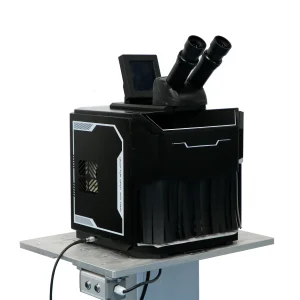
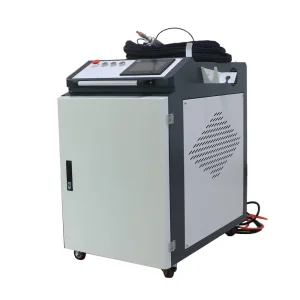

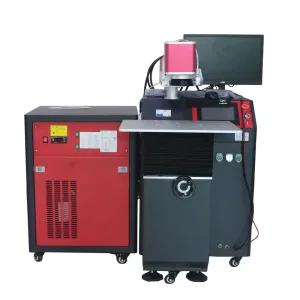
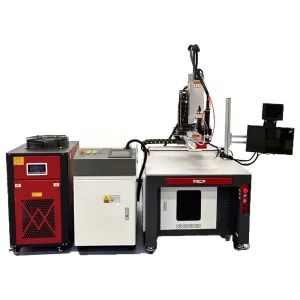

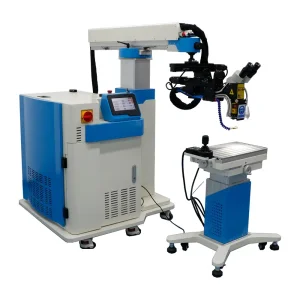

Why the 1kW continuous wave (CW) fiber laser represents the optimal capital-to-efficiency ratio for thin-to-medium gauge precision metal fabrication.
A 1000 Watt fiber laser delivered through a 50-micron delivery fiber concentrates energy to power densities exceeding 106 W/cm2. This triggers localized metal vaporization, creating an instantaneous keyhole cavity that enables full penetration in 3mm stainless steel with minimal thermal diffusion.
Traditional fixed-beam laser welding required near-zero joint gaps (<0.1mm). Our proprietary dual-axis oscillatory beam manipulation oscillates the beam at frequencies up to 300 Hz in circular, line, and figure-eight patterns, bridging fabrication gaps up to 1.5mm without sacrificing metallurgical bonding.
Operating at travel velocities of 20 to 80 mm/s, the 1000W system reduces heat accumulation by 82% compared to conventional GTAW (TIG). The rapid thermal cycle limits carbide precipitation in austenitic stainless steels (304/316L), preventing intergranular corrosion without post-weld pickling.
Field-proven deployments where migrating to a 1000 Watt fiber laser system produces rapid return on investment (ROI) within 3 to 6 months.
Commercial sink assemblies, food-processing tables, and aesthetic architectural balustrades require pristine, spatter-free joints. The 1000W laser creates smooth, convex beads on 0.8mm to 2.5mm stainless steel, eliminating hours of secondary grinding and chemical passivating.
Galvanized steel duct systems and NEMA/IP electrical control enclosures demand hermetic seam sealing without vaporizing zinc layers extensively. Dual-wobble beam optics permit precise control over energy density, producing continuous air-tight and dust-tight joints without warping the sheet frame.
From thin aluminum battery box heat exchangers (1.2mm) to exhaust system manifold repairs and door panel stiffeners, the 1000W system produces strong joints across dissimilar metals (such as copper-to-aluminum tabs or galvanized-to-mild steel brackets) with minimal fixture clamping pressure.
Advertising word fabrication involves micro-welding folded metal faces (0.6mm-1.2mm) to precision returns. Traditional soldering or TIG leads to burn-through and heat warping. Our 1000W channel letter configuration yields fast spot-tack and seam execution without surface discoloration.
Injection tooling, stamping dies, and aluminum die-cast cavities suffer abrasive wear and localized cracking. Instead of discarding costly tool steel blocks, our integrated boom and handheld systems deposit P20, H13, and NAK80 filler wires with zero micro-cracking and negligible residual stress.
Salt-spray exposed hardware manufactured from marine-grade 316L and duplex stainless steels demands absolute grain boundary integrity. The focused 1000W thermal beam maintains protective chromium oxide passive layers without triggering localized sensitization or pit corrosion.
Quantitative empirical performance metrics comparing 1000W handheld fiber laser systems with legacy GTAW (TIG) and GMAW (MIG) joining methodologies on 2.0mm 304 Stainless Steel.
| Evaluation Parameter | 1000W Handheld Fiber Laser | GTAW / TIG (Tungsten Inert Gas) | GMAW / MIG (Metal Inert Gas) |
|---|---|---|---|
| Linear Welding Velocity | 25 - 50 mm/s (Rapid) | 4 - 8 mm/s (Operator limited) | 10 - 15 mm/s (Moderate) |
| Heat-Affected Zone (HAZ) | < 0.25 mm (Minimal) | 2.5 - 5.0 mm (Extensive) | 3.0 - 6.5 mm (Very Wide) |
| Post-Weld Grinding & Rework | 0 - 5% (Near Zero) | 60 - 80% (Labor Intensive) | 70 - 90% (Spatter Removal) |
| Operator Training Curve | 2 to 4 Hours | 6 to 24 Months | 2 to 6 Months |
| Shielding Gas Consumption | 12 - 15 L/min (Argon/N2) | 15 - 20 L/min (Pure Argon) | 18 - 25 L/min (Mixed Gas) |
| Thermal Distortion / Warping | Negligible (No Clamping) | High (Requires Fixturing) | Moderate to High |
| Electrical Wall-Plug Efficiency | 35% - 40% | 10% - 15% | 15% - 22% |
How Shenzhen Youmir Laser Technology Co., Ltd. capitalizes on the world's most dense optoelectronics ecosystem to deliver institutional-grade laser systems at unmatched cost-efficiencies.
Situated in the Guangming District of Shenzhen, Youmir Laser operates within a 20-kilometer radius of tier-1 fiber laser resonant cavity manufacturers, high-power fiber optic combiners, and precision CNC chassis fabricators. This geographical concentration compresses prototype-to-production cycles down to mere days.
Unlike assembly-only vendors, our engineering team has developed optical collimating systems, galvanometer scanning software, and dynamic motor controls in-house since 2010. This direct code and hardware ownership allows rapid customization of wire-feed ramping parameters and oscillation frequencies for specialized alloy batches.
Every single 1000W laser power source and handheld optical head undergoes continuous 72-hour thermal stress testing at 40°C ambient temperatures. Interferometric beam profiling and power attenuation checks ensure that output drift remains under 1.5% across tens of thousands of continuous operational hours.
Key technological inflections redefining portable laser processing systems over the next half-decade.
Transitioning from dual-circuit water chillers to direct-expansion micro-channel phase-change cooling. This slashes system weight by 45%, enabling truly mobile, shoulder-portable 1kW systems for field construction sites.
Coaxial CMOS sensors and embedded neural-network microcontrollers calculate real-time gap variances, dynamically adjusting laser power, oscillation width, and wire feed speed at 1,000 samples per second.
Combining 1070nm near-infrared fiber lasers with 450nm blue diode arrays to eliminate back-reflection spikes when welding mirror-finish copper and aerospace 6000-series aluminum alloys.
Adoption of aerospace-grade magnesium-titanium alloys and molded aspheric optics reduces torch weight down to 480 grams, mitigating repetitive strain injuries during extended eight-hour manufacturing shifts.
Operating a Class 4 high-energy laser requires rigorous engineering safeguards to protect personnel and guarantee regulatory clearance across North America, Europe, and Asia-Pacific markets.
Our torches integrate conductive ground loop continuity verification. The laser source will not fire unless the copper contact nozzle establishes direct electrical contact with the earthed workpiece. Instantaneous shutter cutoff occurs if contact is broken for even 5 milliseconds.
Youmir Laser machines comply strictly with European Machinery Directive 2006/42/EC and EN 60825-1 laser safety standards. Each system is furnished with key-lock switches, emergency e-stop circuitry, emission indicator lights, and FDA Accession documentation for seamless import clearance.
Supported by service hubs and certified distribution channels in North America, Europe, Southeast Asia, and the Middle East. Consumable packs (protective windows, focus lenses, collimators, brass wire nozzles) dispatch within 24 hours, complemented by 24/7 direct video triage from factory engineers.
In-depth answers addressing procurement parameters, metallurgy, process optimization, and operational longevity.
For single-pass continuous butt-joints without bevel preparation, a 1000W system achieves full penetration on stainless steel up to 3.0mm, carbon steel up to 2.5mm, and aluminum alloys up to 1.5mm. Using edge bevels or dual-side welding allows joining up to 5mm stainless steel with structural integrity.
The 1000W configuration is the prime choice for fabrication facilities working predominantly on thin sheet metal (0.5mm to 2.5mm), such as kitchen cabinets, lighting enclosures, and signage. It draws significantly less electrical power, generates less thermal distortion on ultra-thin sheet, and offers lower initial procurement costs.
Industrial pure Argon (99.99%) is recommended for titanium, aluminum, and aesthetic stainless steel where bright weld seams are desired. Pure Nitrogen (99.99%) is widely used on standard stainless steels to improve tensile strength and reduce gas operational expenses by up to 60%.
Our dual-drive servo wire feeder synchronizes directly with the handheld laser gun trigger. When the operator engages the laser, the feeder pushes wire (0.8mm, 1.0mm, or 1.2mm) with programmable delay, pulse feed, and retraction parameters to prevent wire stubbing and guarantee clean crater fill.
The protective cover slide is the primary consumable, lasting between 40 to 120 operational hours depending on spatter cleanline and shielding gas purity. Collimating and focusing lenses last thousands of hours if the protective window is replaced before particulate burn-through occurs.
Yes. We support custom sheet metal chassis colors, CNC screen interface branding, multi-language software localization (English, Spanish, German, French, Russian, etc.), and native electrical transformer adaptations (110V single phase, 220V single/three phase, 380V/480V 3-phase).
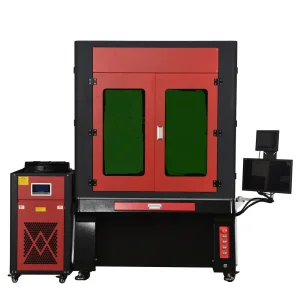
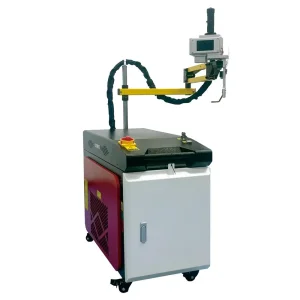
Review our specialized tooling series including boom-mounted mold welders, QCW high-peak-power devices, automated CNC gantries, and industrial 1530 sheet metal cutters.
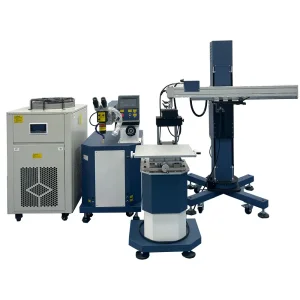

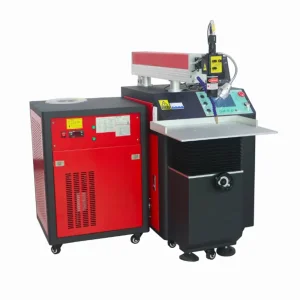
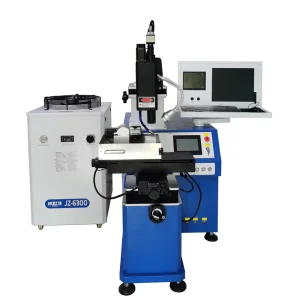


Send your CAD files or raw alloy test coupons to our Shenzhen facility for metallurgical cross-section analysis and custom process parameter development.
5th Floor, Building 4, No. 5 Tianyuan Road, Matan Street, Guangming District, Shenzhen, Guangdong Province, China.
Phone / WhatsApp: +86-137-8778-7637
Email: [email protected] / [email protected]
1. Part feasibility assessment
2. Weld penetration video recording
3. Parameter report & microscopic cross-section delivery.
