Direct manufacturer pricing, modular OEM integration, and field-tested optical configurations.
A deep engineering perspective into transient phase transformation, thermoelastic stress wave dissipation, and selective optical absorption.
The 2000-watt continuous-wave and high-frequency modulated laser delivers a concentrated photon beam that generates extreme thermoelastic pressure inside non-metallic contaminant layers. The differential thermal expansion coefficient creates instantaneous mechanical spallation, ejecting oxides, scale, and coatings without reaching the melting boundary of the parent substrate.
By modulating the laser pulse width and beam wobble frequency (up to 300 Hz across a 300 mm line scan), our optical control head minimizes the Heat-Affected Zone (HAZ). This prevents substrate warping in ultra-thin sheet metals (1.0 mm to 3.0 mm) and preserves the microstructural phase integrity of high-tensile alloys.
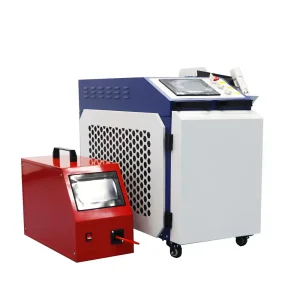
Weighing under 0.95 kg, the patented handheld scanning assembly features dual-protective quartz optics, coaxial air knife purging, and high-speed galvanometer mirrors capable of executing dynamic spiral, circular, linear, and cross-hatch raster profiles for uniform energy deposition.
Quantitative benchmarks: environmental footprint, operational expense (OpEx), and structural integrity.
| Performance Metrics | 2000W Fiber Laser Cleaning | Abrasive Media Sandblasting | Chemical Acid Pickling | Dry Ice CO2 Blasting |
|---|---|---|---|---|
| Operating Speed | 15 - 35 m²/h (Layer Dependent) | 10 - 20 m²/h | Batch Immersion (Slow) | 5 - 12 m²/h |
| Substrate Erosion | 0.00 μm (Non-contact optical reflection) | Severe surface pitting & fatigue stress | Micro-corrosion & hydrogen embrittlement | None to minimal |
| Consumable Costs | Electricity & Protective Optics (~$0.80/h) | Grit media, blast nozzles ($18-$35/h) | Acid neutralizing agents & hazardous disposal | Pelletized solid CO2 ($25-$50/h) |
| Environmental Safety | Zero effluent; localized HEPA extraction | Airborne silicosis risk & massive solid waste | Toxic emissions; hazardous waste discharge | High acoustic noise; asphyxiation risk |
| Operator Training | 1-2 Days (Integrated safety lockouts) | Heavy protective suits; certified training | Hazardous materials certification | Thermal insulation equipment required |
Optimized for mission-critical surface conditioning across key global manufacturing epicenters.
Delicate depainting of composite and aluminum airframes without disrupting base anodization layers. The 2000W modulated beam allows selective topcoat removal, ensuring primer layers remain fully intact while satisfying rigorous FAA and EASA non-destructive testing (NDT) mandates.
Corrosion remediation on container vessel ballasts, dry docks, and offshore oil platforms. The 2000W handheld tool strips heavy sea-salt corrosion, marine biofouling deposits, and thick multi-layer epoxy coatings directly down to white metal (ISO 8501-1 Sa 3 standard).
High-speed stripping of galvanic coatings, sealants, and lubricants along automotive battery tray flanges, EV chassis assemblies, and tailor-welded blanks. Eliminates welding porosity and spatters while enabling pristine joint conductivity for laser braze operations.
Online cleaning of vulcanized rubber residues, plastic mold resins, and carbon release buildup from intricate precision cavities. Eliminates abrasive bead impact and thermal shock damage, prolonging injection die tool life by up to 300%.
Vertical hardware integration, proprietary intellectual property, and scalable OEM production cycles.
Unlike kit-assemblers, Shenzhen Youmir Laser engineers and programs its own dynamic beam control firmware, multi-axis scanning cards, and dual-circuit industrial chillers. This full-stack control enables low-latency real-time parameter tweaking and direct factory software support.
Anchored in Shenzhen’s premier hardware cluster, our manufacturing facilities integrate military-grade 976nm pump sources, quartz fiber delivery cables, and Schneider electrical controls. This localized supply chain reduces unit manufacturing lead times to just 3 to 7 business days.
Every 2000W laser cleaning cabinet undergoes rigorous optoelectronic calibration, optical power meter verification, high-humidity ambient cycling, and continuous 72-hour beam emission testing to ensure uncompromised reliability across international shipping channels.
Anticipating next-generation photonic breakthroughs from high-peak pulse integration to autonomous robotics.
Youmir’s engineering team is developing real-time plasma emission spectroscopy (LIBS). By analyzing the light spectrum generated during laser ablation, the system automatically detects when contaminants are completely removed and attenuates power instantly to protect parent metal structures.
Integrating 2000W fiber systems onto lightweight 6-axis collaborative robots (Cobots) for autonomous pipeline de-coating, structural ship hull scanning, and round-the-clock assembly line surface activation, eliminating manual operator fatigue.
Bridging continuous-wave cost structures with Master Oscillator Power Amplifier (MOPA) pulse control, allowing operators to switch seamlessly between 50kW peak pulses for sensitive micro-electronic de-coating and high-average-power continuous stripping on structural girders.
Engineered to satisfy stringent North American, European, and Asia-Pacific industrial standards.
Equipped with dual-channel safety relay contacts, external emergency-stop loops, active chassis ground monitoring, and optical path shutter sensors. Fully compliant with IEC 60825-1:2014, EN 60204-1, and CDRH 21 CFR standards for industrial deployments.
Direct communication with our Shenzhen-based laser applications engineering hub via remote IoT visual telemetry. We verify pulse profiles, diagnose system alarms, and calibrate scanning widths within hours, backed by stocking hubs for replacement lenses and nozzles.
Factory-configured power systems supporting 220V single-phase or 380V/480V 3-phase standards (50/60Hz). Engineered with rapid quick-connect air, argon, or nitrogen purge hookups for operation under extreme environmental temperatures (-10°C to +45°C).
In-depth insights into laser mechanics, system life cycles, consumables, and international logistics.
Explore our broader line of heavy cantilever welders, high-speed fiber units, and precision mold tools.