
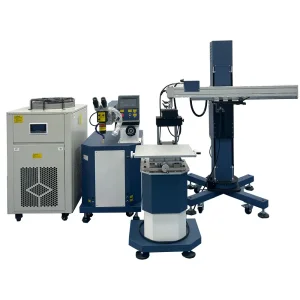
Factory-direct automated platforms engineered with in-house beam delivery optics, high-speed galvanometer integration, and industrial CNC multi-axis synchronization.
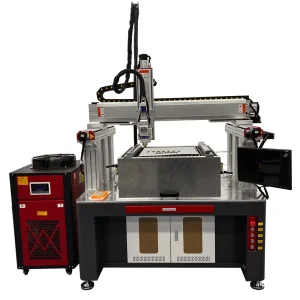
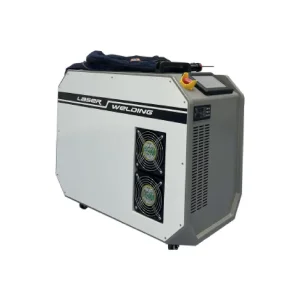
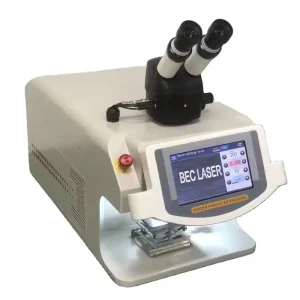
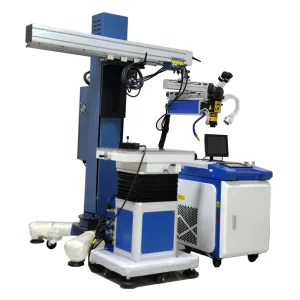
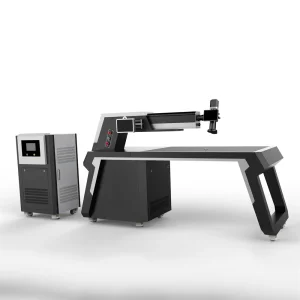
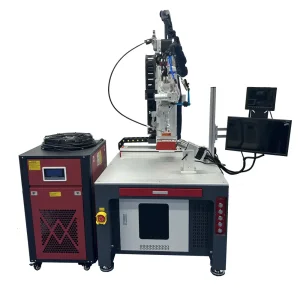
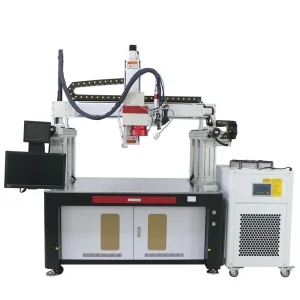
Modern manufacturing environments face stringent structural tolerances, higher alloy complexity, and the necessity to eliminate thermal distortion. Automated laser welding replaces traditional TIG and MIG joining with deterministic, software-driven laser output.
Automation reduces operational downtime by eliminating consumable filler wires, reducing shielding gas consumption by up to 45%, and removing the need for secondary grinding or abrasive planarization. Facilities witness full capital amortization within 8 to 14 months.
Integrating digital dynamic wobble heads with multi-axis gantry or articulated robotic kinematics allows precise spot oscillation profiles (spiral, circular, sinusoidal). This wide gap-bridging capability eliminates cold shut flaws and internal seam porosity.
Modern lines employ coaxial pyrometric sensors and in-process visual seam tracking. Deviation in reflected photon intensity, seam runout, or pool temperature is corrected in real time via high-speed EtherCAT bus protocols, securing automotive-grade yields.
Detailed metallurgical and process metrics comparing Automated Fiber Laser Welding Systems against traditional GTAW (TIG), GMAW (MIG), and Resistance Spot Welding (RSW).
| Performance Parameter | Automated Fiber Laser | Continuous QCW Laser | TIG (GTAW) Manual/Auto | MIG (GMAW) Robotic |
|---|---|---|---|---|
| Heat Affected Zone (HAZ) | Minimal (0.1 - 0.4mm) | Ultra-low (< 0.15mm) | Broad (2.0 - 5.0mm) | Substantial (1.5 - 4.0mm) |
| Linear Welding Velocity | Up to 120 mm/s continuous | Pulse-tailored cycling | 5 - 15 mm/s | 15 - 30 mm/s |
| Mechanical Distortion / Warpage | Virtually undetected | Zero distortion | Severe angular distortion | Noticeable thermal bow |
| Dissimilar Metal Joining | Exceptional (Cu-Al, Steel-Cu) | High precision alloys | Extremely difficult | Not viable without brazing |
| Post-Weld Surface Finishing | None required (mirror finish) | Pristine microscopic seam | Extensive pickling/grinding | De-spatter and grinding |
| Industry 4.0 Traceability | Full sensor data logging | Optical feedback logs | Manual verification | Basic robotic logging |
From micro-electronics micro-joining to 10-ton automotive mold reconstruction, Youmir Laser architects bespoke structural automation adapted to precise thermal boundaries.
Hermetic sealing of prismatic and cylindrical cell busbars, battery trays, and power distribution units. Integrated wobble optics overcome high surface reflectivity in pure copper (C1100) and aluminum (Al6061) without spatter ejection.
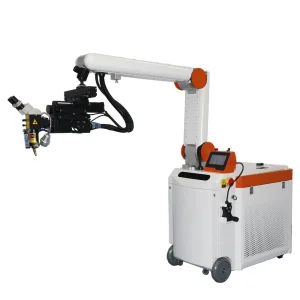
Cantilever and boom-mounted laser weld assemblies enable tooling restoration directly in situ. High-frequency pulsed deposition maintains steel grain alignment in H13, P20, and NAK80 alloys without anneal tempering loss.
Ultra-clean pulsed QCW setups for titanium surgical instruments, pacemaker encapsulation, and turbine thermocouple brackets. Strict inert gas shielding (Ar/He) preserves base metallurgical purity and ISO 13485 compliance.
Deploying machinery into international facilities requires rigorous technical safety interlocks, environmental adherence, and seamless regional utility matching.
Full alignment with CE Machinery Directive 2006/42/EC, EN 60825-1 (Laser Safety), and ISO 13849-1 (Safety-Related Parts of Control Systems). Redundant dual-channel optical interlocks prevent accidental human exposure during cycle execution.
Standard configurations natively engineered for universal three-phase 208V, 380V, 415V, and 480V utilities at 50/60 Hz. Integrated digital step-stabilization protect laser diodes and chiller compressors against harmonic fluctuations.
Secure VPN-enabled remote diagnostics modules allow Shenzhen engineers to troubleshoot PLC logic, calibrate optical galvo offsets, and update firmware parameters anywhere in the world within 2 hours of inquiry notice.
Youmir Laser accelerates advanced applied photonics research to meet the future demands of automated fabrication.
Deep-learning convolutional neural networks (CNNs) analyze melt pool emissions in real time. Micro-adjustments to wattage, focal spot distance, and assist gas pressures occur within 500 microseconds of seam instability detection.
Combining short 450nm blue laser light (highly absorbed by copper and gold) with 1070nm near-infrared fiber lasers. This creates conduction-mode pre-heating followed by keyhole fusion, enabling spatter-free copper battery joints.
Full integration with Siemens, Beckhoff, and Rockwell industrial software suites via OPC-UA protocols. Virtual commissioning allows engineering teams to simulate complex 5-axis tooling passes before physical cycle initiation.
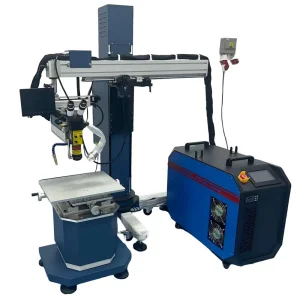
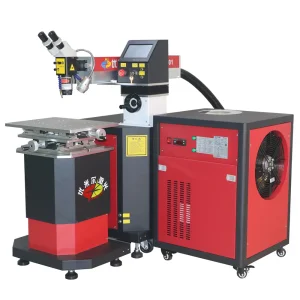
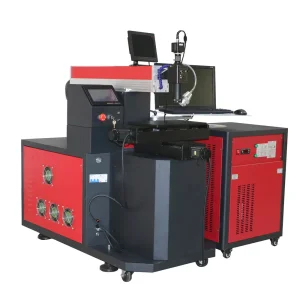
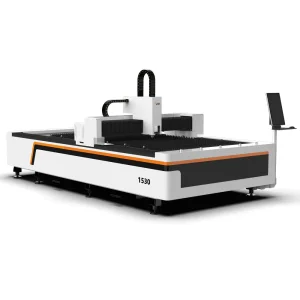
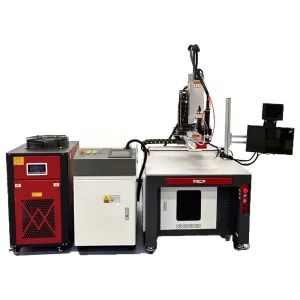
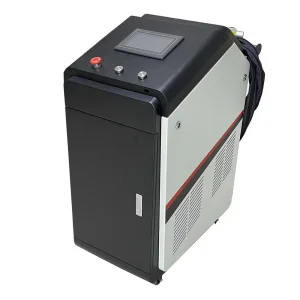
Review our heavy-duty cantilever systems, high-speed gantry setups, precision mold platforms, and high-energy pulsed surface cleaners.

Clear, definitive technical clarifications directly from Youmir Laser's lead automation research engineers.