Explore our verified range of handheld, mold-repair, and continuous galvanometer processing units engineered to international safety standards.



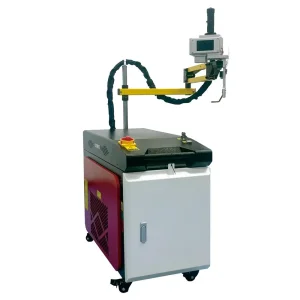
Evaluating the shift from consumable abrasive blasting to non-contact selective laser ablation across global industrial supply chains.
Laser cleaning relies on photothermal and photomechanical vaporization. When high-peak-power photons strike the target, the contaminant layer (rust, oxide, paint, or grease) rapidly absorbs energy exceeding its ablation threshold ($J/cm^2$). The underlying substrate (aluminum, copper, or structural steel) possesses a significantly higher thermal conductivity and reflection threshold, preventing core metallurgical compromise.
Precision tooling mandates pulsed fiber sources (100W–500W) utilizing master oscillator power amplifier (MOPA) control. Pulse widths ranging from 10 to 500 nanoseconds restrict the heat-affected zone (HAZ) to microscopic depths (<5 μm), vital for aerospace alloys and injection molds. Continuous wave (CW) lasers (1000W–3000W) provide aggressive, high-throughput square-meter stripping for heavy structural fabrication and shipyards.
Beyond instantaneous vaporization, rapid thermal expansion induces localized acoustic shockwaves. These micro-bursts mechanically shatter stubborn crystalline corrosion without mechanical profiling or anchor pattern destruction. Handheld systems integrate multi-axis galvanometric wobble heads (linear, circular, spiral, and sinusoidal patterns) to eliminate localized hot spots and guarantee surface uniformity.
Traditional abrasive sandblasting generates roughly 20 to 50 kilograms of hazardous contaminated particulate waste for every single square meter cleaned. Portable fiber laser systems convert the pollutant directly into inert ash or particulate drawn instantaneously into high-efficiency particulate air (HEPA) extraction filtration—yielding a zero-media closed-loop process compliant with ISO 14001, OSHA, and EU environmental standards.
| Evaluation Parameter | Sand / Bead Blasting | Chemical Pickling / Acid | Dry Ice Pelleting | Portable Fiber Laser Cleaning |
|---|---|---|---|---|
| Operating Media Cost | High (Grit media replenishment) | High (Acid / solvent drums) | Moderate (CO2 ice generation) | Zero Consumables (Electricity only) |
| Substrate Integrity | Surface wear, micro-pitting | Hydrogen embrittlement risk | Non-abrasive | Zero mechanical wear, intact profile |
| Operator Health & PPE | Severe silicosis & noise hazard | Corrosive chemical fumes | CO2 asphyxiation hazards | Laser safety eyewear + localized fume extraction |
| Portability & Setup | Bulky compressor & blast pots | Restricted immersion tanks | Dry ice delivery & storage | Compact trolley / backpack (110V/220V plug-and-play) |
How Tier-1 engineering firms evaluate return on investment (ROI), uptime metrics, and structural total cost of ownership (TCO).
When global procurement directors quantify the financial justification for upgrading to portable laser cleaning systems, media disposal fees and downtime dominate the model. Sandblasting entails recurring costs for abrasive purchase, post-processing cleanup, filter blockages, and hazardous disposal manifests. A portable laser cleaner converts maintenance into an electricity-only equation, typically drawing under 3.5 kW for continuous units and under 1.2 kW for pulsed units. The elimination of continuous consumable purchases allows high-utilization workshops to amortize initial CAPEX within months.
Modern environmental, social, and governance (ESG) reporting penalizes chemical-solvent usage (such as methylene chloride or trichloroethylene) and heavy dust pollution. Sourcing managers in the European Union and North America must satisfy strict air quality benchmarks (REACH, EPA, OSHA). Portable fiber laser systems are sealed units featuring Class 4 laser safety enclosures with integrated interlocks, optical beam delivery shrouds, and synchronized HEPA extraction nozzles that isolate vaporized contaminants at the point of origin.
Shenzhen Youmir Laser Technology Co., Ltd. leverages vertical manufacturing integration to guarantee engineering reliability and cost efficiency.
Rather than serving as an assembly shop, Youmir Laser engineers proprietary optical pathways, proprietary collimator designs, and digital galvanometer software in-house. This closed-loop design ensures dynamic beam-profile shaping, fine frequency regulation, and thermal mitigation without licensing markups, translating directly into superior equipment performance and stable procurement pricing for international distributors.
Each unit shipped from our Guangming District, Shenzhen facility undergoes rigorous 72-hour thermal continuous-duty burn-in tests, laser beam quality factor ($M^2$) interferometric profiling, and galvanic high-vibration resilience verification. This manufacturing discipline guarantees that portable backpack and trolley units arrive overseas ready for immediate site integration without field recalibration.
Shenzhen's hyper-dense optoelectronics industrial cluster allows us to maintain rapid turnaround cycles on custom OEM/ODM requests, custom cable lengths (up to 15 meters on select configurations), specialized multi-language CNC human-machine interfaces (HMI), and comprehensive replacement component dispatch through express international channels.
Across North America, Western Europe, and Southeast Asia, portable laser cleaning systems are displacing legacy maintenance tools.
Shipyards in Singapore, Rotterdam, and Busan deploy high-power portable laser cleaners for localized weld preparation, ballast tank descaling, and seawater corrosion abatement. Handheld heads allow workers to navigate cramped cargo holds where grit recovery hoses cannot reach.
Turbine overhaul centers and aerospace composite facilities utilize low-fluence pulsed systems for precision paint stripping and radar-absorbent coating removal from titanium and carbon-fiber skins without altering substrate shear strength or fatigue limits.
Automotive Tier-1 suppliers employ laser cleaning to remove dielectric coatings and oil film from battery pack trays and copper busbars prior to laser welding, ensuring zero-porosity joints and high electrical conductivity.
Tire molds, rubber vulcanization dies, and high-precision plastic injection cavities accumulate carbonized release agents. Pulsed laser cleaning restores complex micro-textures without rounding sharp parting lines or pulling molds off the press.
High-speed rail maintenance depots rely on portable fiber units to inspect and de-grease wheel sets, bogie frames, and brake assemblies, rapidly uncovering hairline fatigue cracks obscured by oil, grime, and rust.
Restoration experts throughout Europe and the Middle East preserve historical masonry, limestone façades, and bronze monuments by targeting soot, biological growth, and oxidation without damaging underlying historical patinas.
Explore our specialized cutting, pulsed surface cleaning, mold maintenance, and compact crafting laser machinery.

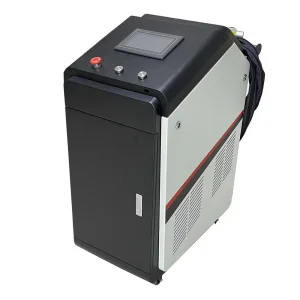

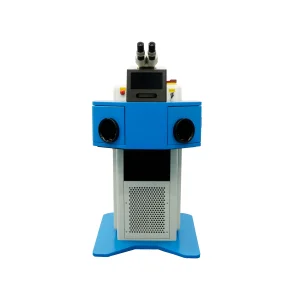

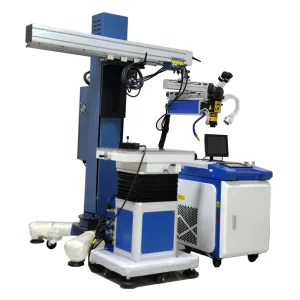

Clear answers from our senior optical engineering and international export logistics divisions.
Thermal deformation is prevented by operating within precise pulse width envelopes (typically 10 to 120 ns in our pulsed MOPA series) combined with high scan speed galvanometer wobble patterns. Because photon absorption occurs in nanosecond bursts, the instantaneous peak power vaporizes surface contaminants before heat has sufficient physical time to diffuse into the substrate bulk ($t < \tau_{diffusion}$). For continuous wave (CW) models on thin sheets, engineers modulate the laser output to a low duty cycle and expand the line beam width to avoid heat accumulation.
Both technologies require zero media consumables, meaning operating expenses are limited to electrical consumption and sacrificial protective cover lenses ($5–$10 each, lasting hundreds of operating hours). Continuous wave (CW) lasers feature a lower initial capital cost per watt ($/W) and higher electrical-to-optical efficiency (roughly 30%), making them ideal for heavy derusting. Pulsed systems carry higher initial CAPEX due to complex fiber amplifier architecture, but provide non-destructive precision, eliminating substrate scrap rates on high-value tooling and aerospace alloys.
Yes. Shenzhen Youmir Laser maintains a dedicated application laboratory. Prospective clients frequently ship material samples (carbon steel, treated aluminum, titanium, injection molds) directly to our Shenzhen factory. Our optical engineers execute systematic parameter sweeps, documenting cleaning rates ($m^2/h$), surface roughness measurements ($Ra$), cross-sectional microscopic morphology, and high-definition video documentation before issuing a comprehensive validation report.
All machines exported by Youmir Laser are fully compliant with CE Machinery Directive (2006/42/EC), Low Voltage Directive (2014/35/EU), and Electromagnetic Compatibility (2014/30/EU). In addition, optical delivery heads incorporate dual-channel safety interlocks, emergency stop loops, and key-switch protection matching FDA CDRH 21 CFR 1040.10 and ISO 11553-2 laser safety standards for handheld equipment.
We offer comprehensive white-label and OEM/ODM engineering partnerships. This covers exterior sheet metal colorways, silk-screened client branding, customized digital touch-screen HMI interfaces in multiple languages (English, German, Spanish, French, Japanese, Russian), and pre-configured parameter libraries. Tiered spare parts consignment programs and distributor training workshops are available globally.
The solid-state fiber laser module is hermetically sealed and rated for an MTBF exceeding 100,000 operational hours with no alignment requirements. Routine maintenance is limited to periodic inspection and cleaning of the protective window lens, quarterly coolant flushing (for water-cooled CW systems), and air filter cartridge replacement on the built-in cabinet heat exchangers. All consumable optical windows use standard quartz substrates with AR coating at 1064 nm.
Partner directly with the R&D engineers behind the equipment. Submit your material specifications, operational cycle times, or target power requirements for an itemized commercial proposal and process consultation.
