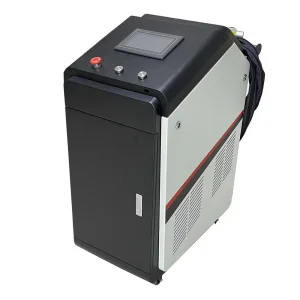
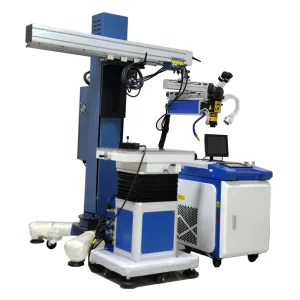
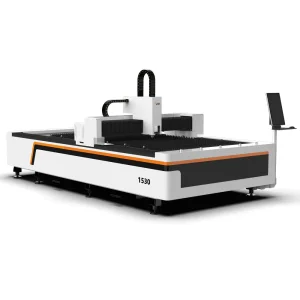
Explore our core selection of precision cantilever, mold repair, fiber cutting, and pulse laser processing systems built directly to CE, ISO, and FDA specifications.
A technical paradigm shift is replacing traditional TIG (Tungsten Inert Gas) and MIG (Metal Inert Gas) joining methodologies across high-demand industrial sectors worldwide.
Global fabrication shops face an unprecedented shortage of certified manual arc and TIG specialists. Handheld fiber laser equipment bridges this labor divide by turning novice operators into precision welders within hours, reducing operator dependence while achieving uniform, aerospace-grade seam integrity.
Traditional electric arcs introduce massive heat-affected zones (HAZ), resulting in structural warping, residual stresses, and extensive secondary rework. Continuous and wobbled laser beams deliver concentrated, energy-dense photon bursts that melt base metals instantly with localized micro-HAZ profiles.
Post-weld grinding and pickling constitute up to 35% of total structural manufacturing expense. Handheld laser systems deposit pristine, fish-scale bead geometries and smooth flush joints that require zero polishing or chemical passivation in decorative and architectural stainless-steel applications.
Shenzhen's hyper-dense optoelectronic ecosystem accelerates R&D turnaround, vertical integration, and unit economics beyond conventional western assembly limits.
Shenzhen's Guangming and Bao'an districts contain the world's most concentrated optical clusters. Diode pump modules, optical delivery cables, and specialized quartz collimators are sourced within hours, accelerating iteration cycles and eliminating supply chain bottlenecks.
Unlike regional integrators who re-label outsourced assemblies, Youmir Laser machines are designed, machined, wired, and calibrated under one roof. Our internal control over CNC sheet chassis fabrication, water chiller loops, and gun optics ensures unmatched hardware reliability.
Our proprietary optical torch engines deliver multi-geometry wobble modes (circle, line, triangle, double-ring) via high-speed galvanometer mirrors. This expands seam gaps tolerance up to 2.5 mm, solving a major challenge in practical structural fitting.
Every handheld fiber laser generator and chilled beam assembly completes a continuous 72-hour stress test at 40°C ambient humidity. Optical power drop is monitored in real-time with calibrated thermopile sensors to guarantee zero output degradation upon delivery.
Engineered for mission-critical industrial manufacturing plants demanding ultra-clean seams, low residual distortion, and rapid cycle times.
Fabrication of commercial stainless equipment (grades 304, 316L) demands pristine root penetration without surface oxidation or microbial entrapment. Handheld laser torches seal seams hermetically with continuous argon shielding, avoiding mechanical buffing or chemical pickling.
Thin aluminized steel tubing, hydroformed frames, and complex silencer brackets require strong bonds across dissimilar cross-sections. Wobble laser heads disperse thermal energy evenly, avoiding blow-through on thin sheet (≤1.0 mm) while penetrating deep parent structural walls.
Galvanized steel ducts typically release hazardous zinc vapors and suffer from spatter when processed with traditional TIG arcs. Our specialized fiber lasers pulse with optimized beam frequencies to vaporize zinc coatings along the seam boundary before puddle coalescence, yielding non-porous welds.
Empirical laboratory data evaluated under standard industrial conditions (304 Stainless Steel, 2.0 mm Butt Joint Configuration).
| Evaluation Parameter | Fiber Laser Handheld (1500W-2000W) | TIG (GTAW) System | MIG (GMAW) System |
|---|---|---|---|
| Welding Speed (2.0mm SS) | 35 - 60 mm/sec (Ultra-Fast) | 5 - 10 mm/sec (Slow) | 12 - 20 mm/sec (Moderate) |
| Heat Affected Zone (HAZ) | < 0.5 mm (Negligible Distortion) | 3.0 - 5.5 mm (Severe Warping) | 2.5 - 4.5 mm (Substantial) |
| Operator Training Ramp | 2 to 4 Hours to Full Competency | 3 to 6 Months Certified Apprenticeship | 2 to 4 Weeks Basic Operation |
| Filler Wire Requirement | Optional (Autogenous or 0.8-1.6mm Wire) | Mandatory for Gap Bridging | Mandatory (Heavy Consumable Cost) |
| Post-Weld Processing | Zero Grinding / Minimal Passivation | Extensive Buffing & Pickling | Heavy Mechanical Deslagging |
| Consumable Electrical Power | ~4.5 - 6.5 kW (High Optoelectronic Yield) | ~7.5 - 10.0 kW (Moderate) | ~8.0 - 12.0 kW (Low Efficiency) |
Crucial configuration points engineering procurement directors and equipment distributors must review before placing international OEM/ODM factory orders.
Specify local power supply standards: 110V/220V Single-Phase (50/60Hz) for small shops, or 380V/480V 3-Phase for heavy industrial duty. Factory-matched transformers prevent premature switching module degradation in regions with grid fluctuations.
Laser sources and gun optics require independent cooling zones. Ensure chillers maintain ±0.5°C stability under 45°C ambient conditions. Dedicated closed-loop refrigerant circuits prevent optical condensation on protective window lenses.
Industrial machinery must conform to international laser compliance standards (EN 60825-1 / Class 4). Verify integrated ground-contact clamp loops, optical shutter interlocks, and emergency trigger lockouts before shipping to North American or European facilities.
Avoid line downtime by stocking genuine field spares with your machine shipment: D20 collimating protection windows, focused beam quartz lenses, brass wire feed tips (0.8-1.6 mm), and specialized inner/outer corner laser nozzles.
Continuous innovation in photonics packaging, weight reduction, and robotics convergence is expanding what small shops and tier-1 production lines can accomplish.
Single fiber sources now combine handheld welding, rust descaling, seam cleaning, and air-assisted sheet cutting. Operators switch modes in seconds by swapping nozzles and recalling digital HMI presets, giving job shops flexible capabilities on a single footprint.
Next-generation optical guns use aircraft-grade aluminum and composite housings to bring total torch weight below 650g. Balanced center-of-gravity ergonomics and flexible corrugated fiber conduits reduce operator fatigue during full 8-hour production shifts.
Handheld laser heads are increasingly mounted onto 6-axis collaborative robotic arms (Cobots). Operators quickly teach weld trajectories by guiding the torch by hand, achieving automated consistency for small-batch runs without complex G-code programming.
Direct answers from Youmir Laser's R&D engineering team regarding machine selection, joint parameters, and international field support.
Continuous-wave systems, QCW micro-deposition welders, mold rebuild workstations, and sheet fiber cutters built to custom OEM specifications.