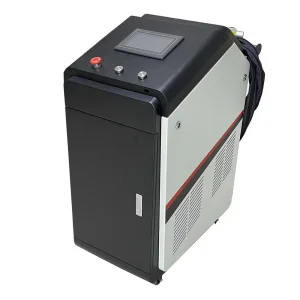
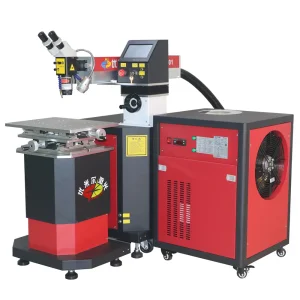
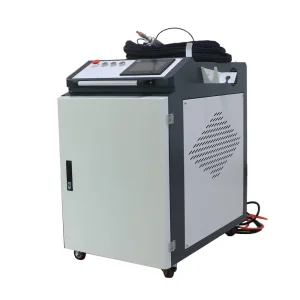
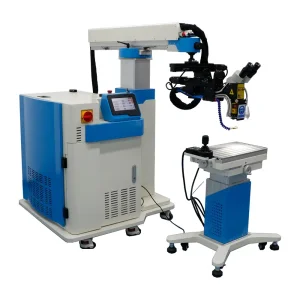
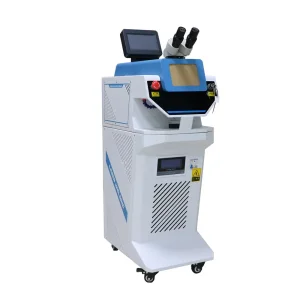
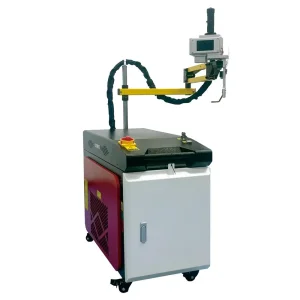
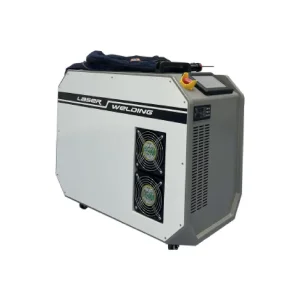
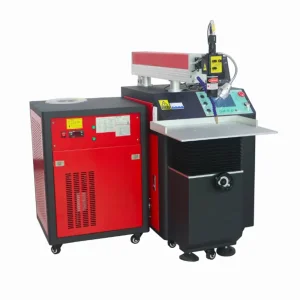
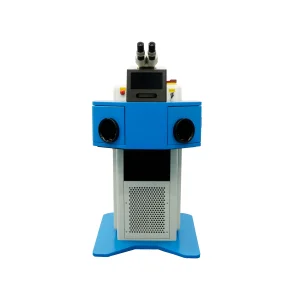
Explore our flagship series of certified industrial laser welders, cantilever mold maintenance stations, and precision pulse systems designed for mission-critical tooling restoration.
A granular thermodynamic and optical comparison detailing how Quasi-Continuous Wave fiber engines resolve micro-cracking, heat sinking, and thermal distortion in premium grade tooling steels.
Unlike continuous-wave (CW) lasers which maintain constant thermal emission, a QCW fiber source operates in both millisecond-pulse mode and continuous mode. With an instantaneous peak power reaching up to 10× its average power (e.g., a 150W average power unit generating 1.5kW peak energy), QCW delivers concentrated energy specifically tailored to overcome the initial high reflectivity of copper alloys, aluminum bronze, and pre-hardened mold steels without heating the underlying core substrate.
Traditional TIG and micro-arc welding inject uncontrolled joules into tool steel, leading to metallurgical degradation such as annealing temper loss, tensile stress buildup, and micro-fracturing along edges. QCW fiber laser beams exhibit an M² beam quality parameter between 1.1 and 1.3, allowing spot convergence down to 0.15mm–0.3mm. This narrow focus limits thermal dispersion to a microscopic perimeter, preserving the bulk hardness (52-58 HRC in H13 or NAK80) right up to the weld boundary.
Legacy lamp-pumped Nd:YAG mold welders suffer from rapid xenon flashlamp degradation, thermal lensing inside the crystal rod, and frequent cavity mirror alignment drifts, yielding electrical-to-optical efficiency ratings under 3%. QCW fiber laser engines utilize high-reliability semiconductor laser diodes coupled directly into a double-clad active fiber, generating wall-plug efficiencies exceeding 30% with an operational MTTF in excess of 100,000 maintenance-free hours.
Engineering Benchmark: In repair tests on mirror-polished S136 plastic injection molds, QCW fiber deposition reduces post-weld electrical discharge machining (EDM) or hand-stoning benchwork by 72% compared to conventional pulsed Nd:YAG systems, completely eliminating sink marks on adjacent polished optical shut-offs.
| Evaluation Parameter | Direct QCW Fiber Laser Welder | Flashlamp-Pumped Nd:YAG Welder | Precision Micro-TIG Repair |
|---|---|---|---|
| Beam Propagation (M²) | 1.1 - 1.3 (Diffraction Limited) | 15.0 - 25.0 (Multi-mode Broad) | N/A (Plasma Arc Discharge) |
| Heat-Affected Zone (HAZ) | 0.05 mm – 0.18 mm | 0.40 mm – 0.85 mm | 1.80 mm – 3.50 mm |
| Wall-Plug Energy Efficiency | 30% – 35% | 2.0% – 3.5% | 60% – 75% |
| Consumable Lifecycle | Zero optical consumables (>100k hrs) | Flashlamps (every 500-800 hrs), DI Water | Tungsten electrodes, ceramic cups |
| Tool Hardness Retention | 100% Parent Alloy Integrity | Partial Boundary Softening (2-4 HRC loss) | Severe Annealing (Requires Full Re-heat Treatment) |
| Minimum Wire Deposition Dia. | 0.10 mm (Micro-fine features) | 0.25 mm | 0.60 mm |
How tier-one automotive suppliers, precision electronics OEMs, and contract toolrooms are restructuring their operational expenditures through in-house QCW laser mold renovation.
With automotive manufacturing shifting toward aluminum structural components and giga-casting processes, tool steel dies (such as 1.2343 ESR or Dievar) endure intense cyclic thermomechanical stresses, culminating in early-stage thermal shock crazing and washouts. Procuring replacement tooling sets demands capital outlays in excess of $250,000 and lead times extending to 26 weeks. Deploying high-duty QCW fiber mold welders directly inside pressrooms facilitates in-situ repair of parting line micro-washouts in hours, maintaining critical press productivity.
Micro-molding systems handling fluoropolymers, PEEK, and liquid silicone rubber (LSR) demand zero defect margins down to 5 microns across gate vests and ejector pin channels. QCW fiber lasers operate with variable spot geometry and inert shielding gas management (Argon/Helium blends) that prevent oxidation porosity during metal addition. This ensures that repaired mold cavities in medical cleanroom applications conform strictly to ISO 13485 bio-compatibility standards without foreign oxide particulate shed.
Transforming discrete maintenance workstations into synchronized, digitally monitored mold life-cycle optimization cells.
Modern plastic bumper molds, consumer appliance housings, and stamping punch sets weigh up to tens of metric tons, making movement to benchtop workstations cost-prohibitive. Our integrated 360-degree boom arm architectures project up to 2.5 meters outward, maneuvering optical welding heads into multi-axis deep cavities directly on the staging floor without dismounting the bolster plate assembly.
Achieving identical thermal expansion coefficients between parent base steels and weld wire filler is critical to avoiding delamination under rapid cyclic heating. We provide comprehensive application protocols for precision matching P20, 718, S136, NAK80, SKD11, and Beryllium Copper alloys using targeted pulse energy ramp-down shaping to eliminate crater cracks at termination boundaries.
Equipped with high-definition stereoscopic binocular microscope optics and real-time coaxial CCD processing arrays, operators achieve unhindered visualization of molten puddle mechanics down to 0.05mm. Programmable wobble heads provide circular, linear, and figure-8 micro-oscillations to bridge unexpected tooling gap offsets while preserving pristine sidewalls.
Strategic product development phases advancing autonomous tool repair through sensor-fusion, high-speed vision feedback, and hybrid multi-beam deposition.
Transition from standard 1064nm or 1080nm single-mode emission to dual-wavelength fiber architectures that combine blue diode absorbing pre-heaters with infrared QCW pulses, overcoming energy rejection in mirror-grade copper components.
Integration of infrared photodiodes embedded within the laser delivery head measuring melt-pool temperature profiles at 10kHz frequencies, automatically modulating instantaneous pulse duty cycles to completely eliminate parent metal blow-through.
Integrated micro-fringe projection mapping mold defect volumes directly on the bolster plate, autonomously determining wire feed velocity, multi-pass toolpath layers, and heat distribution algorithms for hands-free restoration.
Hybridization of wire-fed QCW laser heads with micro-blown atomized powder delivery systems, enabling functionally graded material deposition such as applying wear-resistant tungsten carbide coatings directly onto soft core matrices.
Manufactured in full alignment with international safety, environmental, and electrical harmonization protocols for uncompromised plant floor deployment across North America, Europe, and Asia-Pacific.
Fully engineered to comply with EN 60825-1:2014 laser safety protocols, featuring dual-channel interlock switches, optical shutter fallbacks, protective optical density (OD6+) certified viewports, and active gas pressure cutoff monitors.
Internal transformers adapt seamlessly to dynamic global factory power infrastructures (208V/220V/380V/480V ±10%, 50/60Hz), paired with high-efficiency closed-cycle dual-temperature industrial chillers maintaining laser cavity stability under ambient plant temperatures up to 45°C.
From personalized sheet metal liveries and software UI localization to fully automated 6-axis robotic arm coupling interfaces, our factory delivers customized laser hardware platforms directly configured to brand requirements.
Answers derived directly from our factory application engineering team addressing metallurgical questions, optical longevity, and operational maintenance.
From heavy CNC fiber cutting gantries to high-throughput galvanometer welders, explore the broader precision manufacturing lineup manufactured by our Shenzhen factory.