
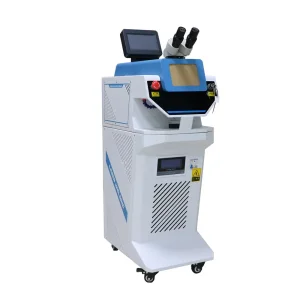
Verified factory configurations equipped with dual-axis oscillation, high-speed beam steering, and thermal stability modules for mission-critical joints.
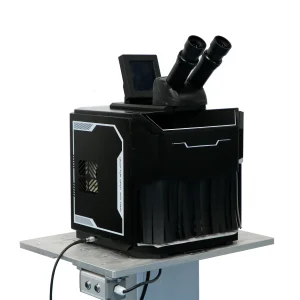

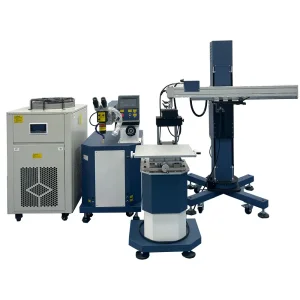
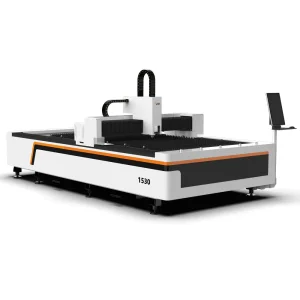



Traditional fixed-spot fiber laser welding presents severe tolerances to fit-up gaps and rapid solidification defects. Oscillating beam optics redefine thermal profiles to resolve these metallurgical constraints.
Unlike standard static heads that focus concentrated irradiance on a sub-0.2mm point, dual-axis galvanometers actively steer the focal spot into dynamic patterns (circle, figure-8, ellipse, and line). Oscillation frequencies reaching up to 300 Hz expand molten pool volume, homogenizing temperature distribution and suppressing violent keyhole spatter.
Manual fit-up discrepancies routinely compromise conventional laser lines, demanding filler wire or intense rework. Wobble beam mechanics bridge seam gaps as wide as 2.5 mm by continuously redistributing molten metal across the joint interface, reducing preparation time by up to 60% without risking structural root defects or blow-through.
Oscillatory motion induces micro-stirring inside the liquid melt. This hydrodynamic agitation disrupts columnar dendritic grain structures, generating equiaxed grain solidification. Consequently, crack-sensitive alloys such as 6000-series aluminum and high-strength steels exhibit superior ductility, fatigue life, and tensile strength under cyclic loads.
| Welding Process Parameter | Conventional Laser (Static Spot) | Wobble Laser Welding (Engineered) | Conventional TIG (GTAW) |
|---|---|---|---|
| Gap Bridging Capacity | < 0.2 mm (Critical constraint) | Up to 2.5 mm (Oscillating reach) | Up to 3.0 mm (Slower manual feed) |
| Heat-Affected Zone (HAZ) | Ultra-narrow (Risk of brittleness) | Optimized Controlled Thermal Area | Extensive (Thermal distortion) |
| Dissimilar Metal Joining | Brittle intermetallic layers | Dynamic dilution control | High cracking vulnerability |
| Process Travel Speed | High (Risk of seam deviation) | High with Wide Process Window | Low (High labor cycle time) |
| Keyhole Porosity Formation | Elevated in volatile metals | Suppressed via continuous degassing | Moderate (Gas entrapment) |
Deploying specialized laser systems tailored to precision tolerances, thermal constraints, and automation standards across vital industrial sectors.
Precision joining of copper-to-aluminum busbars requires balancing vast differences in thermal conductivity and melting points. Wobble frequency modulation limits intermetallic compound (IMC) thickness below 10 micrometers, providing electrical conductivity with lower joint resistance.
Titanium alloys (Ti-6Al-4V) and Inconel require inert gas protection and clean solidification. Oscillating beam heads combined with trailing coaxial argon shields eliminate atmospheric pickup, ensuring zero micro-fissuring and achieving Class-1 radiographic inspection compliance.
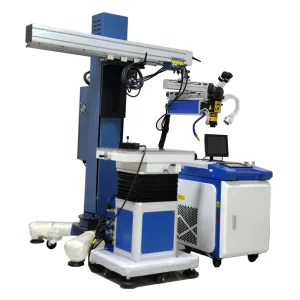
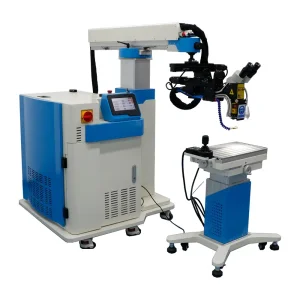
Tool steel components require deposition welding that mitigates edge burn-off and thermal cracking. Integrated cantilever and boom arms deliver energy precisely to damaged parting lines and cavities, eliminating post-process annealing or extensive EDM recovery stages.
Operating from Shenzhen's premier photonics development corridor, Youmir Laser leverages complete vertical engineering to compress lead times and guarantee quality control.
Proprietary galvanometer drive algorithms, anti-reflection coated optical trains, and wobble oscillation software developed in-house ensure seamless firmware-hardware interoperability.
Tier-1 domestic and international fiber source partnerships provide uninterrupted supply chains, while pre-tested laser diodes guarantee consistent, rated beam quality (M² < 1.3).
Every industrial unit undergoes uninterrupted 72-hour power stability cycling, dynamic optical drift monitoring, and thermal dissipation validation under maximum load conditions.
A standardized modular inventory architecture enables rapid configuration of custom handheld, boom, and CNC systems, reducing lead times from industry norms of 8 weeks down to 10 days.
Initial development of specialized fiber laser optics and industrial beam delivery protocols.
Official establishment of Shenzhen headquarters focusing on CNC and pulsed laser stations.
Commissioning of an expansive assembly facility to scale production capacity for international export.
Over 10,000 installations across 50+ countries with full local compliance and engineering support.
Meeting the regulatory and process demands of multinational corporations, Tier-1 automotive integrators, and regional fabrication hubs.
Engineered to international performance and safety standards, featuring dual-channel safety interlocks, optical shielding enclosures, emergency stop loops, and active protective gas sensing conforming to CE Machinery Directive, FDA CDRH laser classifications, and ISO 11553 standards.
We provide full white-label capabilities for overseas machine tool distributors and systems integrators. This includes customized enclosure designs, multilingual HMI programming, localized fieldbus automation protocols (Profinet, EtherCAT), and matched consumables supply contracts.
To de-risk procurement, clients can ship sample parts to our testing laboratories. Our senior application engineers evaluate joint geometry, deliver complete metallographic slice evaluations, document cycle speeds, and supply full process parameters prior to purchase.
The convergence of real-time machine vision, closed-loop acoustic sensors, and adaptive high-speed multi-wavelength laser sources.
Real-time optical coherence tomography (OCT) combined with high-speed CMOS visual sensors scans joint topology milliseconds ahead of the laser focal point, automatically adjusting wobble amplitude, focus depth, and wire delivery speed on the fly.
Edge-computing processors analyze optical emissions and airborne acoustic vibrations during keyhole vapor collapse. Deviation from standard acoustic signatures instantly modulates laser output, eliminating sub-surface void formation before solidification occurs.
Combining 1064 nm infrared fiber lasers with 450 nm blue direct-diode beams overcomes reflectivity barriers in pure copper and high-purity gold. The blue wavelength pre-heats the substrate to stabilize absorption, enabling clean, spatter-free joints at lower overall energy usage.
Discover our industrial cutting beds, pulse cleaning heads, and continuous-wave production platforms built to scale manufacturing output.



Clear answers covering metallurgical mechanics, total cost of ownership, beam safety protocols, and cross-border installation.