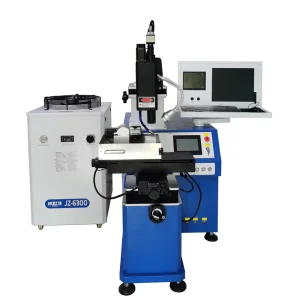
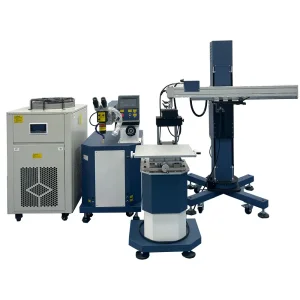
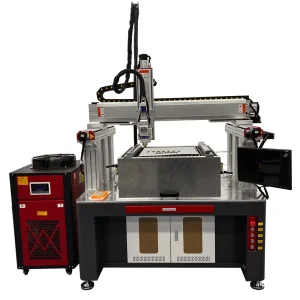
Engineered for high-volume metal processing, tool-room repair, and dynamic structural fabrication with certified CE/FDA optical delivery systems.
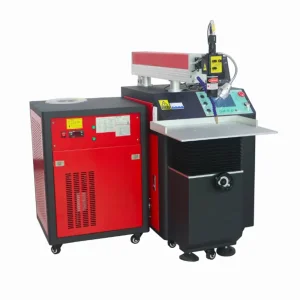
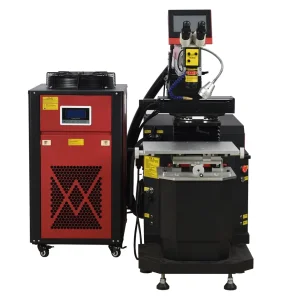
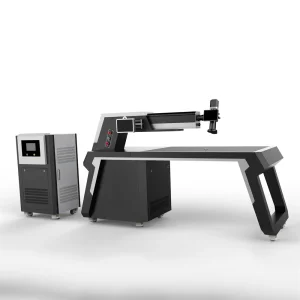
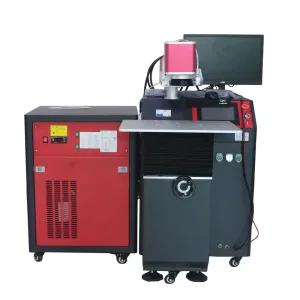
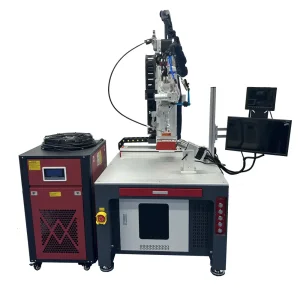
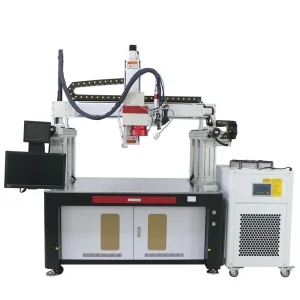
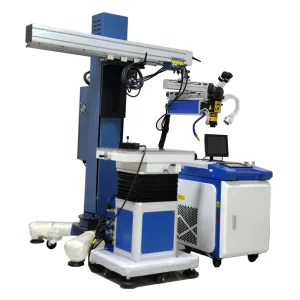
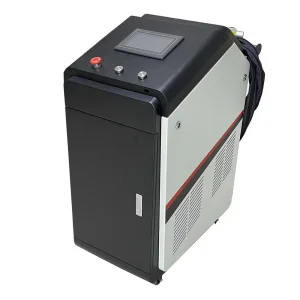
Why modern metal fabrication facilities, OEM component makers, and heavy equipment plants standardize on 2.0 kW Continuous Wave (CW) laser sources over conventional arc setups.
The 2000W threshold delivers power densities exceeding 10⁶ W/cm², allowing instant metal vaporization and formation of a stable keyhole capillary. This transitions the process from conduction-limited welding to deep keyhole fusion, yielding ultra-narrow aspect ratios (depth-to-width up to 5:1), minimal heat-affected zones (HAZ), and structural distortion reductions exceeding 85% compared to TIG.
Legacy single-spot laser welders suffered from stringent tolerance requirements where joint gaps had to remain under 0.1 mm. Custom 2000W setups integrate high-frequency dual-axis galvanometer oscillation (circle, line, ellipse, figure-eight, and triangle modes up to 5mm beam spread), enabling bridgeable gaps up to 1.5mm while eliminating porosity in galvanized and oxidized alloys.
Post-weld processing accounts for up to 45% of labor cost in traditional steel and aluminum fabrication. A 2000W fiber laser produces mirror-smooth weld profiles and controlled fillet geometries that directly accept powder coating or electroplating without manual mechanical grinding, chipping, acid-pickling, or passivating steps.
Procurement directors across North America, Europe, Southeast Asia, and Latin America are evaluating total life-cycle ROI when scaling laser automation lines.
Rising industrial wage indexes and an acute shortage of certified Class-A TIG/MIG welders across the United States, Germany, Japan, and the UK have forced tier-1 and tier-2 manufacturers to automate. The 2000W laser welding platform presents an unprecedented inflection point: an untrained operator can master safe, high-integrity welding within 4 to 8 hours of digital system onboarding.
Furthermore, carbon neutrality mandates in the European Union (CBAM) and strict factory power restrictions worldwide incentivize energy efficiency. A 2000W fiber laser draws roughly 7.5 to 8.5 kW total electrical load under continuous duty (including dual-circuit refrigeration chillers), whereas an equivalent multi-station TIG bank consumes over 24 kW for identical linear throughput.
Custom options—ranging from dual-wire feed systems for heavy chamfer fills to localized inert shielding purges (pure Argon / Nitrogen blends)—allow a single machine to adapt across 304/316L stainless steel, carbon steels, high-strength structural alloys, structural aluminum, and brass sheets.
A rigorous engineering comparison of operating 2,000 operational hours/year on 3mm stainless steel assemblies reveals immediate economic payback:
| Financial Vector | Traditional TIG Rig | 2000W Fiber Laser |
|---|---|---|
| Welding Linear Speed | 150 - 250 mm/min | 800 - 1500 mm/min |
| Operator Skill Level | Certified Specialist ($38/h) | General Operator ($20/h) |
| Secondary Polishing Cost | $14,500 / year | $0 (Eliminated) |
| Annual Energy Draw | ~32,000 kWh | ~14,000 kWh |
| Net Payback Horizon | Baseline reference | 3.8 to 6.2 Months |
Inside the world’s most integrated laser manufacturing hub—how proprietary optical research, modular architecture, and rapid prototyping deliver decisive cost-to-performance ratios.
Unlike regional assemblers relying on off-the-shelf third-party components, Shenzhen Youmir Laser maintains proprietary development across optical collimators, high-damage-threshold protective windows, and proprietary CNC motion control algorithms. This ensures beam parameter products (BPP) remain stable even under high-reflection duty cycles when processing copper and aluminum alloys.
Within a 50-kilometer radius of Guangming District, Shenzhen, our manufacturing facility accesses the full photonics supply chain: military-grade 976nm pump diodes, specialized high-vacuum fiber combiners, precision CNC machined chassis, and multi-lingual HMI software. This tight physical proximity shortens custom OEM/ODM delivery cycles from the Western industry standard of 14 weeks down to just 12 to 18 business days.
Every 2000W laser power source, beam delivery fiber, and handheld welding head undergoes rigorous quality validation prior to crate packaging: 72-hour continuous beam emission stress testing, automated optical leak testing, climatic thermal cycling between -10°C and 55°C, and drop-impact resistance tests on all internal optic housings to guarantee zero beam misalignment during international freight transit.
Transparency in component selection, interface standards, and industrial automation protocols ensures zero unexpected commissioning costs.
| System Component | Standard Handheld 2000W | Custom Multi-Axis CNC 2000W | Custom Galvo / Robotic Workcell |
|---|---|---|---|
| Laser Source Architecture | CW Ytterbium Fiber Laser (1080±10 nm) | CW / High-Peak Modulated Fiber Laser | Quasi-Continuous Wave (QCW) or CW |
| Optical Fiber Core Diameter | 50 μm (Standard) | 35 μm / 50 μm Core Options | 14 μm to 25 μm Single-Mode Option |
| Wobble Scanning Width | 0.2 mm to 5.0 mm Adjustable | Integrated CNC path-linked dynamic spot | 3D Dynamic Scanning (Up to 300x300mm field) |
| Penetration Depth (SS/CS) | Up to 5.0 mm SS / 4.5 mm CS | Up to 5.5 mm (Automated Speed Match) | High-Precision Micro-joints (0.05 - 3.0 mm) |
| Penetration Depth (Al/Cu) | Up to 3.5 mm Al / 2.0 mm Brass | Up to 4.0 mm Al with dual-fill wire | Dedicated Anti-Reflective Optical Isolator |
| Cooling Unit | Dual-circuit dynamic water chiller | Intelligent high-capacity refrigerated chiller | Central manifold factory chilled water interface |
| Safety Interlocks | Loop interlock, dual trigger, CE Level 4 | Fully enclosed Class 1 safety housing | Light curtain, safety PLC, fume extractor sync |
| Indicative Factory Pricing | $4,200 – $6,800 USD | $8,500 – $14,800 USD | $18,000 – $38,000+ USD |
*Note: Quoted pricing reflects FOB/CIF port options depending on optional additions: auto-wire feeding mechanisms, customized wobble heads, clean-cutting attachments, and certified CE/FDA safety enclosure cabins.
Demonstrated metallurgical outcomes, joint parameters, and operational validation across key modern manufacturing sectors.
Welding aluminum alloy battery trays, busbar connections, and seat frame tubular assemblies. The 2000W wobble head suppresses crack sensitivity in 6000-series aluminum while maintaining high electrical conductivity across pure copper-to-aluminum terminals without explosive spatter.
Processing commercial kitchen counters, HVAC ducts, architectural stainless rails, and electrical control cabinets. Hermetic edge seams, zero thermal warping on 1.0mm–3.0mm 304/316 sheet, and completely gas-tight joins that pass rigorous helium leak detection tests.
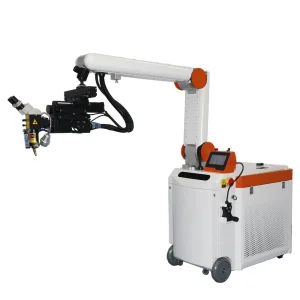
Injection tooling, forging dies, and stamping shear edges suffer frequent chipping. Using cantilever and integrated boom fiber systems, tool-rooms deposit precise tool steel wires (H13, NAK80, P20) into micro-fissures without pre-heating or post-weld annealing cycles.
Fabrication of thin-wall hydraulic lines, titanium alloy brackets, and sensor housings. Narrow beam spot and digital parameter ramp-up prevent keyhole blow-through at seam termination, delivering pore-free microstructure passing Class 1 X-ray non-destructive testing.
Direct technical answers from our senior optical and applications engineering team regarding procurement, process setup, and site deployment.
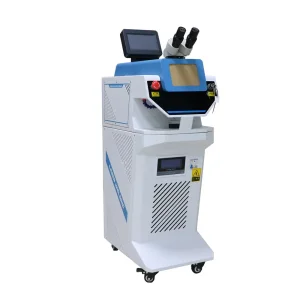
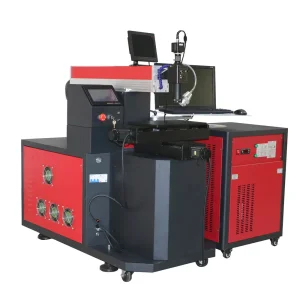
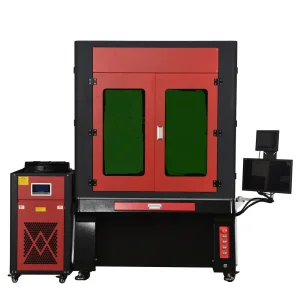
Specialized cantilever systems, heavy mold repair booms, automated CNC enclosures, and multi-axis production centers.