

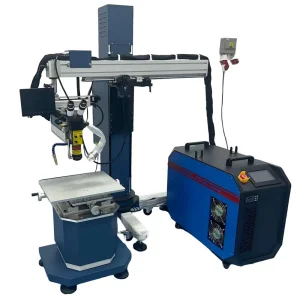
Custom Integrated Boom Mold Welding Machine Manufacturer, Quotes
View Specifications
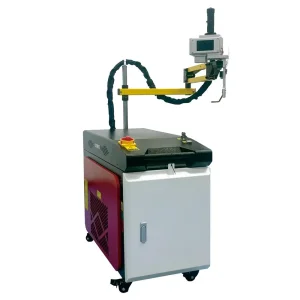
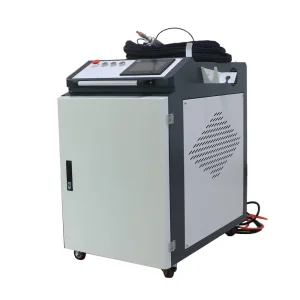
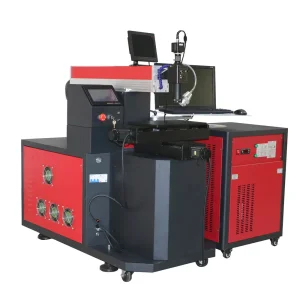
Explore standard OEM and custom fabricated industrial laser systems deployed across international fabrication yards, automotive press lines, and precision mold maintenance centers.
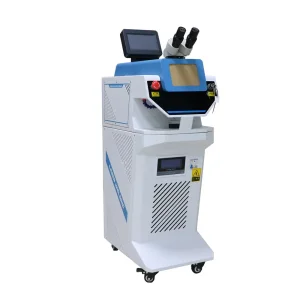
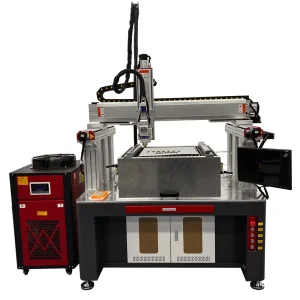
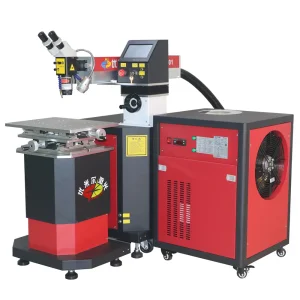
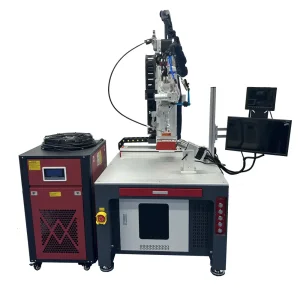
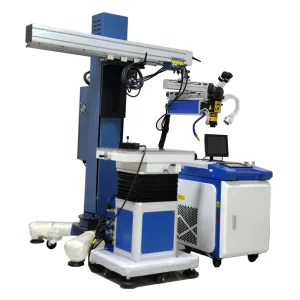
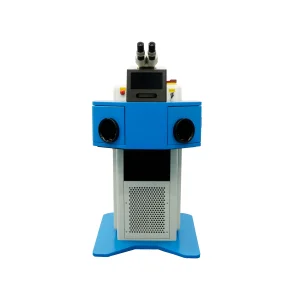
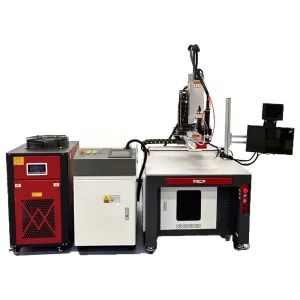
In modern industrial decoating and surface preparation, the 2000 Watt class represents the definitive thermodynamic equilibrium between surface ablation rate, thermal diffusion management, and electrical efficiency.
Unlike lower power regimes (500W–1000W) that rely almost exclusively on slow evaporative ablation, a 2000W continuous wave or modulated beam generates rapid thermoelastic shockwaves within the iron oxide matrix (Fe₂O₃ / Fe₃O₄). This creates interfacial shear stress exceeding oxide bond strength, causing particulate spallation prior to complete molten vaporization.
Global procurement teams favor 2000 Watt laser cleaning systems because they achieve commercial viability where media blasting replacement is mandated. A 2kW unit balances capital outlay against labor reduction, stripping heavy mill scale, paint stacks, and rust pitting at rates that match or beat sandblasting setups without cleanup overhead.
Equipped with dual-axis galvanometer optical heads and multi-waveform control software, 2000W fiber systems dynamically vary the laser beam's spot geometry. Operators oscillate linear, circular, spiral, and polygon raster paths up to 300mm wide, tailoring irradiance to mill scale, marine bio-fouling, grease films, and primer layers without substrate gouging.
Transparent factory-gate pricing tiers, core optical subsystem variations, and technical specifications for direct industrial buyers, overseas distributors, and OEM engineering integrators.
| System Configuration Tier | Optical Architecture | Core Laser Source | Cooling & Controls | Typical Applications | Factory Direct FOB ($USD) |
|---|---|---|---|---|---|
|
CW Heavy-Duty Standard Continuous Wave 2000W |
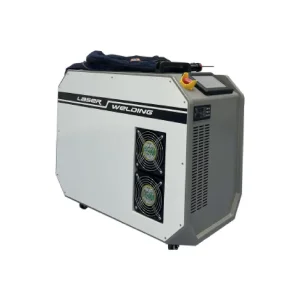
Single-axis hand piece, focal length F254/F300, beam width up to 150mm | Raycus / Maxphotonics Continuous Fiber Laser Engine | Integrated dual-circuit refrigeration chiller, 7-inch PLC touch interface | Structural steel, bridge beams, marine hull decarb, pipe fabrication rust | $6,200 – $7,900 |
|
CW Advanced Dual-Axis Pro Dual Galvanometer 2kW |
Dual-axis 2D scanner head, 8 preset scanning patterns (spiral, cross, box) | Raycus / IPG Photonics Continuous Source with modulation control | High-capacity compressor chiller, multi-language controller, remote diagnostics | Complex weld prep, automotive stamping dies, storage tank descaling | $7,800 – $10,800 |
|
3-in-1 / 4-in-1 Multi-Process Cleaning + Welding + Cutting |
Quick-change optical collimation barrel, dual wire feeder compatibility | Maxphotonics / JPT Continuous Wave 2000W Power Core | Compact mobile chassis, high-duty liquid loop, gas solenoid integration | Contract fabrication shops, mobile equipment repair, shipyard maintenance | $6,900 – $8,900 |
|
High-Peak MOPA Pulsed 2000W Nanosecond High Energy |
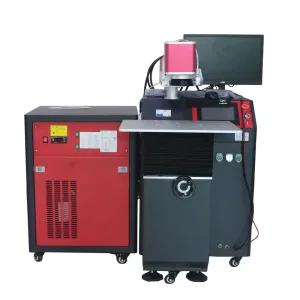
Precision telecentric scan lens, digital galvo system, 0.1mm spot resolution | Custom Master Oscillator Power Amplifier (MOPA) fiber laser cluster | Ultra-stable PID temperature unit, CNC integration bus, safety interlock intertie | Aerospace carbon composite tooling, semiconductor moulds, nuclear decontamination | $42,000 – $68,000 |
|
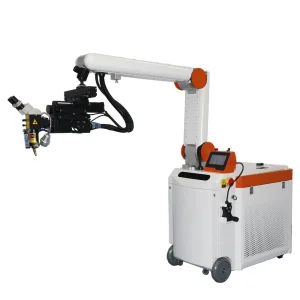
Automated Gantry / Robot Cell CNC / 6-Axis Robotic Arm |
Heavy robotic cleaning end-effector, air-knife optic shield, coaxial vision | 2000W Fiber Engine (Industrial Fieldbus: PROFINET / EtherCAT) | External closed-loop chiller cabinet, central fume extractor sync | Continuous production line derusting, train bogie stripping, rail manufacturing | $18,500 – $38,000 |
Over a standard 3-year operating lifecycle (6,000 operational hours), traditional sand or garnet blasting incurs enormous recurring overhead: consumable purchase, spent media storage, hazardous waste disposal, containment tenting, and continuous nozzle/hose wear. A 2000W laser eliminates abrasive consumables entirely.
Shenzhen industrial factories maintain modular assembly structures allowing extensive OEM branding and functional customization. Typical turnkey lead times range from 7 to 14 business days for standard CW 2kW platforms, and 20 to 30 days for customized automated robotic cells.
Why Tier-1 Chinese laser manufacturers in Shenzhen and Guangdong dominate global laser rust removal equipment production: vertical industrial clusters, resilient supply networks, and accelerated R&D turnaround.
Within a 50-kilometer radius of Shenzhen's advanced optical manufacturing belt, all core tier components are produced: 976nm pump diodes, active double-clad ytterbium fibers, precision fused quartz collimating lenses, galvo servo motors, and CNC sheet metal enclosures. This complete ecosystem compression eliminates transatlantic component shipping delays and slashes procurement markups.
Reputable Chinese laser manufacturers enforce rigid Quality Assurance (QA) regimes. Every 2000 Watt system undergoes a minimum 72-hour continuous thermal stress test, beam power stability telemetry logging, and hermetic seal leak inspection before crating in export-grade fumigated wooden cases.
Tier-1 factories engineer systems strictly adhering to international machinery and laser radiation standards: CE Machinery Directive 2006/42/EC, EN 60825-1 Laser Safety Class 4 guidelines, and US FDA/CDRH accession protocols. Integrated safety interlocks, remote fiber interlock connectors, and dual-channel e-stops come factory standard.
Evaluating peak optical irradiance, substrate thermal thresholds, and microstructural heat-affected zones (HAZ) to guarantee optimal machine-to-task specification.
Continuous wave fiber lasers emit uninterrupted photons at 1064nm–1080nm. Scanning galvanometer optics rapidly sweep the focal spot over the work area to prevent thermal pooling. CW models excel where massive volumetric rust, paint, and scale removal is required on thick structural substrates.
| Peak Optical Power | 2,000 Watts (Constant) |
| Heat Affected Zone | 15μm – 50μm (Substrate dependent) |
| Cleaning Velocity | 15 – 45 m²/hr (Medium rust) |
| Equipment Cost Base | $6,200 – $10,800 USD |
| Best Applications | Ship hulls, structural beams, pipelines, heavy tooling |
Engineering Note: CW systems generate measurable heat. Not recommended for sheet metal under 1.5mm or heat-treated aerospace alloy substrates where structural temper must remain unperturbed.
Pulsed 2kW lasers bundle energy into brief bursts (nanoseconds or picoseconds) yielding peak powers exceeding hundreds of kilowatts per pulse. The duration is shorter than the thermal relaxation time of the base metal, resulting in pure cold ablation with near-zero substrate heating.
| Peak Optical Power | 100 kW – 500 kW (Per Pulse) |
| Heat Affected Zone | < 2μm (Negligible thermal signature) |
| Cleaning Velocity | 8 – 20 m²/hr (Precision de-oxidation) |
| Equipment Cost Base | $42,000 – $68,000 USD |
| Best Applications | Injection molds, aerospace turbine blades, vintage restoration |
Engineering Note: Pulsed systems preserve substrate roughness (Ra values) precisely, making them mandatory for high-precision injection mold tools and sensitive electronic assemblies.
Real-world integration workflows demonstrating how global commercial enterprises utilize 2000 Watt laser rust removal systems to enhance productivity and meet environmental standards.
Shipyards in drydock use handheld 2000W CW systems to remove aggressive salt-water crusting, ballast tank corrosion, and antifouling coatings. Unlike hydro-blasting, laser cleaning creates a completely dry, profile-retained surface ready for immediate epoxy coating application, eliminating flash rusting entirely.
Tier-1 automotive suppliers integrate automated 2kW laser heads onto 6-axis articulated robots. The laser strips zinc coatings, lubricants, and drawing compounds from high-strength galvanized steel and aluminum sheet flanges at 200mm/s, guaranteeing zero porosity during downstream laser welding operations.
Crude oil and gas pipelines suffer from severe atmospheric rust and black bitumen residue. Crawler-mounted 2000 Watt laser heads traverse pipeline circumference segments, stripping corrosion to Sa 2.5 cleanliness standards without generating dust clouds or requiring abrasive clean-up in sensitive ecologies.
Municipal departments and bridge rehabilitation contractors replace noisy grit blasting rigs with trailer-mounted mobile 2000W laser cleaning stations. The quiet, zero-dust process allows structural de-rusting on historical iron bridges, expansion joints, and highway rebar without closing down urban transit corridors.
High-speed rail maintenance depots employ 2kW dual-galvo laser systems to strip thermal baked-on brake dust, rust scale, and paint from train bogies and axle wheelsets prior to non-destructive testing (NDT), ultrasound inspection, and magnetic particle crack evaluation.
Rubber tire vulcanization molds, polyurethane automotive foam tooling, and high-pressure die casting dies collect stubborn carbonized release agent residues. A mobile 2000 Watt pulsed system cleans hot molds directly inside the press at 180°C, slashing line stoppage times from 8 hours to 35 minutes.
Essential checklist criteria verified by industrial engineers before releasing final purchase orders to Chinese laser machinery manufacturers.
Direct technical answers from senior laser application engineers on pricing variances, substrate metallurgy, maintenance routines, and global shipping.
Engineered for continuous heavy fabrication, toolroom refurbishing, precision joining, and high-speed multi-axis profile cutting. Connect with factory engineers for custom quotations.
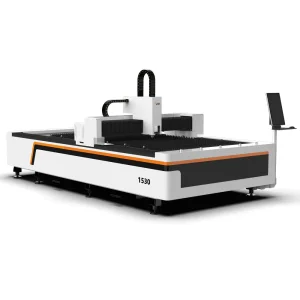
Send your oxidized, painted, or scale-encrusted metal samples directly to our Shenzhen R&D application laboratory. Our photonics engineers will determine your exact ablation threshold, calculate cycle times, and return detailed microscopic surface reports with optimized parameter configurations before you buy.