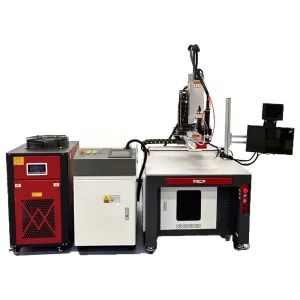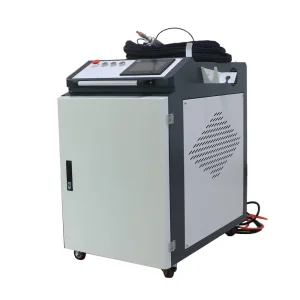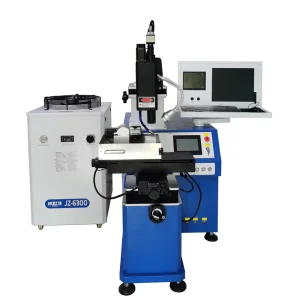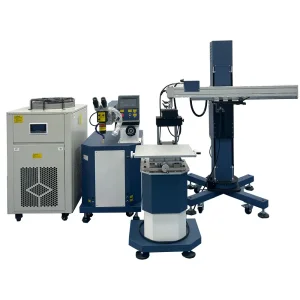
Comprehensive laser workstations designed for rapid cycle-rate joining, multi-axis automated positioning, and fine precious metal deposition.

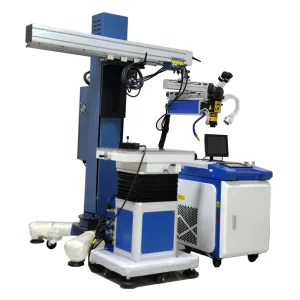
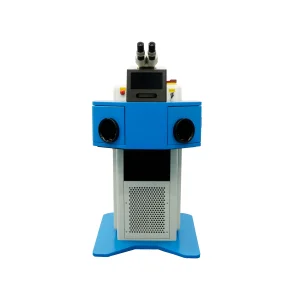
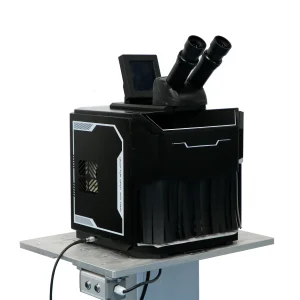
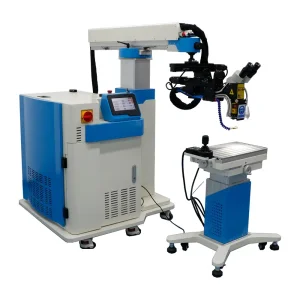
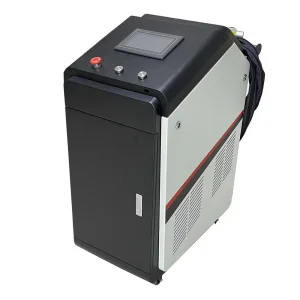
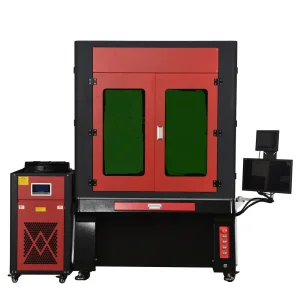
Achieving deep molten pool penetration without damaging heat-sensitive gemstones or inducing structural brittleness requires a comprehensive understanding of laser-matter interaction dynamics.
The micro-welding sector relies on two core laser architectures, each optimized for different operational demands:
Precious metals exhibit low initial absorption at 1064nm wavelengths under room conditions (silver reflects over 95% of incident energy). Our systems counter this using proprietary pulse shaping:
Proper spot welding requires precise inert shielding to stop oxidization on hot weld pools:
Realistic B2B ex-factory pricing baselines from Shenzhen production facilities. Exact investment depends on laser power, optical configurations, and automation assemblies.
| Machine Category / Configuration | Laser Source | Peak Output / Energy | Optimal Materials | Indicative Price Range (FOB) |
|---|---|---|---|---|
| Benchtop Compact Repair Welder | Nd:YAG (Air-Cooled) | 60W / 40J | Gold, Silver, Platinum, Brass | $2,800 – $4,200 |
| Standard Desktop Jewelry Spot Welder | Nd:YAG (Built-in Chiller) | 100W – 150W / 60-80J | Precious Metals, Titanium, Orthodontic Wire | $3,500 – $5,400 |
| High-Duty Vertical Cabinet Welder | Nd:YAG (Water-Cooled Industrial) | 200W / 100J - 120J | Heavy Castings, Chains, Dense Silver Alloys | $4,800 – $7,200 |
| QCW Precision Fiber Laser Welder | Quasi-Continuous Fiber | 150W (Peak 1500W) | Ultra-fine wire, medical sensors, exotic alloys | $8,500 – $13,000 |
| Integrated Boom / Mold Laser Welder | Nd:YAG or Fiber Hybrid | 200W – 400W / 120J | Jewelry Dies, Large Injection Molds, Bronze Sculptures | $6,200 – $10,500 |
*Note: Final pricing variations depend on the choice of microscope optics (Leica vs. Standard HD), optical fiber length, customized chamber sizing, and domestic vs. imported laser pump chambers.
Shenzhen's industrial laser cluster combines integrated component supply chains, rapid prototyping, and cost-efficient high-precision manufacturing.
Within a 50-kilometer radius of our Guangming District plant, we directly access world-class optics, high-pressure ceramic pump cavities, Xenon flashlamps, and tailored precision sheet metals. This concentrated supply chain lowers manufacturing costs by 35-50% compared to European or American alternatives without compromising quality.
We support full-tier white-label manufacturing for global distributors. From personalized touchscreen UI interfaces (available in English, Spanish, Russian, Turkish, Arabic, and French) to specialized industrial casing, custom gas nozzles, and boom-arm adaptations, our internal design team delivers working prototypes within 14 business days.
Every spot welder undergoes a mandatory 72-hour continuous full-power thermal stress and pulse stability trial before packing. Optical beam analyzers verify focal point geometry and pulse energy repeatability, ensuring plug-and-play installation upon customs clearance in destination ports.
Deploying laser machinery into demanding jurisdictions across North America, the EU, and APAC requires clear adherence to international safety protocols and straightforward support infrastructure.
Our export machinery complies fully with European Machinery Directive 2006/42/EC and Low Voltage Directive 2014/35/EU. For US entry, machines register with CDRH/FDA accession guidelines. Workchambers feature dual safety interlocks, emergency-stop circuitry, and certified OD6+ laser protective viewing glass.
Laser uptime directly impacts your bottom line. We provide round-the-clock remote diagnostics via high-speed video support, comprehensive schematic libraries, and stocked warehouses containing replacement flashlamps, deionizing resin filters, focal lenses, and protective glasses dispatchable within 24 hours.
Equipment is packaged in vacuum-sealed moisture barrier foils and heavy-duty, fumigated ISPM-15 compliant plywood crates designed for sea, air, and express couriers (DHL/FedEx). DDP (Delivered Duty Paid) shipping arrangements remove the friction of clearance tariffs for global buyers.
The transition from manual goldsmithing benches to automated micro-manufacturing is driving several clear technological developments.
Modern production incorporates automated target recognition. Machine-vision cameras identify chain links, prongs, or electronic pin positions, compensating automatically for spatial positioning errors and driving robotic servo stages without manual joystick control.
While 1064nm infrared remains the industry standard, green (532nm) and blue (450nm) wavelengths achieve absorption rates above 60% in pure copper and high-karat gold. Hybrid beam setups combine wavelengths to deliver spatter-free, zero-porosity joints on critical electronic pins and luxury items.
Bulky, noisy cabinet systems are giving way to sleek desktop devices designed for retail environments. Quiet, internal closed-loop water chillers, 110V/220V dual-voltage compatibility, and modern exteriors allow boutiques to offer on-the-spot jewelry sizing directly in front of the consumer.
Direct technical responses addressing system longevity, training requirements, metallurgical compatibility, and operational safety.
Yes. The localized nature of a pulsed Nd:YAG or fiber laser creates an extremely narrow Heat-Affected Zone (HAZ). Solder-free prong re-tipping can be carried out right next to diamonds, sapphires, and rubies without thermal shock or scorching. Caution is recommended around organic, soft, or heat-sensitive stones like opals, emeralds, and pearls, which should be protected or submerged in wet putty.
An industrial pulsed Xenon flashlamp typically delivers between 3,000,000 to 5,000,000 pulses, depending on energy levels. For an active workshop, this equates to 12 to 24 months of consistent operation. Replacement flashlamps are inexpensive ($60 to $120) and take about 15 minutes to replace without needing to recalibrate the optical chamber.
Laser spot welding melts parent metals together autogenously without requiring lower-karat solders. This preserves the metal's purity, eliminates flux oxidation, avoids fire-scale removal pickling baths, and shortens cycle times by up to 70%. It also enables reliable repairs on hollow links and complex antique filigree that torch flames would destroy.
Most 60W to 100W desktop spot welders operate on a standard single-phase 110V/220V ±10%, 50/60Hz line, drawing less power than an electric iron (under 1.5 kW). They do not require external industrial chillers. You only need a bottle of welding-grade pure Argon gas (99.999%) fitted with a low-flow regulator (3-5 L/min).
Yes. Bench jewelers with traditional bench skills usually become comfortable with our systems within 2 to 4 hours. Digital touchscreens let operators store optimized parameters for different carats, including 14K, 18K, 24K, 925 silver, platinum, titanium, and stainless steel. Precise crosshairs inside the stereo-microscope simplify beam alignment.
Safety is built directly into our enclosures. The working chamber is surrounded by an optical shield rated OD6+ at 1064nm. The stereomicroscope eyepiece includes a high-speed LCD shutter that darkens in less than 2 milliseconds when the beam fires, completely blocking reflected glare. Microswitch interlocks cut off laser power if the cabinet is opened during operation.
Explore our heavy-duty cantilever systems, continuous CNC fiber welders, and surface preparation units engineered for diverse high-throughput production.