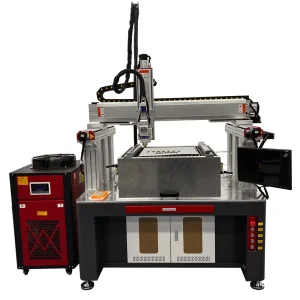
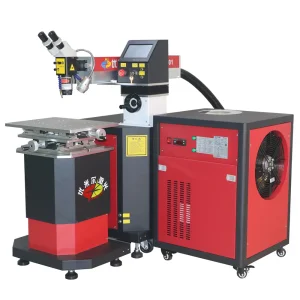
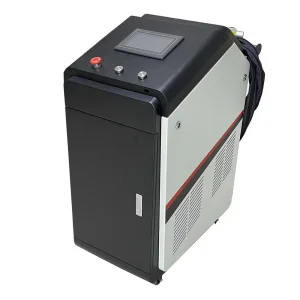
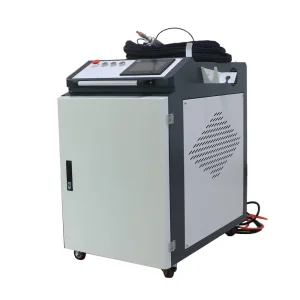
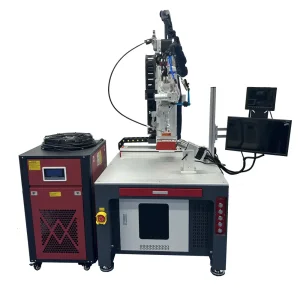
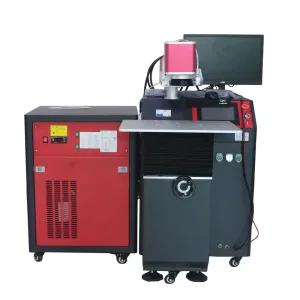
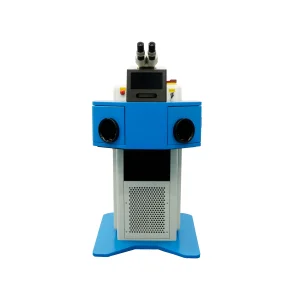
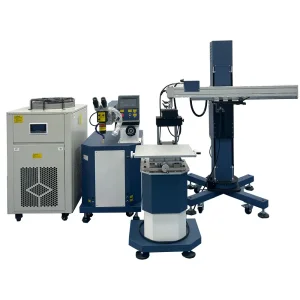
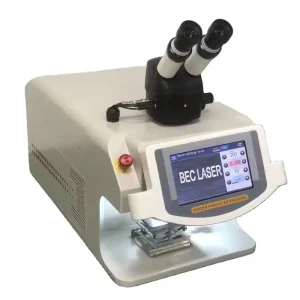
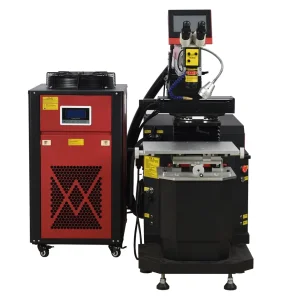
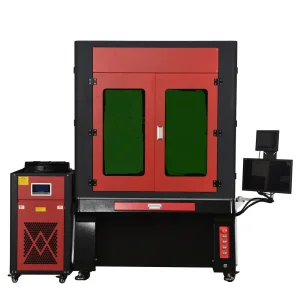
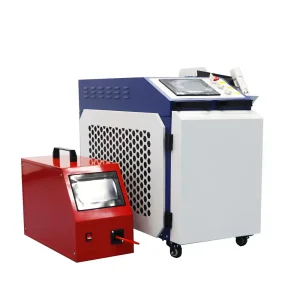
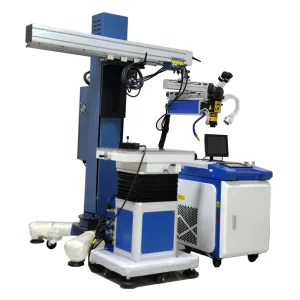
Engineered with proprietary optical control, rigid kinematic arms, and optimized fiber resonators for demanding mold maintenance and micro-machining.
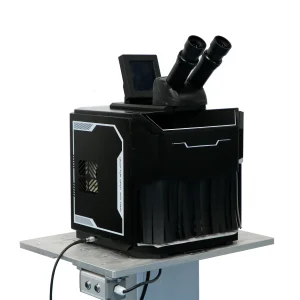
A comprehensive examination of how pulse-shaping fiber and Nd:YAG laser deposition eliminates heat-affected zone (HAZ) stress cracking in high-tensile tool steels.
Traditional Tungsten Inert Gas (TIG) micro-welding imparts excessive heat transfer into mold base materials, causing thermal stress risers, micro-cracking, and base-metal warping. Custom mold laser welding machines generate high-density photon concentrations focused to spots as narrow as 0.15 mm to 0.3 mm.
By confining thermal diffusion to within fractions of a millimeter, the base metal structure—including tempered H13, S136, and NAK80 alloys—retains its pre-hardened core hardness without sink marks or microstructural annealing.
Rapid heating and cooling rates inherent in pulsed fiber laser cladding encourage dendritic crystal grain refinement in deposited filler alloys. Using compatible wire alloys (such as Cr-Mo-V tool steels and nickel-base superalloys), laser micro-deposition produces an almost pore-free metallurgical bond.
The resulting weld deposit demonstrates superior fatigue strength, wear resistance, and polishing capability, reaching mirror finishes above SPI A1 standards without orange peel or pinholes.
Disassembling large injection mold bases or multi-ton stamping dies causes extended machine downtime and secondary alignment calibration errors. Modern integrated cantilever and boom arm mold laser welders bring high-precision energy beams directly inside the molding machine.
With multi-axis motorized articulating heads reaching up to 1.8 meters, operators can repair parting line wear, core pin fractures, and gate erosion within hours rather than days.
| Process Parameter | Conventional TIG Welding | Micro-Plasma Arc | Youmir Fiber Mold Laser Welder |
|---|---|---|---|
| Heat-Affected Zone (HAZ) | 2.5 mm – 6.0 mm (Severe) | 1.0 mm – 2.0 mm (Moderate) | 0.10 mm – 0.35 mm (Negligible) |
| Minimum Deposit Diameter | 1.2 mm | 0.8 mm | 0.15 mm (Ultra-fine wire) |
| Base Material Annealing | Frequent; requires re-hardening | Occasional localized softening | None; base hardness maintained |
| Post-Weld Machining Time | High (Extensive EDM & grinding) | Moderate grinding needed | Minimal; manual stone or polish |
| Mirror Finish Attainability | Poor (Porosity and pitting risk) | Acceptable for SPI B2 | Superior (SPI A1 / Optical grade) |
How the rapid shift toward structural EV die-castings and medical micro-molding is reshaping OEM capital equipment specifications across Europe, North America, and Asia.
The automotive industry’s adoption of 6,000 to 12,000-ton high-pressure die casting (HPDC) machines for single-piece rear underbody structures has introduced new toolroom challenges. Die inserts weighing hundreds of kilograms suffer from localized thermal fatigue cracking, cavitation pitting, and soldering.
Global procurement teams specify custom boom-type mold laser welders equipped with extended reach cantilevers and fiber-delivered energy to perform on-press cladding without unseating multi-ton die sets.
High-cavitation injection molds for insulin delivery systems, microfluidic chips, and diagnostic cassettes demand dimensional repair tolerances within ±5 microns. Toolmakers in medical clusters across Germany, Switzerland, and the United States require laser welding platforms featuring high-magnification binocular stereomicroscopes, crosshair CCD overlays, and specialized pulse-shaping firmware.
These capabilities permit micro-deposits along razor-thin shut-off lands without flash formation or thermal cavity collapse.
Corporate procurement analyses demonstrate that while traditional TIG systems involve lower initial capital expenditure, laser mold welding delivers an average ROI in under 6 months. By eliminating secondary heat treatment costs, reducing scrap rates on complex hot-runner manifolds, and slashing manual hand-stoning labor by up to 75%, fiber laser mold repair units substantially reduce operational overhead.
How vertically integrated optical engineering, direct motion-controller manufacturing, and strict quality verification deliver unmatched reliability for global industrial clients.
Headquartered in Shenzhen’s high-tech manufacturing corridor, Youmir Laser leverages an integrated optical and mechanical supply chain. Our proprietary R&D encompasses optical collimation heads, water cooling chillers, custom swing-arm kinematics, and high-speed galvanometer drivers.
Eliminating third-party sub-assembly markups guarantees rapid spare-parts availability and delivers significant cost advantages to international buyers without sacrificing component quality.
Every laser welding and cleaning system undergoes a mandatory 72-hour continuous thermal cycling burn-in protocol before crating. Laser power stability is recorded via calibrated power meters, ensuring output power fluctuations remain below ±1.5% across 8-hour continuous shifts.
Optical paths are sealed in positive-pressure, dust-controlled cleanrooms to protect sensitive coated lenses from airborne particulate contamination.
Our machinery strictly adheres to European CE directives, ISO 9001:2015 manufacturing workflows, and FDA laser device standards. International clients receive full electrical schematic documentation tailored to local industrial voltages (including 200V, 220V, 380V, and 480V three-phase configurations).
Supported by multilingual remote telemetry and factory-direct engineer dispatch, your production lines remain fully operational around the clock.
Real-world engineering use cases spanning tier-1 automotive tooling, high-volume consumer electronics, and aerospace manufacturing facilities.
Repair of parting line damage and shear wear in textured automotive interior molds (P20 & 718 steels). Pulsed wire deposition prevents surface sink marks and preserves adjacent EDM grain texturing, eliminating the need to completely re-texture the cavity.
Aluminum HPDC molds face recurring thermal fatigue micro-cracking around cooling channels and gate runners. Laser cladding with specialized maraging or H13-equivalent wire seals micro-fissures and halts crack propagation under high cycling loads.
High-speed tungsten carbide or D2 progressive stamping dies develop chipping and rounded cutting profiles over millions of strokes. Laser micro-welding restores sharp 90° cutting edges without inducing edge brittleness or post-weld microcracking.
When design revisions require adding material to core inserts or moving rib gates, laser cladding builds up accurate metallurgical volumes. This enables rapid CNC remachining in hours without scrapping hardened tooling sets.
In-depth answers addressing metallurgy, equipment configuration, shielding gases, warranty protocols, and export logistics.
Flashlamp-pumped Nd:YAG lasers deliver high single-pulse peak powers (up to 9 kW) at low repetition rates, making them well-suited for medium-to-large wire diameters (0.3–0.6 mm) on tool steels. QCW and continuous fiber lasers provide near-diffraction-limited beam quality (M² < 1.2), exceptional electro-optical efficiency (>30% vs. 3% for YAG), and maintenance-free operational life up to 100,000 hours. QCW fiber lasers allow extremely fine micro-welding with wires as thin as 0.1 mm, whereas continuous fiber with wobble heads excels at rapid, larger-area cladding.
Yes. The ultra-narrow focal spot and customizable pulse shaping (square, ramping, or annealing pulse profiles) control heating and cooling rates with precision. By preheating the localized spot with an initial ramp and shielding the melt pool with 99.999% pure argon gas, the weld freezes without creating untempered brittle martensite. As a result, the tool retains uniform hardness (typically 50–54 HRC depending on wire selection) and polishes uniformly to SPI A1 optical clarity without sunken boundaries.
High-purity industrial Argon (minimum 99.99%) is the standard shielding gas, delivered at a laminar flow rate of 6 to 12 liters per minute through a coaxial or side-blown adjustable nozzle. For reactive alloys or beryllium copper core inserts, nitrogen or argon-helium blends may be deployed. Maintaining correct flow dynamics is critical: excessive velocity induces venturi-effect oxygen entrainment, leading to microscopic porosity that ruins optical polishing.
Our boom mold laser welding series features a 360-degree rotating cantilevered arm, motorized Z-axis elevation (up to 1200 mm), and smooth cross-arm telescoping reaching up to 1800 mm. The optical welding head rotates along three spatial axes (±90° pitch and roll), allowing operators to orient the laser beam horizontally or obliquely into deep recesses inside an injection molding machine clamp, completely bypassing the need to remove the tool.
Youmir Laser provides a comprehensive 24-month warranty on laser sources and optical heads, backed by a 5-year guarantee on mechanical framework assemblies. Critical spare components (protective quartz cover slides, focus lenses, collimators, and circuit boards) ship via international express air freight within 24 hours. Overseas support includes remote cloud diagnostic connections, direct engineer video consultations, and available on-site deployment through our international distributor network.
Yes. We operate an advanced application laboratory dedicated to sample testing. Overseas customers can ship damaged mold inserts, specific alloy coupons, or custom wire stock to our factory. Our metallurgists will perform complete cladding trials, generate macro/micro-section metallurgical reports, film high-resolution process videos, and recommend precise laser power, pulse duration, and wobble parameters tailored to your exact production goals.
Explore specialized cantilever welders, high-speed galvanometer systems, and multi-axis CNC machines engineered for demanding toolroom environments.
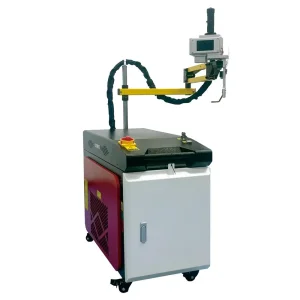
Send your workpiece drawings, alloy specifications, and cycle-time requirements to our Shenzhen R&D engineering center for a comprehensive technical proposal and free lab testing video.