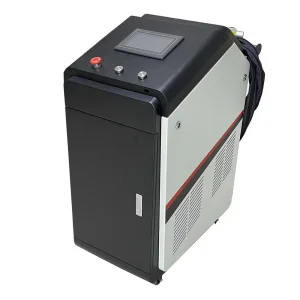
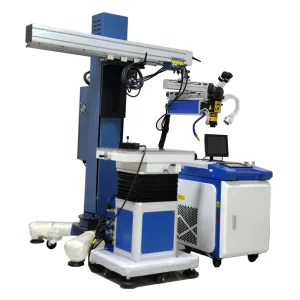
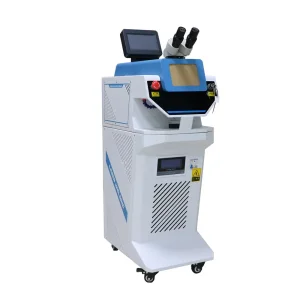
Direct-from-factory laser processing equipment engineered for die remediation, manufacturing scalability, and precision metallurgical bonding.
Comprehensive engineering breakdown of solid-state laser deposition welding for high-precision injection tooling, stamping dies, and rapid metallurgical prototyping.
Unlike conventional TIG or micro-arc setups, pulsed solid-state Nd:YAG resonators localize thermal dissipation within millisecond pulse durations. The resulting Heat-Affected Zone (HAZ) remains microscopic, preventing dimensional shrinkage, structural warpage, and temper softening on complex tool-grade steels (NAK80, H13, S136, SKD11).
YAG beam absorption characteristics enable clean micro-wire deposition down to diameters of 0.1 mm to 0.8 mm. Operators precisely deposit matching metallurgical alloys into worn ejector pin holes, shear edges, micro-cracks, and parting-line washouts under high-magnification stereomicroscopic visualization with crosshair alignments.
Large-format mold remediation demands extreme maneuverability. Our multi-axis articulated optical boom assemblies, featuring motorized 360-degree rotation, cantilever extensions, and localized magnetic locking, allow on-press remediation of 10+ ton tools directly on the production floor without tool disassembly.
Strategic shift from lamp-pumped solid-state architectures to intelligent quasi-continuous wave (QCW) and high-brightness fiber laser solutions.
| Evaluation Parameter | Legacy Flashlamp Nd:YAG | Next-Gen QCW Fiber Architecture | Continuous-Wave (CW) Hybrid Wobble |
|---|---|---|---|
| Wall-Plug Efficiency (WPE) | 2.0% – 3.5% (High Cooling Overhead) | 28.0% – 35.0% (Air/Low-Power Chiller) | 35.0% – 42.0% (Integrated Chilling Unit) |
| Pulse Peak Power Dynamics | Extremely high peak (~9 kW to 15 kW) | Dynamic scalable peak (Up to 15 kW) | Continuous flat output or wobble-shaped |
| Pulsed Thermal Stability | Thermal lens distortion over long runs | Zero thermal lensing, monolithic optical fiber | Uniform energy distribution profile |
| Maintenance Cycle | Flashlamp replacement at 800-1200 hrs | Diode stack lifespan > 100,000 hrs | Diode pump modules > 100,000 hrs |
| Primary Application Scope | Micro-precision edges, high-gloss cavities | Ultra-fine medical dies, micro-mold seams | Heavy deposition, large-die cladding |
Quantifiable operational impacts and tool lifespan extensions documented across global industrial clusters.
Tier-1 automotive stamping facilities face up to $15,000 per hour in unplanned line downtime. Integrated cantilever boom YAG systems allow in-press edge rebuilding on Class-A surface dies, reducing tooling turnarounds from 72 hours down to 4.5 hours with zero loss in surface tension or polishability.
For high-density micro-connectors and optical lens molds, multi-cavity injection matrices require micro-tolerance repeatability. Our closed-loop CCD tracking configurations enable sub-micron wire feed deposition without burning adjacent optical mirror-finish surfaces.
In accordance with ISO 13485 production environments, medical fluidics injection molds demand zero contamination repair. Inert argon envelope shrouding combined with customized pulse-shaping profiles eliminates micro-porosity formation within surgical tooling cavities.
Strategic value decoupling: High-specification optoelectronic manufacturing delivered directly from our Shenzhen production campus.
By producing critical optical cavities, kinematic booms, control boards, and chilling configurations in-house, Youmir delivers industrial-grade mold laser welding hardware at a 40% to 60% lower CapEx footprint than domestic European or American machinery distributors, bypassing multilayer dealer markups.
Our localized Greater Bay Area electronics and precision engineering ecosystem ensures guaranteed consumable availability. Ceramic cavities, Nd:YAG crystals, flashlamps, beam expanders, and micro-manipulators maintain standard off-the-shelf shelf-life buffers, securing international logistics dispatch within 48 hours.
Every industrial unit leaves our facility subject to rigorous stress-testing: continuous 72-hour pulse stability logging, optical power output attenuation verification under elevated ambient temperatures, and multi-point dielectric safety checks conforming to CE and FDA CDRH standards.
Complete export qualification, comprehensive safety compliance, and robust technical support to streamline cross-border implementation.
Youmir mold laser systems incorporate active interlocks, Class IV enclosure protocols, dual-channel emergency cutoff loops, and OD6+ integrated microscope optical attenuator shutters to ensure complete operator eye safety during high-magnification pulse alignment.
Factory-integrated industrial networking interfaces allow our Shenzhen-based R&D team to execute real-time telemetry diagnostics, parameter calibration, waveform optimization, and system troubleshooting directly with your internal plant maintenance personnel worldwide.
Through regional distribution networks and factory flying-squad support engineers, Youmir offers comprehensive operator commissioning programs covering metallurgical filler matching, weld seam profiling, microscopic inspection protocols, and preventive maintenance routines.
In-depth technical answers addressing operational variables, procurement concerns, and application parameters.
Explore our broader line of specialized cantilever platforms, continuous galvo-driven weld stations, and micro-jewelry systems.