Explore our top-tier continuous fiber, galvanometer handheld, multi-axis automated CNC, and mold repair laser systems configured for industrial throughput and micron-level seam repeatability.

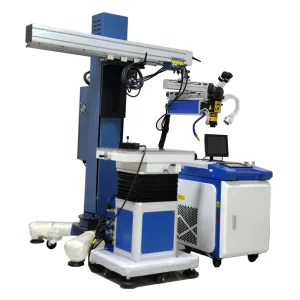



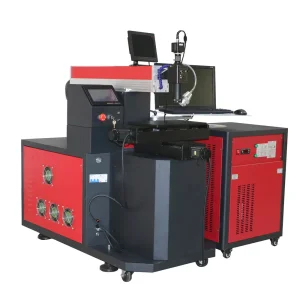

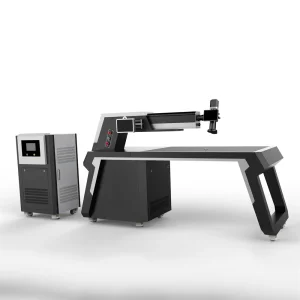
Unlike trading intermediaries, Shenzhen Youmir Laser Technology Co., Ltd. controls the complete optomechanical engineering cycle. From proprietary dual-axis wobble optical heads and digital driver circuits to proprietary embedded CNC software, our machines are designed to eliminate thermal drift and maintain constant beam focus over continuous 24/7 duty cycles.
Located in the heart of China's optical technology cluster, our factory integrates tier-1 fiber laser sources (Raycus, Maxphotonics, IPG), high-precision linear guides (Hiwin), and industrial refrigeration units (S&A Chiller). This strategic geographic advantage yields unrivaled supply chain velocity, expedited component customization, and significant factory-direct pricing benefits for foreign purchasers.
All our industrial laser systems adhere rigorously to European CE Machine Directives (2006/42/EC), Low Voltage Directives (2014/35/EU), Electromagnetic Compatibility (2014/30/EU), and US FDA radiation health standards for laser equipment. Every shipment undergoes full metallographic weld-penetration cross-section testing and 72-hour continuous thermal aging prior to container loading.
A comprehensive review of continuous wave (CW) versus quasi-continuous wave (QCW) beam delivery, oscillation mechanics, and thermal penetration dynamics across standard industrial alloys.
Continuous wave fiber lasers emit a sustained, uninterrupted beam of coherent light at a wavelength of 1070nm (±10nm). By concentrating photon densities exceeding 106 W/cm2 into a beam spot diameter under 100 μm, the process immediately bypasses traditional conduction-mode melting to initiate "deep penetration keyhole" welding.
Inside this microscopic keyhole, metal vapor pressure holds open a deep, narrow cavity surrounded by liquid molten metal. As the laser moves, liquid metal flows around the vapor cavity and solidifies at the trailing edge, resulting in an exceptionally high depth-to-width aspect ratio (frequently exceeding 5:1 to 10:1). This drastically minimizes the Heat-Affected Zone (HAZ), prevents grain coarsening, and curtails thermal workpiece warpage by 80% compared to conventional TIG/MIG arcs.
Traditional static-beam laser welding required extreme seam fit-up tolerances (gap clearances under 0.1mm), rendering manual or structural fabrication costly due to tight machining requirements. Modern Youmir handheld and automated welders integrate dual-axis galvanometer oscillation (Wobble) optics.
By rapidly translating the beam in selectable circular, elliptical, hourglass, or linear patterns at frequencies up to 300Hz, the effective focal beam width expands from 0.2mm to as wide as 5.0mm. This dynamic optical oscillation bridges joint gaps up to 1.5mm–2.0mm effortlessly, increases weld bridge capability, agitates the melt pool to liberate trapped hydrogen gas (preventing porosity), and refines the dendritic grain structure during rapid solidification.
For tool, die, and mold micro-restoration, high-carbon tool steels (P20, NAK80, SKD11, H13) are prone to thermal cracking under continuous thermal input. Quasi-Continuous Wave (QCW) fiber lasers deliver peak pulse powers up to 10× their average rated wattage (e.g., a 150W average power laser yielding 1.5kW instantaneous peak power) in short millisecond bursts.
This delivers instantaneous localized melting precisely at the point of repair wire feeding without elevating the bulk substrate temperature. The mould's critical temper, surface hardness, and microscopic dimensional tolerances remain completely preserved, eliminating post-weld annealing, stress-relieving heat treatments, or excessive EDM spark erosion re-machining.
| Process Parameter | Continuous Fiber Laser | TIG (GTAW) Welding | MIG (GMAW) Welding |
|---|---|---|---|
| Welding Velocity (1.5mm SS) | 25 - 60 mm/s (Rapid) | 5 - 10 mm/s (Slow) | 12 - 20 mm/s (Moderate) |
| Heat-Affected Zone (HAZ) | 0.2 - 0.5 mm (Minimal) | 2.5 - 5.0 mm (Severe) | 3.0 - 6.0 mm (Extensive) |
| Thermal Distortion & Warpage | Virtually Zero / Negligible | Severe angular warping | Moderate to severe distortion |
| Post-Weld Processing | Immediate use, no grinding/pickling | Heavy descaling, buffing, grinding | Slag removal, aggressive grinding |
| Dissimilar Metal Joining | Excellent (Cu to Al, SS to CS) | Very poor (intermetallics form) | Unfeasible for most alloys |
| Operator Training Curve | 1 - 3 Days (Intuitive UI) | 6 - 24 Months certified training | 1 - 3 Months shop training |
| Electrical Power Efficiency | 30% - 35% Wall-plug conversion | 10% - 15% Electrical efficiency | 15% - 20% Electrical efficiency |
Field-tested maximum material thickness specs using coaxial or trailing argon/nitrogen gas shields. Higher power ratings significantly escalate continuous travel speeds on thinner gauges.
| Rated Laser Power | Stainless Steel (304/316) | Carbon / Mild Steel (Q235) | Aluminum Alloys (6061/5052) | Brass / Copper (C1100) | Recommended Industrial Use Cases |
|---|---|---|---|---|---|
| 1000 Watt Fiber | Up to 3.0 mm | Up to 2.5 mm | Up to 1.5 mm | Up to 1.0 mm | Sheet metal enclosures, electrical cabinets, advertising signage, decorative tubing. |
| 1500 Watt Fiber | Up to 4.5 mm | Up to 4.0 mm | Up to 3.0 mm | Up to 2.0 mm | Commercial kitchen equipment, architectural handrails, HVAC ducting, furniture frames. |
| 2000 Watt Fiber | Up to 6.0 mm | Up to 5.5 mm | Up to 4.5 mm | Up to 3.0 mm | Automotive chassis components, battery busbars, pressure vessels, dairy processing tanks. |
| 3000 Watt Fiber | Up to 8.5 mm | Up to 8.0 mm | Up to 6.5 mm | Up to 4.5 mm | Heavy structural frames, agricultural machinery, shipbuilding panels, petrochemical pipes. |
* Note: Double-sided welding passes double effective penetration depths. For high-reflectivity alloys (pure copper, gold, polished brass), integrated anti-back-reflection optical isolators are standard on all Youmir systems to safeguard optical diodes.
Laser welding has transitioned from niche laboratories to the primary production backbone of modern manufacturing. Discover how diverse sectors deploy Youmir systems worldwide.
The global transition to electric vehicles demands ultra-reliable, spatter-free welding of copper busbars, aluminum battery casing cans, and prismatic cell pack tab interconnections. Our dual-wavelength and wobble fiber welders minimize brittle intermetallic phase formation in mixed copper-to-aluminum joints, maintaining pristine electrical conductivity and structural integrity under high-vibration automotive operations.
High-tonnage injection molds and casting dies often suffer microscopic parting-line chipping, cavitation erosion, or engineering revisions. Transporting multi-ton molds is cost-prohibitive. Our cantilever and integrated boom mold welders allow operators to execute localized micro-weld deposition directly on the press bed, saving mold builders tens of thousands of dollars in downtime and CNC re-machining.
Pharmaceutical fluid channels, endoscope assemblies, surgical instruments, and dairy piping demand 100% full-penetration, crevice-free seams that prevent bacterial accumulation. Continuous fiber laser welding provides hermetically sealed, oxidation-free joint geometries with zero chemical filler flux, fully meeting stringent FDA and cGMP sanitary standards without post-process pickling.
Job shops handling custom elevator enclosures, high-end stainless storefronts, commercial kitchen hoods, and signage letters benefit from 4-in-1 multi-functional handheld heads. Operators switch from wire-fed fillet welding to cosmetic surface cleaning or quick edge trimming in seconds, reducing capital equipment duplication and shop-floor footprint.
Shenzhen Youmir Laser engineers custom multi-axis CNC cells, robotic arm integrations, and automated conveyor lines tailored to high-mix, high-volume manufacturing facilities.
Equipped with 3-axis, 4-axis, or 5-axis interpolated servo gantry drives and planetary rotary chucks, our CNC enclosed systems handle circumferential circular welds on cylinders, linear seams, and complex 3D contour paths. Optical vision seam-tracking cameras auto-compensate for thermal part expansion in real-time, maintaining laser focal alignment to within ±0.02mm.
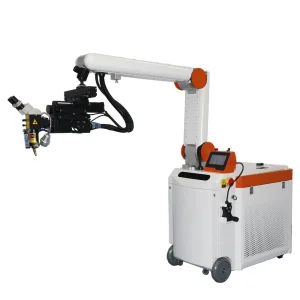
For large assemblies, automotive sub-frames, and complex stamping enclosures, we integrate 6-axis industrial articulated robots (KUKA, FANUC, ABB, or Estun) with fiber laser heads and automatic wire feeders. This eliminates manual ergonomics issues while multiplying daily throughput by 300% to 500% compared to manual welding crews.
When joint fit-ups exceed 0.5mm, automated wire feeding becomes critical. Our microprocessor-controlled dual-roller drive units eliminate wire slippage, feeding aluminum (ER4043, ER5356) and stainless steel (ER308L, ER316L) wire smoothly down to 0.8mm–1.6mm diameters with precise pulse retract anti-stick mechanics.
When calculating Return on Investment (ROI) for industrial machinery, equipment purchase price represents only a fraction of lifetime expenditures. Here is how laser technology compares against traditional arc welding over a 3-year baseline.
Experienced TIG welding professionals command premium hourly rates ($30–$60+/hr in North America and Western Europe) and face severe industry shortage. Fiber laser welders allow general operators with only 2 days of onboarding to produce mirror-finish, defect-free seams, shrinking factory labor burdens by 60%.
TIG processes consume expensive tungsten electrodes, ceramic cups, argon gas, and excessive filler rods. Laser welding consumes shielding gas at a significantly lower flow rate (12–15 L/min), eliminates tungsten entirely, and reduces protective cover slide costs to under $2.00 per replacement window.
Grinding, deburring, wire wheel polishing, and acid pickling paste treatments typically occupy 40% to 50% of total shop labor in stainless steel fabrication. Laser welds form ultra-smooth, uniform crowns that completely eliminate grinding, allowing products to proceed immediately to powder coating or final packaging.
Fiber laser pump diodes operate at over 30% wall-plug electro-optical efficiency, compared to older solid-state flashlamp YAG lasers (2% to 3%) or legacy transformer arc sets. A 1500W fiber laser typically draws only 5 to 6 kW of total electricity including chiller operation, reducing electrical utility bills dramatically.
At Youmir Laser, no machine is crated until it passes our comprehensive 5-stage engineering inspection protocol, backed by documented test logs and video verification provided directly to the overseas buyer.
Using calibrated Ophir laser power meters and CCD beam profilers, our technicians measure focal spot diameter, beam caustic propagation (M2 factor < 1.2), and real optical output power across a stepped power curve from 10% to 100% capacity.
The entire system, including optical laser sources, industrial dual-temperature chillers, and CNC controllers, undergoes a 72-hour continuous cycling test inside high-ambient temperature rooms to guarantee immunity against thermal power drift and component failure.
Buyers are invited to dispatch their proprietary production workpieces to our Shenzhen factory. Our metallurgists conduct test welds, section the joints, polish and chemical-etch the cross-sections, and provide comprehensive metallurgical reports confirming grain structure and penetration.
Clear, technically accurate answers directly from our senior optical engineering and international trade support teams.
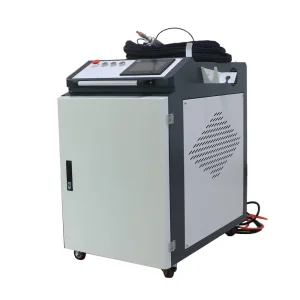
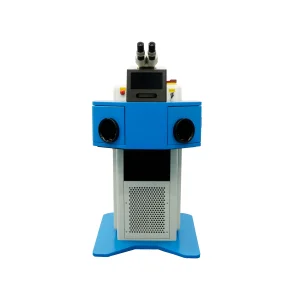
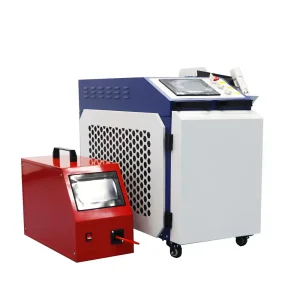
Explore our specialized industrial solutions, from ultra-high-precision jewelry spot welders and cantilever die repair workstations to nanosecond pulsed surface cleaners and fiber sheet cutters.




Connect directly with Shenzhen Youmir Laser application engineers. Send your alloy technical drawings or physical workpieces to our Shenzhen laboratory for metallographic trial testing, parameter benchmarking, and tailored machinery quotations.
