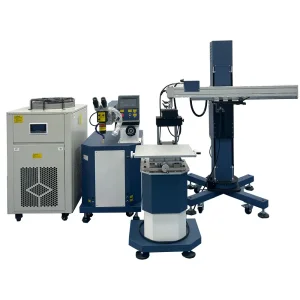
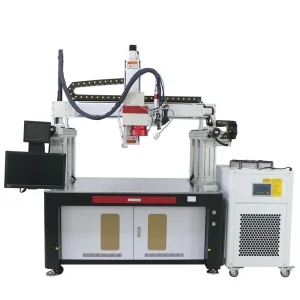
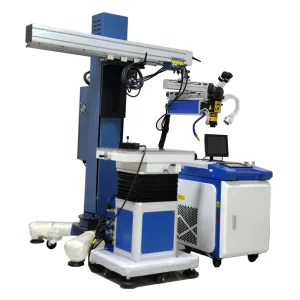
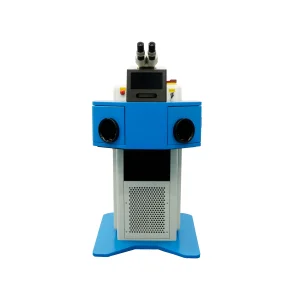
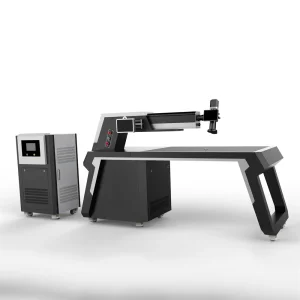
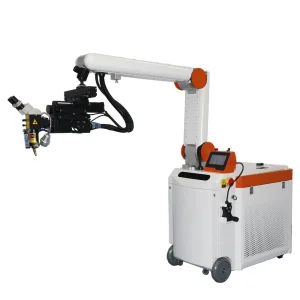
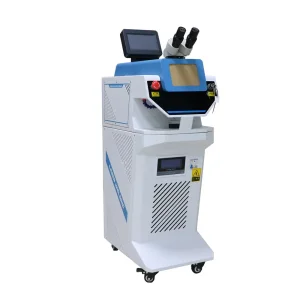
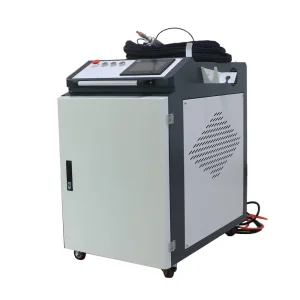
Explore our high-performance CNC, galvanometer, continuous fiber, and cantilever mold repair systems engineered in Shenzhen for high-volume automated manufacturing and exacting artisan metallurgy.
The manufacturing paradigm is shifting decisively from legacy resistance spot welding (RSW) and micro-TIG arcs toward non-contact laser spot welding systems, unlocking unmatched micro-structural integrity.
Traditional resistance spot welding suffers from electrode degradation, high electrical draw, and broad mechanical deformation. Modern industrial factories replace copper tips with Quasi-Continuous Wave (QCW) fiber lasers, eliminating consumable wear and applying exact millijoule energy doses without mechanical contact.
In thin foil bonding, battery terminal bussing, and medical instrument micro-welding, excessive heat ruins structural tempering. Laser spot welding reduces the heat-affected zone (HAZ) by over 75% compared to micro-TIG, allowing hermetic spot joins within 0.2 mm of heat-sensitive electronic substrates and ruby gemstone settings.
With fiber electro-optical conversion efficiencies exceeding 30% to 35% (versus 2-3% for flashlamp-pumped Nd:YAG crystals), manufacturers cut plant electrical overhead drastically. The absence of mechanical tooling wear translates to mean-time-between-failures (MTBF) exceeding 100,000 laser operating hours.
From dynamic high-speed beam oscillation to dual-wavelength hybrid welding, our engineering and R&D labs integrate tomorrow's breakthroughs into turnkey factory production systems.
Dual-axis galvanometer wobble heads oscillate the laser beam in circular, elliptical, figure-eight, and line vectors up to 1500 Hz. This stirs the molten pool dynamically, venting trapped vapor pockets, bridging joint gaps up to 0.5 mm without filler, and virtually eliminating keyhole blowout porosity.
By dividing the spot into an independent high-intensity center core and a surrounding ring beam, ARM technology preheats reflective metals like pure Copper (C1100) and Gold while the core penetrates the seam. This minimizes molten metal spatter by 90% during EV battery tab and hair-pin stator welding.
Our integrated CMOS camera optical modules and Optical Coherence Tomography (OCT) scan the target pre-weld to auto-align spot placement within ±5 μm. During laser firing, photodiode back-reflection sensors verify spot penetration depth, instantly rejecting cold joins on automated factory lines.
Explore how Youmir Laser spot welders serve regional industrial clusters around the globe with specialized kinematic architectures and material-specific laser recipes.
Engineered for high-karat gold, 925 sterling silver, titanium, and platinum repair. Binocular stereo microscopes with anti-glare liquid crystal shutters protect artisan vision while pulsing 0.1 mm micro-spots for prong re-tipping, ring resizing, porous casting sealing, and orthodontic bridge joining.
Integrated boom and cantilever arm laser systems reach directly into 10-ton plastic injection molds and stamping dies without dismounting the tooling. Using specialized hard-facing wire (H13, NAK80, P20), laser spot welding repairs parted lines, broken ejector pin holes, and chipped gate corners without sink marks or annealing.
Micro-joining multi-layer copper and aluminum foil tabs, prismatic cell busbars, and cylindrical 18650/21700 cell pack matrices. Low-impedance metallurgical bonds withstand grueling thermal and vibration shock profiles while preserving internal electrolyte pouch integrity.
Hermetic spot micro-welding for implantable pacemakers, laparoscopic instruments, and aerospace telemetry sensors. Eliminates flux and spatter under Class 100 cleanroom conditions with inert argon/nitrogen shielding, meeting stringent ISO 13485 and AS9100 manufacturing specifications.
Engineered reference data directly from our Shenzhen testing labs. Match your alloy chemistry, component thickness, and duty cycle to the optimal laser source and optical delivery mechanism.
| Laser Source Type | Pulse Energy / Power | Focused Spot Size | Target Material Spectrum | Best Industrial Application |
|---|---|---|---|---|
| Pulsed Nd:YAG (Lamp-Pumped) | 40 J – 120 J / 100 W–200 W | 0.1 mm – 3.0 mm | Gold, Silver, Titanium, Platinum, Ni-Alloy | Artisan Jewelry, Dental Restoration, Precision Prototyping |
| Quasi-Continuous Wave (QCW) Fiber | 15 J – 75 J / 150 W–600 W (Peak 6 kW) | 0.03 mm – 1.5 mm | Copper, Brass, Stainless, Tool Steels | Injection Mold Repair, Battery Tab Welding, Micro-Relays |
| Continuous Wave (CW) Fiber | 1000 W – 3000 W Continuous | 0.2 mm – 4.0 mm (Wobble) | Carbon Steel, Stainless, Aluminum Alloy | Automated Automotive Frames, Sheet Metal Cabinets, Structural HVAC |
| High-Speed Galvo Scanner Fiber | 300 W – 1500 W Fiber / QCW | 0.05 mm – 0.8 mm | Thin Foils, Dissimilar Cu-Al, Busbars | Mass EV Battery Pack Production, Consumer 3C Electronics |
| Cantilever / Boom Arm Fiber | 300 W – 500 W QCW / 1.5 kW CW | 0.2 mm – 2.5 mm | H13, NAK80, 718, S136 Tooling Steels | Heavy Die Casting Molds, Extrusion Screw Refurbishment |
Shenzhen Youmir Laser bridges stand-alone laser hardware with modern Industry 4.0 production environments, offering fully customized automation cells for international manufacturing plants.
We pair fiber spot laser welders with 6-axis industrial robots (KUKA, ABB, Fanuc) or Cartesian XYZ gantry systems. Synchronized rotary indexers (A/B axes) enable 360-degree cylindrical weld paths on complex sensors, turbine fuel nozzles, and automotive solenoid valves with ±0.01 mm repeatability.
Our automation systems integrate real-time optical process monitors that measure spectral emission and melt pool infrared radiation on every pulse. Out-of-spec micro-voids, contamination, or laser energy drops trigger pneumatic reject diverters on conveyor lines in less than 20 milliseconds.
We provide full OEM/ODM branding, bespoke UI development in 15+ languages, and regional electrical conformity (UL, CE, CSA, UKCA). With cloud-connected telemetry, our factory engineers deliver 24/7 remote optical calibration, diagnostic sweeps, and localized process optimization anywhere in the world.
Anticipating the demands of next-generation solid-state batteries, aerospace composites, and sub-micron electronics through proactive optical research.
Standard infrared (1064 nm) laser beams face up to 95% surface reflection on pure copper and gold. Our next-generation optical engines incorporate 450 nm blue and 532 nm green laser sources, where copper absorbs over 65% of room-temperature energy. This enables zero-spatter conductive spot welding on EV pouch cells and semiconductor pin grids without substrate thermal burn.
Moving beyond thermal conduction welding, our R&D laboratories are validating cold ablation micro-welding via ultrafast picosecond pulses. This yields zero heat diffusion, enabling molecular bonds between transparent polymers, quartz glass, and delicate silicon semiconductor dice without intermediate adhesive agents.
Future spot welding heads will feature edge-computing neural accelerators. By analyzing high-speed coaxial melt pool thermal imaging at 10,000 frames per second, machine learning models will auto-adjust pulse duration and peak power during the 15-millisecond firing cycle to compensate for alloy oxidation and mill-scale variances.
Integrating localized coaxial micro-powder feeding nozzles directly into manual and CNC spot welding optical heads. This allows single-setup repair for worn turbine blade tips, micro-gears, and fine cutting tools, combining additive material build-up and spot smoothing in one machine.
In-depth insights covering machine selection, operational parameters, shielding gases, material compatibility, and international after-sales support.
Discover our dedicated line of vertical jewelers' workbenches, advertising channel-letter welders, fiber-coupled transmission workstations, and precision laser surface cleaners.