Direct factory configurations calibrated for extreme metallurgical integrity, deep weld penetration, zero post-grind cleanups, and 24/7 continuous industrial duty cycles.
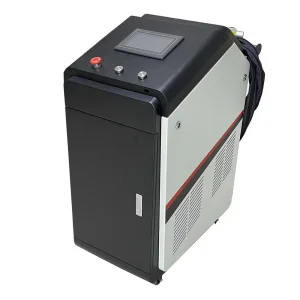


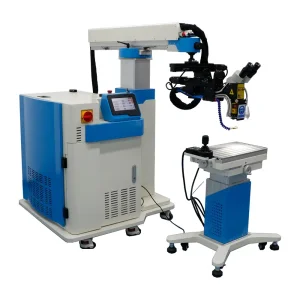
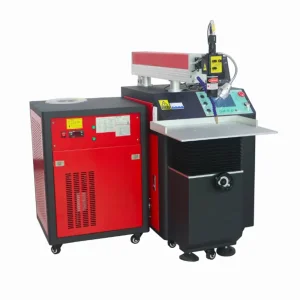
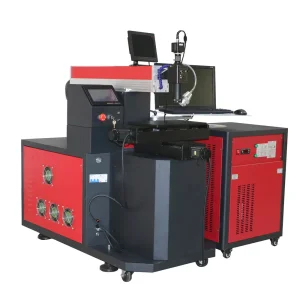
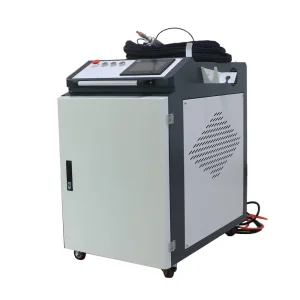

A granular analysis of keyhole vapor capillary mechanics, thermal diffusion zones, and why high-density beam delivery supplants traditional Gas Tungsten Arc Welding (GTAW/TIG) and Gas Metal Arc Welding (GMAW/MIG).
Traditional electric arc welding relies purely on conductive heat transfer from an electric discharge, causing a widespread Heat-Affected Zone (HAZ) of 1.5mm to 3.5mm, leading to severe thermal warpage. In contrast, our Light Weld Laser Welder systems operate at power densities exceeding 106 W/cm2. This instantly vaporizes a micro-column of substrate material, establishing an ionized plasma keyhole that concentrates 1070nm photons straight through the joint interface with minimal lateral heat bleed (HAZ < 0.2mm).
Early direct-beam fiber welders suffered from stringent joint tolerance limits: gaps larger than 0.2mm would cause undercutting or drop-through. Our advanced handheld heads feature integrated dual-axis galvanometer scanning mirrors capable of dynamic beam wobbling at frequencies up to 300 Hz. Beam patterns (circular, figure-eight, sinusoidal, triangular) synthesize an adjustable weld pool width from 0.5mm to 5.0mm, accommodating uneven joint gaps while actively expelling gas bubbles from molten titanium, stainless, and aluminum baths.
Because the laser thermal cycle entails rapid heating and ultra-fast cooling rates (103 to 105 K/s), dendritic grain boundaries are dramatically restricted compared to the coarse, columnar grain structures of TIG welding. In high-tensile steels and austenitic stainless alloys (such as 304 and 316L), this rapid solidification effectively eliminates chromium carbide precipitation (sensitization), preserving corrosion resistance without post-process pickling, passivation, or mechanical re-work.
| Welding Process Parameter | Light Weld Laser Welder | TIG (GTAW) System | MIG (GMAW) System |
|---|---|---|---|
| Heat-Affected Zone (HAZ) | < 0.25 mm (Ultra-Narrow) | 1.80 mm – 3.20 mm (Broad) | 2.50 mm – 5.00 mm (Severe) |
| Feed Travel Speed (1mm 304 SS) | 35 – 70 mm/s (4x - 6x Faster) | 5 – 10 mm/s (Operator Paced) | 12 – 18 mm/s |
| Thermal Distortion / Sheet Warpage | Virtually Undetectable | High (Requires clamping/jigging) | Very High (Post-straightening required) |
| Operator Skill Ramp-Up Curve | 2 to 4 Hours Basic Competence | 6 to 18 Months Apprenticeship | 2 to 4 Months Specialized Training |
| Post-Weld Processing | Zero Grinding / Clean Seam | Extensive Grinding / Pickling | Heavy Deslagging / Flap Wheel Buffing |
| Electrical Wall-Plug Efficiency | > 38% Direct Solid-State | ~ 20% – 25% | ~ 22% – 28% |
How Shenzhen Youmir Laser harnesses the Greater Bay Area’s hyper-integrated optical, mechanical, and semiconductor industrial clusters to deliver institutional reliability at disruptive enterprise pricing.
Unlike Western equipment assemblers who rely on fragmented third-party subcontractors across continents, Youmir Laser executes in-house manufacturing from the ground up in Shenzhen. We control our optical collimation train, fiber combiners, QBH output interfaces, and algorithmic digital controllers within our own 5,000+ m² production base. This vertical ownership slashes procurement lead times, protects IP consistency, and completely circumvents middleman distribution margins.
Every industrial laser unit produced undergoes a merciless 72-hour full-load thermal stress cycle in environmentally controlled burn-in bays. Optical power degradation is tracked via calibrated Molectron laser power meters, verifying less than 0.8% drift over continuous high-ambient runs. Our vibration analysis benches simulate global ocean and air transit shocks to guarantee plug-and-play alignment upon arrival at international facilities.
We empower regional machine distributors and equipment brands across Europe, North America, and Southeast Asia. From custom sheet-metal powder-coating matched to corporate RAL palettes to multilingual GUI touchscreen firmware (English, German, Spanish, French, Japanese, Vietnamese, Arabic), our engineering team executes full turnkey customization alongside complete CE compliance dossiers and FDA CDRH accession filing documentation.
Analyzing OSHA/FDA safety architecture alongside a comprehensive Total Cost of Ownership (TCO) breakdown demonstrating typical 4 to 7-month capital expenditure payback cycles.
Handheld fiber laser welders emit Class 4 infrared radiation (1070nm), demanding rigorous fail-safe systems. Youmir machines feature a hardware-level dual-channel optical interlock system. The laser emission circuit activates *only* when the conductive welding copper tip maintains uninterrupted electrical continuity with the earthed workpiece. Coupled with redundant emergency e-stops, optical fiber breakage loop sensing, and dual-pressure gas sensing relays, operators are shielded from accidental beam discharges.
Every overseas export from Youmir carries comprehensive international certifications: European Machinery Directive 2006/42/EC, Low Voltage Directive (LVD) 2014/35/EU, and Electromagnetic Compatibility (EMC) Directive 2014/30/EU. For the North American market, our systems comply with FDA CDRH 21 CFR 1040.10 and 1040.11 safety accessions, ensuring customs clearance without quarantine delays and seamless integration into factory OSHA-audited facilities.
Fabrication shops spend thousands monthly on skilled TIG labor, abrasive flap discs, shielding gases, and post-weld chemical cleaning. By replacing TIG cells with a Youmir Light Weld Laser Welder, typical throughput surges 400%, filler wire consumption drops by up to 60%, and post-weld grinding labor is 100% eliminated. Based on standard American and European shop rates ($45 - $85/hr for certified welders), an enterprise unit recoups its full capital acquisition cost within 120 to 180 operating shifts.
| Laser Source Output | Austenitic Stainless (304/316) | Structural Carbon Steel | Aluminum Alloys (5xxx/6xxx) | Shielding Gas Recommendation |
|---|---|---|---|---|
| 1000 Watt Fiber | 0.5 mm – 3.0 mm single pass | 0.5 mm – 2.5 mm single pass | 0.5 mm – 1.5 mm single pass | Industrial Argon (99.99%) / Pure Nitrogen |
| 1500 Watt Fiber | 0.8 mm – 4.5 mm single pass | 0.8 mm – 4.0 mm single pass | 0.8 mm – 2.5 mm single pass | Nitrogen (Clean stainless) / Argon (Alu) |
| 2000 Watt Fiber | 1.0 mm – 6.0 mm single pass | 1.0 mm – 5.5 mm single pass | 1.0 mm – 4.0 mm single pass | Nitrogen (High-speed) / Argon (Alu) |
| 3000 Watt Fiber | 1.2 mm – 8.5 mm single pass | 1.2 mm – 8.0 mm single pass | 1.2 mm – 6.5 mm single pass | Nitrogen / High-purity Argon mix |
From sanitary food processing manufacturing to lightweight EV battery trays, see how localized engineering modifications solve distinct regional fabrication challenges.
Stainless steel cabinetry, commercial refrigeration units, and dairy pipework demand non-porous welds immune to microbial colonization. Handheld light weld technology delivers flat, hermetic autogenous seams free of spatter. Because the purge requirement and discoloration are drastically curtailed, fabricators skip abrasive mechanical sanding, preserving decorative 2B, satin, or mirror-polished architectural surfaces.
Electric vehicle (EV) battery tray assemblies demand low-porosity joins in 5000- and 6000-series aluminum. High optical reflectivity and hot cracking sensitivity traditionally plague these alloys. By deploying our high-peak oscillating wobble heads with synchronized micro-pulsed wire deposition, aluminum oxide surface skins are vaporized, yielding continuous gas-tight welds without cracking or micro-fissuring.
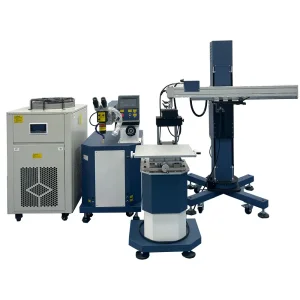
Traditional TIG repair of tool-grade steels (P20, H13, NAK80, S136) causes heat sinking that draws hardness from the mold core, introducing internal stresses, heat checking, and micro-sink marks. Youmir boom-arm laser welders direct pulsed energy with pinpoint spatial accuracy, depositing matching tool steel wires without annealing neighboring cavity details, preserving tool life and dimensional fidelity.
From aluminum letters to luxury brass frames, delicate aesthetics collide with rapid turnaround requirements. Our dedicated advertising word welders utilize long-focus optical nozzles to access deep interior 90° corners that bulkier TIG torches cannot reach. This eliminates heat burn-through on thin 0.6mm mirror-finished bronze and polished titanium-gold sheet metal.
The industry is rapidly pivoting from single-purpose tools to agile multi-process equipment. Youmir's flagship 4-in-1 platforms enable operators to swap optical nozzles in 30 seconds, instantly alternating between laser welding, pre-weld surface rust stripping, narrow slot cutting, and post-weld passivating heat treatment. This consolidation drastically reduces capital footprint inside mobile fabrication trucks and compact job shops.
Global export demands more than a plug adapter. Youmir systems ship with localized electrical transformers supporting North American split-phase 220V/240V 60Hz, European single/three-phase 380V/400V 50Hz, or Japanese 200V systems. Integrated IoT modules offer optional cloud-based optical health monitoring, letting our Shenzhen factory engineers diagnose beam transmission issues or assist local technicians in real time.
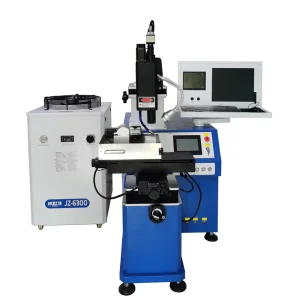
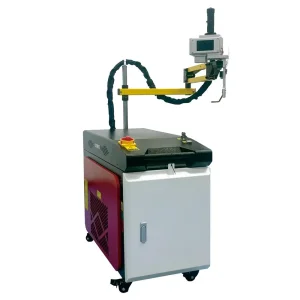
High-duty cycle platforms covering QCW jewelry manufacturing, CNC galvanometer production, large-format sheet cutting, and heavy cantilever tool maintenance.





Clear, uncompromising answers directly from Youmir’s senior laser optical and process engineering team to streamline equipment evaluations.
Eliminate technical uncertainty before you invest. Send your complex alloys, stamped profiles, or challenging joints directly to our Shenzhen application laboratory. Our engineers will prove penetration, cycle time, and joint aesthetics on video.
