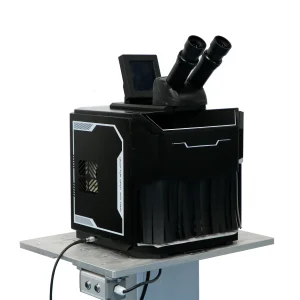
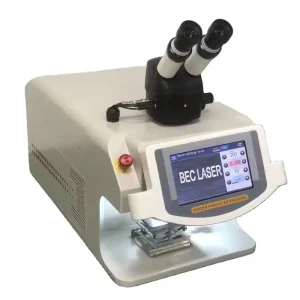
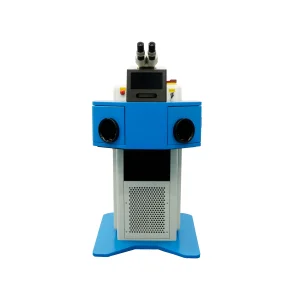
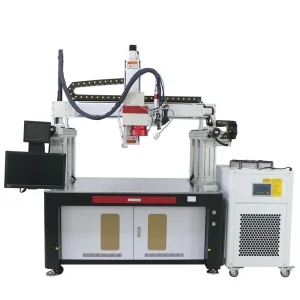
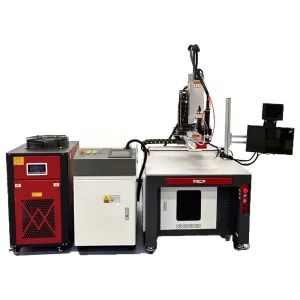
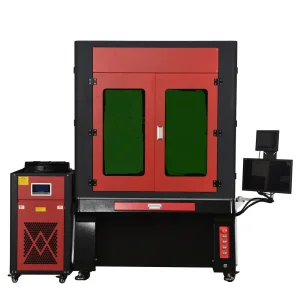
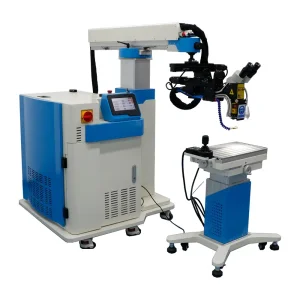
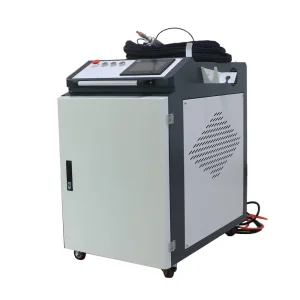
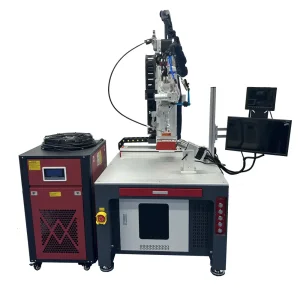
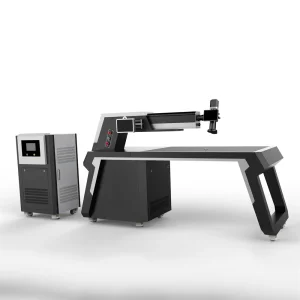
Engineered in Shenzhen for mission-critical tooling, structural manufacturing, and high-tolerance metallurgical joining.
A technical assessment of keyhole hydrodynamic stability, gap-bridging tolerance, and thermal profile control in fiber laser processing.
Traditional static-beam fiber laser welding relies on an exceptionally concentrated optical focal spot, often ranging between 20 to 100 micrometers. While this concentrated power density achieves rapid deep-penetration keyhole welding, it causes steep temperature gradients, high surface tension instabilities, and violent vapor plume dynamics. These factors lead to spatter expulsion, undercutting, and root porosity—especially when dealing with materials like aluminum alloys, zinc-coated steel, or copper.
Wobble laser welding overcomes these physical constraints by incorporating high-speed galvanometer-driven mirrors into the optical collimation and focusing path. By projecting high-frequency oscillations—such as circular, sinusoidal, figure-8, and vortex geometric patterns—the laser beam sweeps across the melt pool at frequencies reaching hundreds of Hertz. This motion generates a controlled stirring effect within the molten pool, yielding specific metallurgical benefits:
Dual-axis scanning heads manipulate the beam spot independently across both X and Y coordinates. Operators can select linear, circular, elliptical, or dual-arc oscillation shapes to match the specific joint design and thermal properties of the workpiece.
Youmir wobble laser systems feature optical circuit protection, dual-channel earth ground detection, internal gas pressure monitoring, and reflective sensor loops. The beam shuts off immediately if contact with the conductive substrate is broken.
Equipped with dual-temperature water chillers that separate the laser source from the wobble optical head. Intelligent multi-sensor controllers prevent thermal drift across optical components during continuous three-shift operations.
Transparent cost modeling, component-level breakdown, and CAPEX evaluation for industrial procurement officers.
| System Class / Power | Core Optical Source | Wobble Mechanism | Target Material Thickness | FOB Factory Price Range (USD) |
|---|---|---|---|---|
| Portable Wobble 1000W | Single-Mode Fiber (1080nm) | Single/Dual Oscillation (0.2-4mm) | SS: ≤3.0mm | CS: ≤2.5mm | AL: ≤1.5mm | $2,800 – $4,200 |
| Standard Industrial 1500W | Continuous Wave Fiber Engine | Dual-Galvo 2D Multi-Vector (0-5mm) | SS: ≤4.5mm | CS: ≤4.0mm | AL: ≤2.5mm | $3,500 – $5,200 |
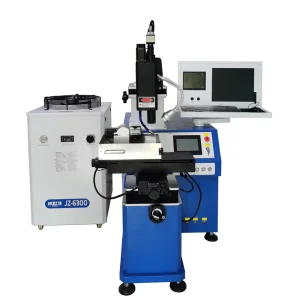
| High-Duty Heavy 2000W | High-Power Industrial Fiber | High-Frequency Wobble + Auto-Feeder | SS: ≤6.0mm | CS: ≤5.5mm | AL: ≤4.0mm | $4,800 – $6,900 |
| Heavy Production 3000W | Multi-Channel Fiber Resonator | Heavy-Duty Water-Cooled 2D Galvo | SS: ≤8.5mm | CS: ≤8.0mm | AL: ≤6.5mm | $6,800 – $9,600 |
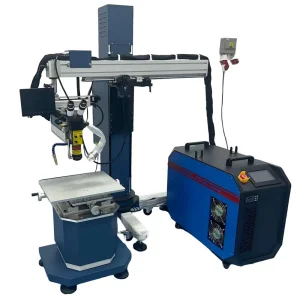
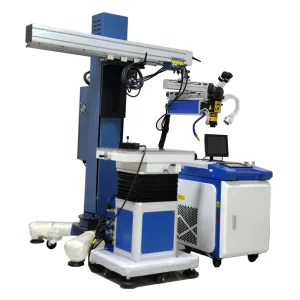
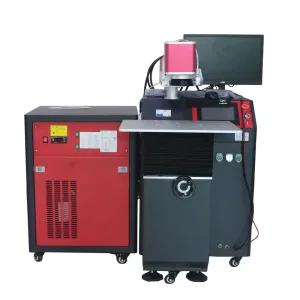
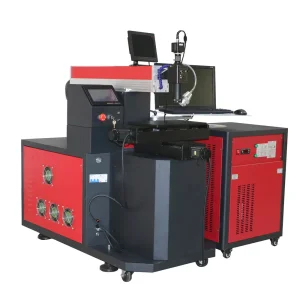
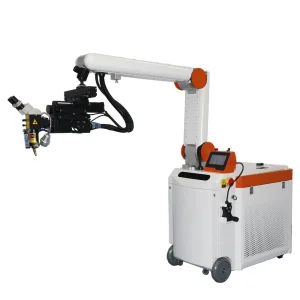
| Multi-Axis CNC / Robotic | QCW / Fiber Integrated Unit | Synchronized CNC / Boom Galvo Head | Customized Tooling & Mold Repair | $11,500 – $28,000+ |
Purchasing managers evaluating custom wobble laser equipment should consider these four main hardware cost drivers:
How dynamic beam wobble welding solves complex manufacturing challenges across key industrial sectors.
Wobble welding provides the controlled thermal profile needed to join dissimilar metals, such as copper-to-aluminum busbars and battery modules. The high-speed oscillatory pattern breaks up brittle intermetallic compound layers, improving electrical conductivity while preventing joint cracking under mechanical stress.
Injection molds, stamping dies, and high-pressure casting tools often suffer edge wear, micro-cracking, and washouts. Using boom-mounted or cantilevered laser welders, mold makers can deposit tool-steel filler wires with minimal preheating and localized heat input, eliminating distortion in critical cavities.
Fabricators of stainless-steel kitchen gear, medical cabinets, and food processing hardware get clean, cosmetically consistent fillet welds. Wobble heads leave a smooth, uniform seam that largely eliminates post-weld grinding and pickling, reducing overall labor costs.
The transition from manual wobble operation to autonomous, AI-driven closed-loop laser processing.
Youmir Laser's Shenzhen R&D engineering division focuses on four main phases in its technology roadmap:
Built-in protections to ensure smooth deployment and regulatory compliance for international industrial buyers.
Buyers can send sample materials to our Shenzhen lab prior to manufacturing. Our application engineers optimize process parameters, produce cross-section weld samples, and supply high-resolution video recordings alongside an engineering test report.
Every system undergoes a continuous 48-hour burn-in cycle, optical power stability checks, chiller load tests, and rigorous insulation resistance testing before export crating in vacuum-sealed, moisture-barrier wooden cases.
Our electrical cabinets follow IEC 60204-1 safety standards. We provide laser safety interlock integration, certified optical density (OD6+) safety goggles, and full documentation to support localized workplace safety inspections.
Direct engineering answers on parameters, gas shielding, consumables, and international deployment.
Advanced fiber continuous systems, automated CNC platforms, high-speed galvanometer workstations, and surface preparation equipment.