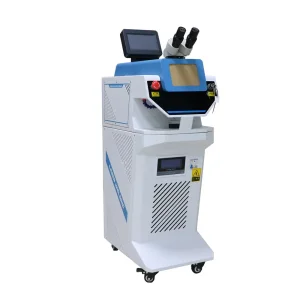
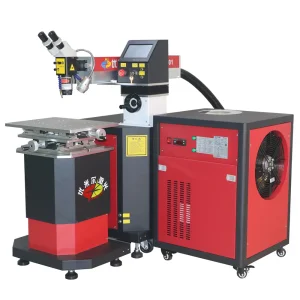
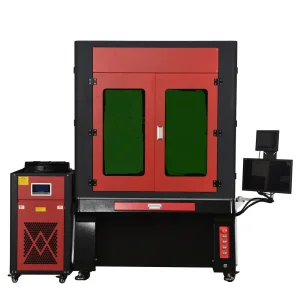
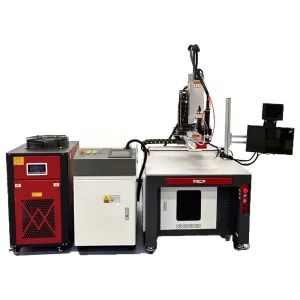
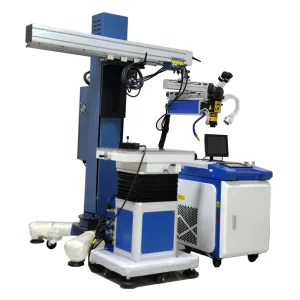
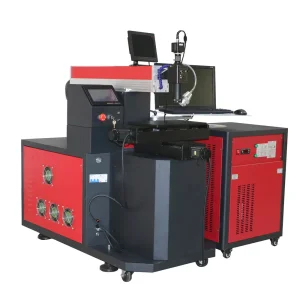
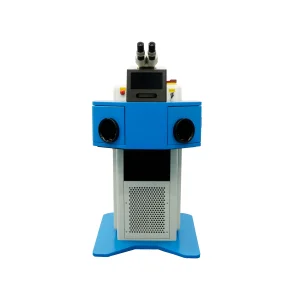
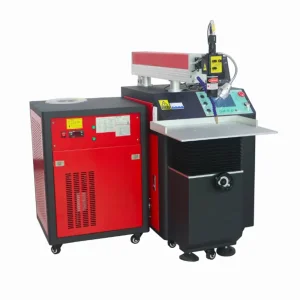
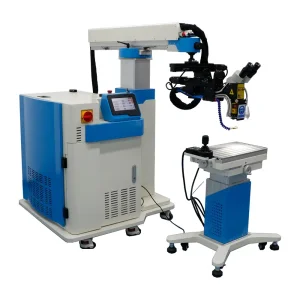
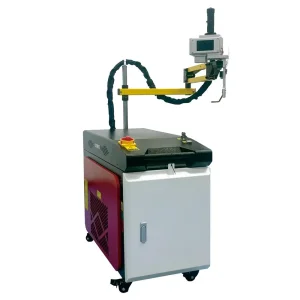
Explore our core industrial laser processing machinery developed in-house at Shenzhen Youmir Laser Technology Co., Ltd.
A rigorous examination of energy waveform shaping, high-reflectivity alloy joining, and thermal diffusion limits in modern battery manufacturing lines.
YAG (yttrium aluminum garnet, 1064 nm) pulsed lasers allow fine tailoring of single-pulse profiles. By utilizing real-time closed-loop optical feedback, engineers program leading preheating spikes to break the native oxide film and overcome copper's 90%+ room-temperature optical reflectivity, followed by a sustained plateau and a gradual thermal taper to eliminate cooling solidification cracks.
Unlike traditional Cartesian CNC stages that suffer mechanical inertia bottlenecks, high-speed dual-axis digital galvanometer mirror scanners achieve jump speeds exceeding 3,000 mm/s. By incorporating precision telecentric F-theta scan lenses, the focused laser beam impinges perpendicularly across the entire working field (e.g., 110x110 mm or 180x180 mm), ensuring identical spot geometry from center to perimeter.
In cylindrical cell cap and pouch tab joining, thermal dissipation must never compromise the separator membrane (typically polyethylene or polypropylene degrading above 130°C). Pulsed YAG and Quasi-Continuous Wave (QCW) galvanometer systems concentrate thermal energy strictly within microsecond windows, restricting the heat-affected zone (HAZ) to <45 μm and protecting sensitive internal electrolytes.
How laser micro-welding has displaced resistance, ultrasonic, and mechanical crimping to become the definitive standard for gigawatt-hour battery pack assembly.
The accelerated transition toward Electric Vehicles (EVs), grid-scale Battery Energy Storage Systems (BESS), and consumer electronics has forced battery manufacturers to operate under extreme throughput, safety, and cycle-life demands. As cell capacities increase (from standard 18650 and 21700 formats to massive 4680 cylindrical and 300Ah+ prismatic cells), the internal electrical currents scale dramatically. Even a fraction of a milliohm in parasitic resistance across tab and busbar interconnects generates severe localized Joulean heating (ΔQ = I²Rt), compromising overall module efficiency and escalating thermal runaway risks.
Shenzhen Youmir Laser Technology Co., Ltd. addresses this industrial bottleneck by engineering customized galvanometer welding stations designed to drop junction impedance to baseline metallurgical levels while sustaining high continuous line speeds.
Historical techniques such as resistance spot welding suffer from rapid electrode contamination, copper pickup, and mechanical indentation stresses that weaken fragile foil current collectors. Ultrasonic welding introduces severe mechanical vibrations that cause micro-fracturing along ultrasonic horn edges and loosen internal jelly-roll winding tensions.
In contrast, non-contact optical galvanometer laser welding delivers zero physical tool wear, zero mechanical impact, and dynamic spot manipulation that bridges fit-up gaps without structural deformation.
| Joining Technology | Electrical Resistance (mΩ) | Cycle Speed / Joint | Tool Wear & Consumables | Mechanical / Thermal Stress | Dissimilar Metal Handling |
|---|---|---|---|---|---|
| Galvo Laser Micro-Welding (Youmir) | < 0.08 mΩ | 0.05 – 0.35 s | Zero contact / Lenses only | Near-zero / <45μm HAZ | Superior (Cu, Al, Ni, SS) |
| Resistance Spot Welding | 0.25 – 0.60 mΩ | 0.8 – 1.8 s | Severe electrode dressing | High compression deformation | Prone to intermetallic embrittlement |
| Ultrasonic Wire/Foil Bonding | 0.12 – 0.20 mΩ | 0.6 – 1.4 s | Frequent sonotrode replacement | Acoustic resonance cracks tabs | Limited penetration depth |
| Mechanical Riveting / Bolting | > 0.45 mΩ (varies with age) | 3.0 – 6.0 s | Fasteners, washers, torquing | Vibration loosening over time | Galvanic corrosion risks |
Specific metallurgical challenges solved across four high-demand manufacturing operations in energy storage and mobility assembly lines.
Precision connection of negative nickel/copper collector discs to nickel-plated steel cans, or positive aluminum tabs to current interrupt device (CID) caps on 18650, 21700, and 4680 cells. High repetition galvo spiral patterns ensure high shear strength without puncturing 0.15 mm steel bottoms.
Hermetic closure of liquid electrolyte filling ports (aluminum seal balls/pins) and explosive-proof rupture disk vents. Pulsed YAG and CW galvanometer optics create continuous, zero-porosity circular seam seals that withstand 1.5–3.0 MPa burst test pressures without thermal degradation.
Joining laminated high-purity copper or aluminum cell terminals directly to nickel-plated copper busbar backbones. Employs dynamic high-frequency wobble trajectories that break up intermetallic compound (IMC) brittleness (e.g., Al₂Cu phase control) to prevent mechanical fracture under road vibration.
Micro-welding flexible printed circuit (FPC) leads, thermal sensors, and thin nickel sensing ribbons to cell terminal studs. Ultra-low energy pulse settings allow stable micro-spot deposition without scorching surrounding polymer insulation, polyamide carriers, or delicate cell shrink wrappers.
Built for direct integration into international production lines with full certification, standardized electrical schematics, and responsive multi-tier support.
Youmir Laser machines are designed and certified to conform with international safety directives. Systems feature Class IV laser interlocks, certified OD6+ optical viewing safety windows, emergency stop circuit redundancies, and CE Machinery Directive compliance.
We do not just ship bare laser heads. Our mechanical engineering division designs custom pneumatic clamping nests, zero-backlash rotary indexing tables, coaxial argon/nitrogen gas shrouds, and vacuum chucks tailored to your battery pack architecture.
Backed by our headquarters in Guangming District, Shenzhen, and technical facilities in Zhongshan and Hunan, overseas distributors and tier-1 factory buyers receive comprehensive remote video diagnostics, process parameter optimization, and on-site deployment training.
Advancements bridging solid-state electrolytes, dual-beam fiber/diode hybrids, and automated machine vision inspection.
The industry is transitioning toward hybrid beam structures comprising a central high-intensity laser core surrounded by a concentric ring beam. The ring gently preheats the copper or aluminum substrate to lower surface tension, while the central core keyholes the joint, resulting in practically zero spatter and pristine melt pool stabilization.
By integrating high-magnification coaxial CCD optics directly through the galvanometer mirror assembly, artificial intelligence algorithms detect sub-millimeter part offsets in real time. The scanning beam automatically adjusts its trajectory dynamically to correct for robotic pick-and-place misalignment prior to laser firing.
Optical Coherence Tomography (OCT) integration enables simultaneous interferometric depth tracking during welding. By sampling backscattered reference light, the system measures true keyhole penetration depth in real time, catching void defects, under-penetration, or burn-through instantly without destructive cross-section testing.
Expert answers directly from our factory engineering desk regarding procurement, process capability, and technical configurations.
Comprehensive machinery engineered for automated tooling, heavy mold deposition, sheet cutting, and continuous production lines.
Consult with our senior laser optical engineers in Shenzhen. From application reviews and sample trials to automated production-line integration, we provide fully customized hardware and software solutions.