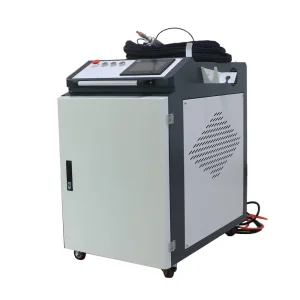
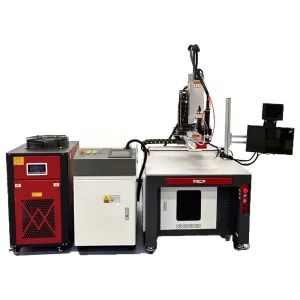
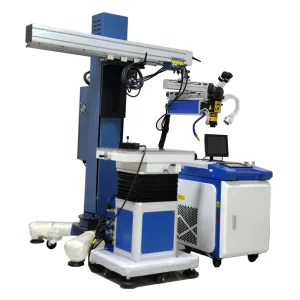
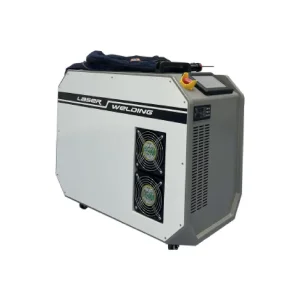
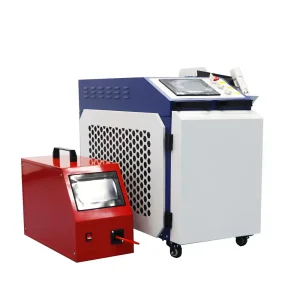
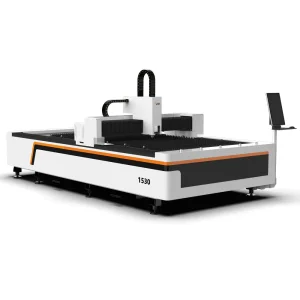
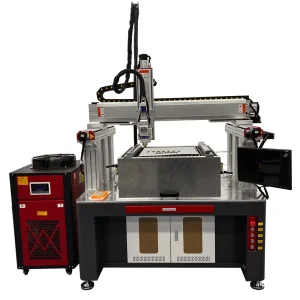
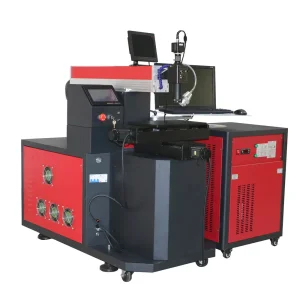
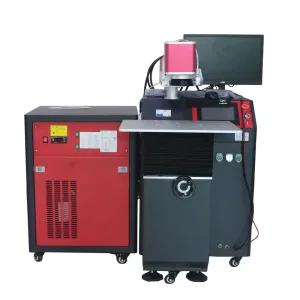
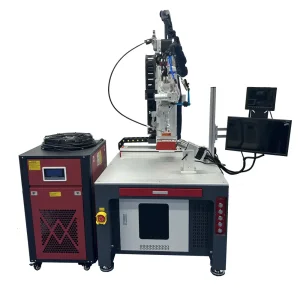
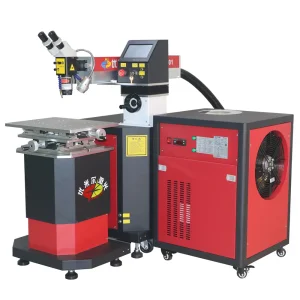
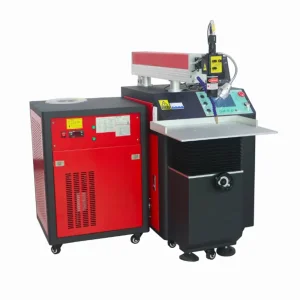
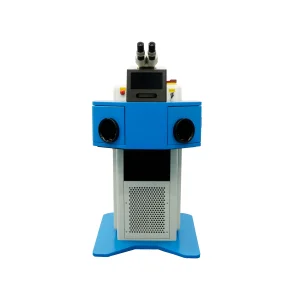
Engineered for continuous duty cycles, high repeatability, and rapid return on investment. Explore our flagship handheld fiber welders, automated CNC workstations, and surface treatment machines.
Modern manufacturing faces a dual crisis: a global shortage of certified GTAW/GMAW welding artisans and aggressive margin compression caused by labor-intensive secondary finishing operations.
Unlike tungsten inert gas (TIG) or metal inert gas (MIG) welding that introduces broad thermodynamic heat input, a 1000 Watt handheld laser welder focuses energy into an exact 0.1 mm to 0.2 mm focal spot. This achieves power densities exceeding 106 W/cm2, initiating instantaneous vaporization and keyhole-mode melting. The result is deep penetration with negligible macroscopic distortion.
Thin-gauge sheet fabrication (0.5 mm to 3.0 mm) historically suffers from buckling, thermal warping, and angular distortion due to excessive Heat-Affected Zones (HAZ). With continuous-wave fiber laser welding, thermal diffusion into the adjacent parent metal is minimized by 70–80%, completely bypassing post-process hydraulic straightening and mechanical leveling.
Achieving sanitary, cosmetic welds with traditional TIG requires years of muscle memory and arc-gap calibration. In contrast, handheld laser welders utilize ergonomic wobble guns with integrated digital parameter presets. Entry-level operators can be trained to weld flawless, inspection-grade stainless steel and aluminum seams within just 4 to 8 hours of hands-on coaching.
While 1500W, 2000W, and 3000W units dominate structural plate welding, the 1000 Watt fiber laser welder offers the optimum balance of beam quality (M2 < 1.3), electrical efficiency, thermal controllability on delicate metals (<1.5mm), and portability. It avoids the severe burn-through risks inherent to higher wattage systems when joining thin-gauge decorative stainless, appliance panels, and electrical cabinets.
An inside look at how high-power ytterbium fiber modules interact with high-speed galvanometer mirrors to deliver industrial-grade stability and bridge loose part tolerances.
Traditional fixed-spot laser welding demanded stringent joint fit-up tolerances (<0.05 mm), making it impractical for standard metal fabrication. Modern 1000W handheld systems incorporate dual galvanometer scanning mirrors inside the hand torch.
By driving the laser beam in programmed geometric oscillations (Linear, Circular, Figure-8, Double-Crescent, and Triangle) at frequencies up to 300 Hz, the effective beam width expands dynamically from 0.2 mm up to 5.0 mm. This fluidly accommodates seam gaps up to 1.5 mm while stirring the molten pool to degas volatile vapors and suppress solidification cracking.
The powerhouse of the system is an ytterbium-doped active fiber laser module operating at the central wavelength of 1070±10 nm. Optical energy is transmitted via an armored, high-flexibility 50 µm to 100 µm core delivery cable with integrated QBH or QCS termination.
Top-tier manufacturers incorporate multi-stage optical back-reflection isolators. When working with highly reflective non-ferrous metals like copper, brass, and 6000-series aluminum, hazardous 1070 nm back-scattered photons are diverted into internal water-cooled beam dumps, preventing catastrophic damage to the pump laser diodes.
Verified lab benchmarks for butt, lap, and fillet joints. These parameter envelopes serve as baseline recipes for process engineers calibrating automated and handheld lines.
| Base Material | Thickness (mm) | Joint Configuration | Shielding Gas & Flow | Wobble Pattern / Width | Welding Speed (mm/s) | Penetration Profile |
|---|---|---|---|---|---|---|
| AISI 304 / 316 Stainless Steel | 1.0 mm | Square Butt Joint | Pure N2 (12 L/min) | Circle / 1.5 mm (120 Hz) | 35 – 50 mm/s | Full 100% Penetration, Mirror Finish |
| AISI 304 / 316 Stainless Steel | 3.0 mm | Outside Corner / Lap | Pure Ar or N2 (15 L/min) | Triangle / 2.5 mm (100 Hz) | 15 – 22 mm/s | Zero Under-bead Sagging, Clean Root |
| Carbon Steel (Q235 / A36) | 1.5 mm | T-Fillet Joint | Pure Argon (15 L/min) | Figure-8 / 2.0 mm (140 Hz) | 25 – 35 mm/s | Dense Grain, Void-Free Fusion |
| Carbon Steel (Q235 / A36) | 2.5 mm | Beveled Butt Joint | Pure Argon (18 L/min) | Line / 2.5 mm (80 Hz) | 12 – 18 mm/s | High Tensile Yield, Low Spatter |
| Galvanized Steel Sheet | 1.2 mm | Lap Joint (0.1mm gap) | Pure N2 (16 L/min) | Double-Circle / 2.5 mm | 20 – 30 mm/s | Zinc Degassed, Zero Porosity |
| Aluminum Alloy (5052 / 6061) | 1.0 mm | Square Butt Joint | High-Purity Ar (20 L/min) | Triangle / 2.0 mm (180 Hz) | 20 – 32 mm/s | Oxide Broken, Smooth Convex Bead |
| Aluminum Alloy (5052 / 6061) | 1.5 mm | Corner Fillet (with 1.0mm wire) | High-Purity Ar (20 L/min) | Circle / 3.0 mm (150 Hz) | 12 – 18 mm/s | Crack-Resistant, Uniform Ripples |
| C11000 Copper / Brass H62 | 0.8 mm | Edge Seam Butt | Pure Argon (20 L/min) | High-Freq Dot / 1.0 mm | 10 – 16 mm/s | Keyhole Stabilized, Anti-Reflective |
Selecting between Nitrogen and Argon fundamentally alters weld microstructure. For austenitic stainless steels (304/316), pure Nitrogen acts as an austenite stabilizer, preserving corrosion resistance and imparting a bright silver finish without oxidation. For reactive carbon steels, aluminum, and titanium, 99.999% industrial Argon is strictly mandated to avoid nitrogen embrittlement and surface micro-fissuring.
How 1000W handheld laser technology transforms manufacturing throughput across mission-critical vertical industries worldwide.
Sanitary fabrication rules demand smooth, crevice-free welds that harbor zero bacterial pathogens. 1000W laser welders eliminate the porous undercuts common in TIG. Sinks, counters, exhaust hoods, and food processing vats are welded without burn-through, reducing subsequent scotch-brite and electro-chemical polishing labor by over 90%.
Industrial switchgear, control cabinets, and IT server racks rely on thin galvanized steel and powder-coated cold-rolled sheets. Laser welding prevents the zinc coatings from flaking violently, producing neat corner seams that seal NEMA 4X / IP66 enclosures against particulate and moisture ingress with minimal thermal warpage.
Architectural handrails, elevator interiors, and spiral HVAC ducting require immaculate cosmetic finishes. Handheld laser welding provides continuous hermetic joints without weld spatter, eliminating aggressive grinding disks that thin wall thickness and ruin brushed architectural grain.
A transparent breakdown of capital expenditures (CapEx), operating expenses (OpEx), and real-world amortization models for commercial procurement teams.
When requesting quotes from high-grade manufacturers, the price variance for a genuine 1000W system is dictated by four critical core assemblies:
In a standard 2-shift operational environment (4,000 operating hours annually), a 1000W handheld laser achieves payback within 3.2 to 5.8 months.
| Cost Vector | Traditional TIG (GTAW) | 1000W Handheld Laser |
|---|---|---|
| Electrical Consumption | ~6.5 kW wall-plug | ~3.8 kW wall-plug |
| Consumables (Nozzles/Tips) | Tungsten electrodes, ceramic cups ($$$) | Protective quartz windows ($2/ea), copper nozzles |
| Secondary Post-Grinding | 15–30 min per meter of seam | 0 to 2 min per meter |
| Shielding Gas Draw | Argon @ 12–15 L/min continuous | Argon/N2 @ 12–15 L/min (4× faster speed = 75% gas savings per part) |
Industrial fiber lasers emit invisible 1070 nm Class 4 radiation. International compliance, electrical certifications, and multi-tier interlock protocols are non-negotiable for commercial deployment.
All legitimate export units conform to European Directives 2006/42/EC (Machinery), 2014/30/EU (EMC), and EN 60825-1:2014 (Safety of Laser Products). The control cabinet includes key-switch laser locks, emergency stop (E-stop Cat.3 / PL d), and dual-channel safety relays.
The laser trigger is electronically locked until a physical electrical continuity circuit is completed between the torch tip, the workpiece, and the earth clamp. If the torch tip leaves the metal surface by more than 2 mm, the beam output shuts off in under 5 milliseconds.
Standard production models are engineered for 220V ± 10% 1-phase (50/60 Hz) operations. For North American 110V or 208V/480V installations and European 400V 3-phase plant grids, industrial step-up or step-down toroidal isolation transformers are configured for smooth plug-and-play field integration.
Over 16 years of continuous laser innovation. From our 5,000+ m² Shenzhen manufacturing headquarters to active deployments in 50+ countries worldwide.
Shenzhen Youmir Laser Technology Co., Ltd. was incorporated in Shenzhen in 2012, building on specialized fiber laser joinery research initiated by our core team back in 2010. Expanding with our Zhongshan branch in 2017 and Hunan Youmir Laser Technology Co., Ltd. facility in 2018, we operate fully integrated production lines encompassing optical coating, CNC chassis machining, software engineering, and clean-room fiber splicing.
By designing the optical path, proprietary digital touch control interfaces, and mechanical torch balances entirely in-house, we eliminate third-party integration markups and offer true OEM/ODM capability for overseas brand owners, distributors, and high-volume industrial end-users.
We remove every procurement risk before capital commitment. Importers and workshop managers can dispatch raw sample materials (coupons, press-braked components, complex extrusions) directly to our Shenzhen application laboratory.
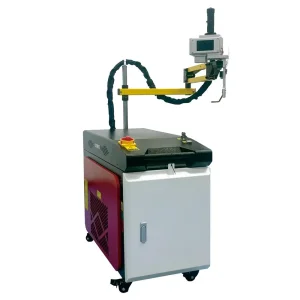
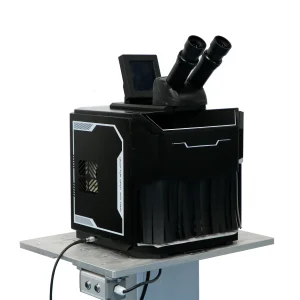
Explore specialized precision welders, automated galvanometer workstations, continuous heavy-duty fabricators, and micro-jewelry systems engineered by Youmir Laser.
Strategic research initiatives shaping the next iteration of industrial handheld laser welders.
Next-generation 1000W models are transitioning toward advanced Gallium Nitride (GaN) power electronics paired with microchannel phase-change heat dissipation. By eliminating bulky water compressors, system weight drops from 85 kg to under 38 kg, allowing true jobsite portability and operation in sub-zero or high-ambient climates without coolant freezing or boiling.
Miniaturized coaxial machine vision cameras embedded within the torch nozzle feed real-time weld pool imagery into onboard neural processing units. The system dynamically compensates for operator hand tremors, adjusting laser output power, wobble width, and wire feed speed on-the-fly to guarantee penetration uniformity across long, winding passes.
The convergence of welding, single-pass weld seam cleaning, raw substrate rust/paint stripping, and thin-sheet trimming into a single quick-change nozzle platform. Operators can clean oxidized raw mill-scale, weld the seam, passivate the thermal tint, and perform final perimeter trimming without disconnecting the torch cable.
Technical, operational, and commercial questions answered directly by Youmir Laser application and service engineers.