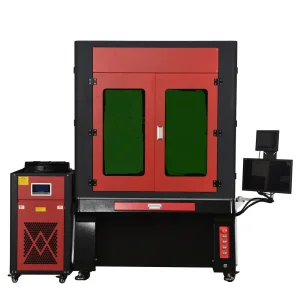
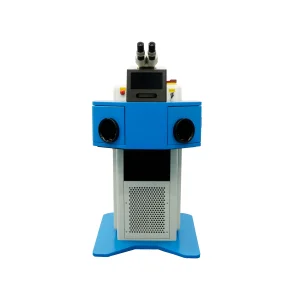
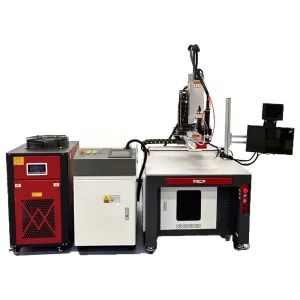
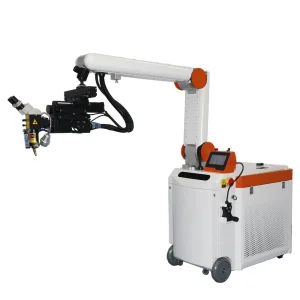
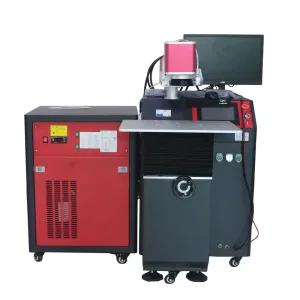
Engineered in our Shenzhen manufacturing center with proprietary optical paths, ergonomic binocular optics, and optimized peak-pulse stability.

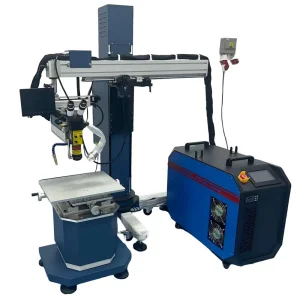
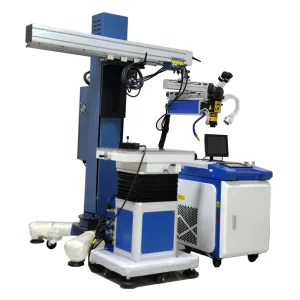

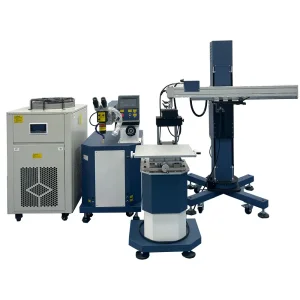
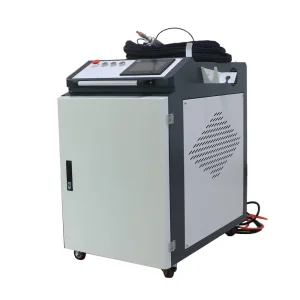
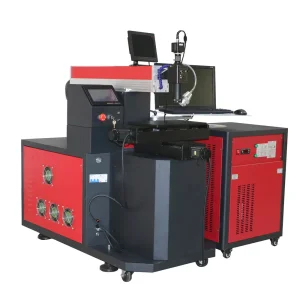

A comprehensive engineering overview on thermal management, pulse profiling, and metallurgy of precious metal joining.
Traditional torch soldering dissipates thermal energy across the whole piece, requiring stone unmounting and causing alloy discoloration. Spot laser welding operates within a localized Heat-Affected Zone (HAZ < 0.1 mm), allowing seamless joints directly beside heat-sensitive gemstones such as emeralds, opals, and pearls.
Silver (Ag) and Gold (Au) present extreme optical reflectivity (>90% at 1064 nm). Youmir's custom-engineered pulsed systems deliver steep rising edges and dynamic pulse shaping (pre-heating pulse followed by a plateau welding pulse) to break surface reflectivity without violent spatter or micro-cracking.
By eliminating toxic low-karat solder fluxes, laser spot welding yields an autogenous joint preserving parent-metal metallurgical purity. Hallmarking integrity is maintained, joint corrosion is permanently prevented, and post-processing polishing time is reduced by up to 75%.
| Evaluation Parameter | Pulsed Nd:YAG Spot Welder (Classic) | Quasi-Continuous Wave (QCW) Fiber | Traditional Torch Soldering |
|---|---|---|---|
| Heat Affected Zone (HAZ) | 0.05 mm – 0.20 mm (Microscopic) | 0.03 mm – 0.10 mm (Ultra-fine) | 10.0 mm – Entire Workpiece |
| Precious Metal Mass Retention | 100% (No solder dilution) | 100% (Micro-wire feeding) | Loss due to acid pickling & solder |
| Spot Diameter Range | 0.1 mm – 3.0 mm (Continuously variable) | 0.05 mm – 1.5 mm (High precision) | Unfocused Flame (> 5.0 mm) |
| Reflective Metal Processing | Exceptional (High instantaneous peak power) | Superior (Adjustable pulse synthesis) | Unpredictable oxidation risk |
| Duty Cycle & Consumables | Flashlamp maintenance required (~10M pulses) | Zero optical consumables (>100K hours MTBF) | High consumption of gas, fluxes, pickling acids |
Key procurement patterns observed across North American jewelry chains, European luxury houses, and Southeast Asian manufacturing hubs.
The explosive demand for welded clasp-free chains (bracelets and anklets) across retail boutiques has generated a surge in compact, desktop-class, safety-interlocked laser spot welders capable of rapid, customer-facing operation without open flame hazards.
Master bench jewelers with decades of flame soldering expertise are retiring. Modern jewelry brands require intuitive, program-assisted CNC spot welders and microscope-assisted systems that lower the training curve from years down to days.
Medical jewelry, titanium implants, and luxury horology require zero residue. Spot welding under inert argon gas environments eliminates oxidation without messy flux cleanups, meeting ISO cleanroom manufacturing directives.
How Shenzhen Youmir Laser delivers superior cost-to-performance, modular customization, and robust batch stability.
Situated in Shenzhen's core industrial hub, Youmir integrates tier-one pump sources, high-dielectric optical mirrors, crystalline Nd:YAG rods, and precision CNC chassis within a 30-minute logistics radius, drastically shortening production lead times.
Because optical assemblies, control boards, and firmware are engineered in-house, we offer full flexibility: from custom chassis branding and software multi-language localization to specialized automation fixtures for mass ring & chain production lines.
Every jewelry spot welder undergoes continuous 72-hour pulse stability burns, laser energy meter calibration across variable duty cycles, and strict helium-neon pointing alignment before seaworthy crating and international export.
From high-end luxury fabrication to medical and horological micro-mechanics.
Rebuilding worn prongs directly adjacent to heat-sensitive diamonds and precious gemstones without stone removal or risk of thermal fracturing.
Repairing deep gouges, filling micropores on vintage stainless steel or gold cases, and restoring bezel edges with color-matched micro filler wires.
Precision spot welding of cobalt-chrome (Co-Cr), titanium framework joints, and dental clasp assemblies without altering structural temper.
Eliminating micro-porosities and surface voids in investment-cast gold, platinum, and silver parts by smoothing with parent-metal wire filler.
Authoritative answers directly from our factory engineering and export sales departments.
Laser spot welders emit coherent pulses lasting merely 0.5 to 20 milliseconds. Because the optical energy is concentrated into an adjustable 0.1 mm to 3.0 mm spot, the heat is confined strictly to the weld pool and cools almost instantaneously. Precious stones located as close as 0.5 mm from the weld remain unaffected by thermal expansion stress.
Gold exhibits strong thermal absorption and can be welded effectively with a 60W–100W machine. Silver, however, possesses extreme thermal conductivity and surface reflectivity. For heavy silver rings, continuous chain production, or thick bangles, we recommend an 80W–200W unit with peak pulse energy of at least 50 Joules to ensure reliable fusion without surface cracking.
Industrial or medical grade Argon (Ar) gas with 99.99% purity is standard. Argon blankets the molten pool, completely displacing atmospheric oxygen and preventing discoloration or blackening during high-temperature fusion. Integrated coaxial gas nozzles route argon directly to the focal zone.
All Youmir machines are backed by an extensive 12-to-24 month warranty on core laser sources. We maintain round-the-clock technical coverage with direct engineer-to-engineer video diagnostics, sample testing verification reports prior to purchase, and rapid spare-parts air-freight dispatch worldwide.
Explore our complete manufacturing spectrum for micro-welding, mold reconditioning, industrial continuous fabrication, and high-speed laser cutting.