Explore our calibrated micro-welding stations, boom arm systems, and CNC fiber workstations deployed across fine jewelry fabrication facilities and toolrooms worldwide.


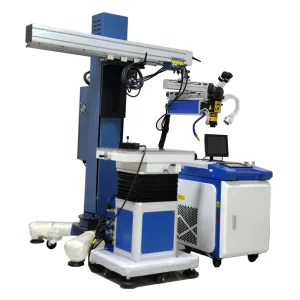
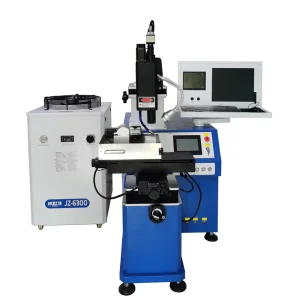

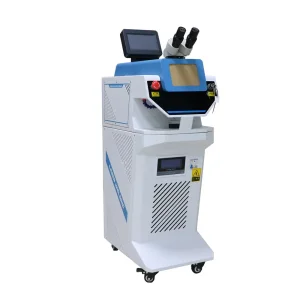


Transitioning from manual oxy-gas torch soldering to concentrated coherent photon fusion: eliminating oxidation, heat distortion, and stone degradation in haute horlogerie and fine gold smithing.
Traditional torch brazing disperses thermal energy across the workpiece, heating mountings and necessitating the unsetting of precious gemstones like emeralds, sapphires, and opals. Laser micro-welding deposits localized photon energy within pulse durations of 0.1 to 20 milliseconds.
Soldered seams utilize lower-karat filler alloys, leaving visible discoloration lines, pitting, and acid vulnerability during assay hallmarking. Laser autogenous fusion joins identical parent metal without intermediary low-temperature solder.
Atmospheric oxygen and nitrogen trigger embrittlement and micro-porosity during liquid metal freezing. Our equipment integrates coaxial pure Argon (Ar) gas delivery with pneumatic micro-nozzles directly surrounding the optical focal point.
B2B procurement criteria analyzed across boutique goldsmith studios, regional repair franchises, and multi-axis automated jewelry mass-production plants.
Primary Drivers: Footprint constraints, acoustic noise control, plug-and-play single-phase electrical operation, and stereomicroscope optical ergonomics for delicate gemstone settings.
Compact Desktop Nd:YAG or Portable Air-Cooled Welder (60W – 100W peak output), 10X/15X Leica or Motic binocular microscope, high-definition CCD crosshair display, integrated fume extraction filtration.
Primary Drivers: Duty cycle resilience, fast thermal dissipating chillers, wide parameter memory presets (storing 50+ alloy pulse profiles), and heavy-duty arm support for continuous 8-hour operation.
Freestanding Vertical Cabinet Nd:YAG (150W – 200W, 80J – 120J single pulse energy), internal dual-circuit water chilling compressor, high-frequency capacitor bank charging systems.
Primary Drivers: Automated high-cadence seams, CNC multi-axis coordination, automated wire feeders, galvanometer high-speed scanning, and quasi-continuous wave (QCW) fiber laser sources.
Enclosed CNC 3-Axis / 4-Axis Fiber Laser Welding Workstation (150W – 300W Average Power, 1500W – 3000W Peak Power), synchronized rotary chucks, vision-guided seam tracking software.
A deep-dive technical engineering comparison between flashlamp-pumped solid-state crystal cavities and modern quasi-continuous ytterbium-doped fiber laser engines.
| Evaluation Parameter | Pulsed Nd:YAG (Flashlamp) | Quasi-Continuous Wave (QCW) Fiber | Continuous Wave (CW) Wobble Fiber |
|---|---|---|---|
| Central Emission Wavelength | 1064 nm (Near Infrared) | 1070 nm ± 10 nm | 1080 nm ± 10 nm |
| Peak Output Power | 5.0 kW – 12.0 kW (High Pulse Energy) | 1.5 kW – 6.0 kW (Extremely Precise) | Equal to Average Power (1.0 kW – 2.0 kW) |
| Precious Metal Reflectivity Handling | Excellent (High instantaneous peak overcomes Ag/Au reflection barrier) | Superior (Excellent beam parameter product BPP < 2.5 mm*mrad) | Moderate (Risk of back-reflection without wobble beam oscillation) |
| Thermal Heat-Affected Zone (HAZ) | Minimal (< 0.15 mm controlled via pulse shaping) | Ultra-minimal (< 0.08 mm, cold micro-joining) | Moderate (Continuous thermal transfer, higher conduction) |
| Wall-Plug Electrical Efficiency | 2.5% – 4.0% (Requires robust water chilling) | 30% – 35% (Extremely low power draw) | 35% – 42% (High industrial energy efficiency) |
| Pump Source Lifespan (MTBF) | Xenon Flashlamp: 2,000 – 4,000 operating hours | Semiconductor Diode: 100,000+ operating hours | Semiconductor Diode: 100,000+ operating hours |
| Target Jewelry Applications | Bespoke repair, stone-adjacent retipping, casting pore filling | Ultra-fine filigree, spring clasps, automated hollow chain links | Heavy silver bangle joints, belt buckles, stainless steel jewelry |
The neodymium-doped yttrium aluminum garnet (Nd:YAG) crystal rod remains the gold standard for manual fine jeweler benches. Excited by xenon arc flashlamps, this technology generates immense instantaneous peak pulses (up to 80-120 Joules) essential for overcoming the extreme optical reflectivity of polished 24K yellow gold and 999 fine silver at 1064 nm. Programmable pulse wave shaping (pre-heat ramp, welding plateau, annealing downslope) guarantees crack-free crystallization on high-stress metallurgical joints.
QCW fiber lasers represent modern solid-state photonics. Delivering peak pulse powers up to ten times their average continuous power, QCW fiber modules combine the micro-pulse control of Nd:YAG with the maintenance-free, 100,000-hour diode life of fiber laser resonators. Operating with exceptional single-mode beam quality, QCW lasers produce focal spot diameters under 30 microns, making them unmatched for automated CNC micro-welding in automated hollow rope chains and precision luxury watch casings.
How Shenzhen's complete optical, electronic, and precision mechanical ecosystem delivers engineering customization, rapid prototyping, and unmatched value to global jewelry equipment brands.
Our Shenzhen and Guangdong production plants tap into an integrated regional supply chain: crystal growth labs, optical anti-reflective coating facilities, laser cavity CNC milling centers, and specialized micro-chiller producers within a 50 km logistics radius.
Eliminating multi-tiered western importers and distribution markup drops capital expenditure by 40% – 60% without compromising optical grade. Direct factory pricing allows jewelry manufacturers to achieve full hardware ROI in under 4 to 6 months.
Need custom multi-axis rotary clamps for bangles, localized dual-gas manifold switching (Argon & Nitrogen), customized operating software GUI in 14 languages, or unique chassis sheet-metal industrial design? Our in-house R&D team executes designs in weeks.
Each unit undergoes a mandatory 72-hour continuous thermal burn-in test, beam profile measurement via photon energy meters, dielectric leakage screening, and actual 18K gold and 925 silver bead sample weld verification before export crating.
Jewelry welding machine requirements differ significantly across global manufacturing capitals. Here is how our equipment architecture supports localized precious metal processing standards.
Renowned for hollow rope chains, mesh bracelets, and luxury designer manufacturing. Procurement mandates ultra-clean seams, automated continuous feed compatibility, and zero discoloration on intricate 18K yellow, white, and rose gold jewelry.
Massive gold consumption centered around 22K/24K traditional bridal ornaments and diamond setting. Equipment requires continuous high duty-cycle capacitors to endure heavy workshop ambient temperatures and porous casting defect repair.
Fast-turnaround custom casting shops and high-karat filigree manufacturers. Focuses on desktop compact footprints with easy microscope viewing, high pulse energy (80J+) for rapid thick link joining, and multi-lingual interface controls.
Jewelry repair franchises, platinum wedding band resizing ateliers, and custom CAD/CAM bench artisans. Demands turnkey OSHA-compliant safety interlocks, CE/FDA certification, and 110V single-phase electrical compatibility.
Global colored stone setting hub (rubies, sapphires). Extreme requirement for zero-heat conduction lasers that weld prongs directly bordering heat-sensitive, un-oiled natural corundum and beryllium-diffused gemstones.
Exporting high-value micro-pave diamond jewelry, jadeite settings, and Pt950 luxury horology pieces. Sourcing prioritizes high-magnification stereomicroscopes with 4K HDMI digital image outputs for micro-inspection.
Real-world bench procedures where laser micro-welding replaces legacy goldsmith torches, saving hours of labor and mitigating financial risk on high-value jewelry.
The Challenge: Re-tipping worn claws on an antique ring set with fragile emeralds or opals. Torch heat risks thermal shock cracking the gem, requiring the stone to be unset, re-cut, or completely replaced.
The Laser Solution: Using a 0.2 mm beam spot with a pre-formed gold wire ball or wire feed, photon energy is pulsed directly onto the prong tip in 3 ms bursts under coaxial Argon shielding. The stone experiences virtually zero temperature rise (< 40°C at 0.5 mm distance), preserving stone integrity.
The Challenge: Surface micro-pits and subsurface gas entrapment reveal themselves during initial tripoli wheel buffing on cast gold or platinum rings, ruining fine polished surfaces.
The Laser Solution: The operator uses overlapping laser pulses (70% – 80% overlap) with an identical alloy donor wire. The laser penetrates 0.5 – 1.0 mm deep, boiling out entrapped micro-voids and creating a dense, non-porous homogenous metallurgical surface ready for high-luster polishing.
The Challenge: Soldering platinum (Pt950, melting point 1,768°C) directly to 18K yellow gold (melting point ~900°C) with a torch inevitably melts and slumps the gold before the platinum reaches brazing temperature.
The Laser Solution: Focused laser energy can be biased slightly toward the higher-melting-point platinum workpiece. The ultra-fast micro-melt pool bridges the two metals instantly without slump, producing a clean intermetallic bond on luxury two-tone jewelry.
The Challenge: Repairing or assembling lobster clasps, memory-wire bangles, or watch case spring latches. Torch heating anneals internal tempered steel springs, destroying mechanical elasticity.
The Laser Solution: By pinpointing a 0.3 mm pulse directly onto the outer closure seam, the spring mechanism millimeters away stays ambient, maintaining full mechanical tension and eliminating costly clasp replacements.
Comprehensive engineering responses to questions asked by fine jewelry workshop managers, production directors, and equipment importers.
Explore heavy-duty boom arms, automated CNC enclosures, galvanometer continuous welding setups, and industrial laser cleaning solutions from our factory catalog.





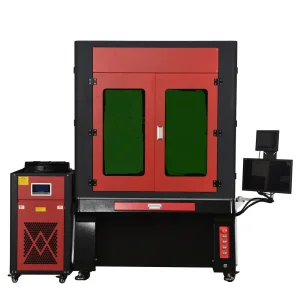


A rigorous five-stage quality gate ensuring that every laser welder leaving our assembly floor meets exact international metallurgical criteria.
Clients can courier proprietary precious alloy components directly to our Shenzhen application laboratory. Our optical engineers evaluate weld penetration, beam diameter, shielding gas balance, and cycle speed, providing complete high-speed video footage and cross-sectional microscopic test reports before contract signing.
Every resonant cavity is aligned using He-Ne red guide lasers and calibrated via Coherent power meters. Assembled machines undergo a continuous 72-hour automated test firing inside temperature-monitored testing bays to eliminate infant diode failure and verify closed-loop chiller performance under peak thermal loads.
Finished equipment is treated with anti-corrosion barrier wrapping, desiccant packed, and bolted onto fumigated ISPM-15 compliant plywood crates with shock and tilt indicators. Direct relationships with DHL Express, air-freight forwarders, and ocean carriers guarantee seamless door-to-door delivery with full customs documentation worldwide.
