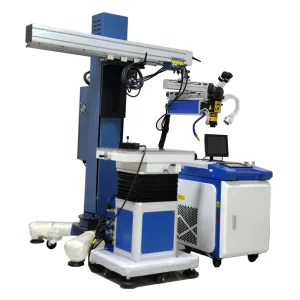
Direct-to-buyer precision industrial configurations engineered by Shenzhen Youmir Laser Technology Co., Ltd. for toolmaker precision and high-throughput production lines.






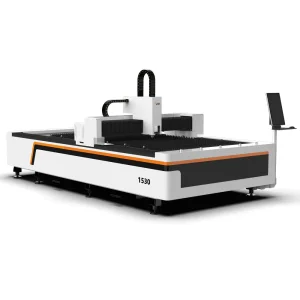
Transforming industrial fabrication through high-brightness fiber lasers, interpolating multi-axis CNC gantries, and oscillating wobble optics that overcome traditional weld pool tolerances.
At the heart of modern CNC laser welding systems lies the solid-state ytterbium-doped continuous wave fiber laser operating at the near-infrared wavelength of ~1070 nm (1.07 μm). Unlike legacy Nd:YAG flashlamp crystals with thermal lensing limits, fiber lasers yield beam parameter products (BPP) down to 0.38 mm·mrad. This tight optical focus delivers power densities in excess of 10⁶ W/cm², instantly vaporizing base metal to establish stable "keyhole" deep-penetration welding regimes with aspect ratios up to 10:1, while reducing overall thermal input by 75%.
Historic fiber laser implementations suffered from micro-gap sensitivity: fit-up variations over 0.1 mm caused joint undercuts or blow-through. Modern CNC laser welders incorporate high-speed dual-axis galvo optics within the welding end-effector. By oscillating the beam at frequencies up to 1000 Hz in circular, figure-eight, sinusoidal, or triangular wobble trajectories, the effective weld pool bridges joint tolerances up to 1.2 mm. Furthermore, controlled hydrodynamic agitation homogenizes molten pool viscosity, releasing trapped gases to prevent solidification porosity.
Integrating laser optics with 3-axis to 6-axis CNC mechanical stages (or multi-axis articulated articulated robots) requires nanosecond-level bus synchronisation. Utilizing deterministic real-time protocols such as EtherCAT, the CNC interpolates X-Y-Z-R spatial trajectories while simultaneously scaling laser pulse energy based on instantaneous velocity feedrates. When executing sharp radii or transitions, deceleration-induced over-melting is eliminated through look-ahead power gating algorithms, ensuring absolute seam geometry consistency across high-volume production cycles.
| Performance Metrics | Continuous CNC Fiber Laser | Pulsed Nd:YAG Laser | Automated TIG (GTAW) | MIG / GMAW Welding |
|---|---|---|---|---|
| Welding Velocity (2mm 304 SS) | 2.5 – 4.5 m/min | 0.2 – 0.5 m/min | 0.3 – 0.6 m/min | 0.6 – 1.0 m/min |
| Heat-Affected Zone (HAZ) | Minimal (0.1 – 0.3 mm) | Narrow (0.4 – 0.8 mm) | Broad (2.0 – 5.0 mm) | Extensive (> 4.0 mm) |
| Post-Weld Finishing Operations | None required (mirror finish) | Minimal deburring | Extensive grinding & pickling | Aggressive grinding & spatter removal |
| Electro-Optical Efficiency | 35% – 42% | 2% – 4% | N/A (Arc-based) | N/A (Arc-based) |
| Wall-Plug Power Consumption (3kW) | ~8.5 kW | ~35 kW | ~12 kW | ~14 kW |
Direct manufacturer pricing brackets for international OEM procurement, container shipping configurations, and capital expense amortisation models.
| Equipment Category | Resonator Source & Optics | Working Envelope / Axes | Primary Industrial Use Case | Direct FOB China Price (USD) |
|---|---|---|---|---|
| Handheld Multi-Function 4-in-1 Welder | 1500W – 3000W Fiber (Raycus / Max) | Flexible 10m Armored Fiber Cable | General fabrication, on-site ducting, maintenance | $2,800 – $5,200 |
| Standard 3-Axis CNC Laser Welder | 1500W – 2000W CW Single-Mode | 500 × 500 × 300 mm (X/Y/Z Gantry) | Precision sensors, solenoid valves, electronics | $11,500 – $18,500 |
| High-Speed Galvo Scanner CNC Welder | 2000W – 3000W Quasi-CW or CW | Field: 160 × 160 mm + Rotary Indexer | Prismatic battery packs, micro-electronic contacts | $16,000 – $24,500 |
| Heavy Die & Mold Cantilever Welder | 400W – 600W Pulsed / 2kW Fiber | Integrated Telescoping Boom (360° rotation) | Automotive plastic injection dies, forging tools | $13,500 – $22,000 |
| Custom 6-Axis Robot Automated Cell | 3000W – 6000W High-Brightness | 1.8m – 2.1m Reach (Fanuc / Kuka / Estun) | Automotive structural sub-assemblies, aerospace parts | $38,000 – $75,000 |
| Precision Micro Jewelry & Dental Welder | 60W – 200W Desktop QCW / Nd:YAG | Microscope CCD 10× Magnification | Gold, silver, platinum chain repair, dental appliances | $2,200 – $4,600 |
Procuring a CNC laser welder delivers financial payback through consumable and shielding gas optimization. Traditional TIG requires dedicated tungsten electrodes ($12/day in high-production shops), frequent filler wire feeding, and secondary mechanical grinding that consumes up to 3 abrasive discs ($9) per linear meter of stainless steel seam. Conversely, a CNC fiber laser welder utilizing autogenous wobble welding eliminates filler wire in 80% of applications, operates at 92% lower argon gas consumption through focused micro-nozzle shrouds, and produces defect-free seams that bypass secondary grinding entirely. The resulting operational savings typically amortize the initial equipment acquisition cost within 6.4 to 9.2 operating months.
Pioneering advancements in optical coherence tomography, multi-wavelength beam shaping, and AI-driven deep-penetration feedback algorithms.
Real-time non-destructive quality assurance is moving directly into the optical processing head. In-situ OCT systems project a secondary low-coherence infrared sensing beam co-axially through the welding focus optics directly to the root of the vapor capillary. By measuring interferometric phase shifts at 100 kHz, the CNC controller computes precise keyhole depth, seam tracking misalignment, and post-weld joint profile elevation in real time, auto-flagging porosity or incomplete penetration without offline radiography.
Processing pure copper, gold, and other highly reflective non-ferrous metals has historically been hampered by 95% optical back-reflection at 1070 nm. Next-gen systems integrate dual-wavelength architectures: a high-absorption 450 nm blue diode beam (absorption > 65% on cold copper) pre-melts the surface, while a central fiber laser establishes keyhole penetration. Paired with Adjustable Ring Mode (ARM) fibers that split power between a central core and an outer donut ring, spatter emissions are reduced by 99%.
Leveraging high-frame-rate co-axial CMOS sensors paired with embedded neural network vision processors, CNC laser welders now adapt to dynamic workpiece thermal distortions. As weldment expansion shifts seam positions during long continuous cycles, edge vision models predict trajectory shifts with < 0.015 mm variance. The CNC instantly compensates via servo positioning and dynamically tunes wobble amplitude and wire-feed velocity to maintain uniform weld crown reinforcement.
Engineered application solutions deployed across high-precision global supply chains, from electric vehicle powertrains to aerospace components.
High-speed hermetic sealing of aluminum prismatic battery shells, cell-to-pack copper busbars, and motor stator hairpin connections. High-brightness galvo scanners achieve 120 welds/min with zero thermal degradation to internal electrolyte separators.
Specialized cantilever and swing-boom CNC laser welders repair high-wear injection molds, stamping dies, and casting cavities in tool steels (H13, NAK80, P20). Spot deposition down to 0.2 mm restores sharp parting lines without annealing the substrate matrix.
Micro-welding of implantable titanium enclosures, endoscope guide tubes, and Nitinol memory alloy assemblies. The focused laser delivers hermetic autogenous joints with zero bio-incompatible fluxes or toxic slag residues.
Joining thin-walled nickel-based superalloys (Inconel 718), titanium ducting, and avionics hermetic shielding. Minimized heat dissipation preserves tensile strength and fatigue life under extreme vibration envelopes.
How Shenzhen's ultra-dense optoelectronic industrial belt empowers global buyers with unparalleled cost efficiency, rapid customization, and rigorous quality control.
Situated within the Guangming photonics manufacturing hub in Shenzhen, Youmir Laser operates in the epicenter of the global laser component supply chain. High-purity optical crystals, quartz fiber preforms, galvanometer scanning motors, servo drives, and dual-temperature industrial chillers are produced within a 30-kilometer radius. This vertical supply integration reduces component procurement cycles from months to days and drives manufacturing cost efficiencies that are passed directly to our enterprise clients.
Bypassing commercial distributors, Youmir pairs global buyers directly with laser systems design engineers. Whether customizing 5-axis gantry stroke envelopes, engineering specialized dual-wire feeding nozzles for wide bevel gaps, or embedding proprietary PLC fieldbus protocols, our in-house optical, mechanical, and software engineers deliver validated 3D mechanical schematics within 72 hours and functional prototypes within 14 business days.
Reliability is non-negotiable in automated lines. Every CNC machine leaving our Shenzhen plant undergoes a 72-hour uninterrupted full-power stress test in a temperature-controlled soak bay. Beam parameters are continuously mapped via laser beam profiling interferometers, chiller coolant stability is verified across ambient extremes up to 45°C, and CNC positioning accuracy is certified using Renishaw laser ballbars to ensure compliance with ISO 230-2 standards.
Full compliance with North American, European, and Asia-Pacific industrial safety standards, backed by international technical SLAs.
All Youmir systems are certified to European CE Machinery Directive 2006/42/EC, Low Voltage Directive 2014/35/EU, and EN 60825-1 Safety of Laser Products. For export to North America, equipment complies with US FDA/CDRH Class IV or Class I enclosed specifications, featuring dual-channel safety interlocks, OD 6+ protective observation glass, optical fiber break sensors, and integrated exhaust fume interlocks that halt emission instantly upon cabin breach.
Global factories utilize divergent electrical infrastructures. Youmir builds tailored electrical control cabinets compliant with NFPA 79 (USA) and IEC 60204-1 (International). Systems are configured for 220V Single-Phase, 380V 3-Phase, 415V, or 480V 60Hz grids with industrial transformers and surge suppressors. Control interfaces are fully localized into English, German, Spanish, Portuguese, French, Russian, and Vietnamese.
We minimize unexpected downtime with industrial IoT remote telemetry. Our factory engineering specialists securely connect to your machine’s CNC controller via cloud gateway to analyze optical temperature anomalies, diagnose chiller alarms, and update motion parameters. Overseas partner hubs in North America, Europe, Southeast Asia, and the Middle East provide rapid replacement consumable shipments and on-site engineering commissioning.
The objective technical scorecard used by industrial procurement teams to evaluate duty cycles, laser powers, optics, and wire feeding mechanisms.
| Evaluation Parameter | Critical Engineering Inquiries | Recommended Specification Threshold | Common Procurement Mistake |
|---|---|---|---|
| Laser Power Sizing | What is the maximum penetration depth required in full production runs? | 1500W for ≤ 4mm SS; 2000W for ≤ 5mm; 3000W for ≤ 8mm SS or 5mm Al | Under-sizing power for aluminum/copper, triggering keyhole collapse |
| Collimation & Focal Length | What Rayleigh length (depth of focus) is needed for your joint fit-up? | Focal length: 150 mm (wide tolerance) vs 100 mm (micro-spot energy) | Using high-magnification short focal lengths on loose joint tolerances |
| Shielding Gas Dynamics | What metallurgical gas purity and shroud delivery angle are implemented? | 99.999% Pure Argon or Nitrogen; coaxial trailing shoe nozzle at 30°–45° | Using industrial-grade 99.5% gas, leading to seam oxidation and micro-cracking |
| CNC Drive Kinematics | Are axes driven by open-loop steppers or absolute AC servos with ballscrews? | Dual-drive Panasonic/Yaskawa AC Servos with C5 precision ground ballscrews | Choosing cheap rack-and-pinion stepper drives prone to lost steps at speed |
| Dual Auto Wire Feeder | Does the wire feeder support synchronous pulsing with the laser controller? | Digital dual-wheel wire feeder with micro-encoder reverse retraction | Unsynchronized continuous push feeding causing wire pile-up at corners |
Transparent, deep technical answers formulated by our senior optoelectronic and automation application engineers.
Explore our full line of industrial fiber laser welders, long-reach cantilever boom systems, and surface cleaning systems engineered in Shenzhen.