Explore factory-direct handheld, cantilever, QCW, and automated boom laser welders calibrated for micron-level metallurgical bonding and minimum cycle times.
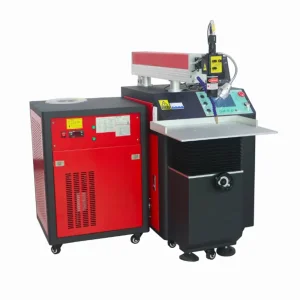
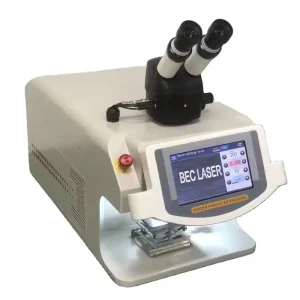
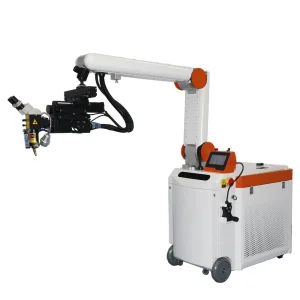
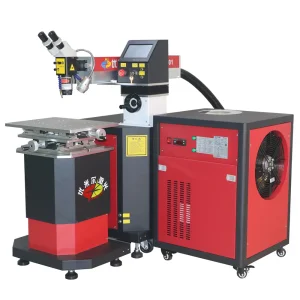
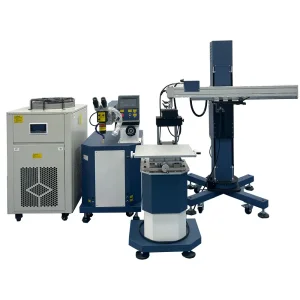
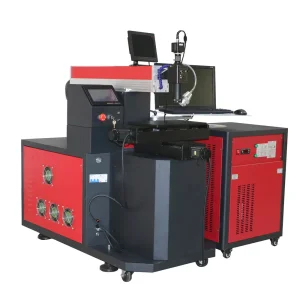
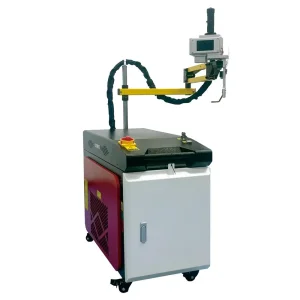
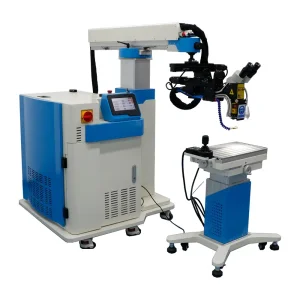
Continuous optical and mechanical engineering innovation established since 2010 in Shenzhen.
Ultra-short pulsed energy deposition preventing structural warping and boundary degradation.
Peak power reaching 10 times the average power rating to overcome reflective precious alloys.
Active tier-1 manufacturing deployments across North America, Europe, SE Asia, and the Middle East.
Handheld laser processing has historically faced a fundamental operational dilemma: delivering adequate energy density to overcome material reflectance and achieve deep penetration while preventing excess heat accumulation in sensitive parts. In standard Continuous Wave (CW) fiber laser welders, energy is delivered continuously over time. While this results in rapid travel speeds on medium-to-thick sheet metal, it frequently causes excessive Heat-Affected Zones (HAZ), metallurgical distortion, blow-through on thin gauges, and temper softening on precision mold tool steels.
By contrast, our Pulse Laser Welding Machine Handheld architecture utilizes Quasi-Continuous Wave (QCW) and flashlamp/diode-pumped Nd:YAG or pulsed fiber laser sources. Pulse systems concentrate laser emission into millisecond or microsecond bursts. During each pulse (typically 0.1 ms to 20 ms), instantaneous peak power reaches 3 kW to 10 kW, instantly vaporizing surface oxides and forming a localized keyhole. Between consecutive pulses, an inter-pulse cooling phase allows instantaneous dissipation of thermal energy into the bulk material.
Pulsed laser welding decouples thermal penetration from total thermal input. By modulating pulse width (τ), repetition rate (Hz), and pulse energy (Joules), operators can weld immediately adjacent to sensitive electronic packaging, polished injection surfaces, or gemstone settings without causing micro-cracking, annealing, or discoloration.
Empirical laboratory metrics comparing thermal input across industrial welding methodologies on 1.0mm 316L Stainless Steel:
Deploying specialized handheld pulse laser systems to solve high-value manufacturing bottlenecks, eliminate scrap rates, and maintain structural integrity in high-stress alloys.
Repairing wear lines, parting lines, micro-pitting, and chipping on high-hardness tool steels (P20, NAK80, H13, S136) directly inside CNC tooling machines without pre-heating or post-annealing.
Hermetic seam fusion on Inconel 718, Hastelloy, Grade 5 Titanium, and ultra-thin corrugated bellows where heat buildup induces intergranular corrosion or micro-fissuring.
Joining surgical instruments, endoscope housings, catheter tubes, and orthopedic implants manufactured from biocompatible Nitinol and 316LVM implant-grade stainless steels.
A rigorous cost-benefit comparison illustrating why manufacturing operations across North America, Europe, and Asia are transitioning from conventional welding to pulsed laser systems.
| Evaluation Parameter | Pulsed Laser Welding Handheld | Continuous Wave (CW) Fiber Laser | Conventional Micro-TIG / GTAW |
|---|---|---|---|
| Thermal Input Dynamic | Millisecond Peak Bursts (Negligible HAZ) | Continuous Constant Heat Input | Sustained Arc Heat Transfer (Broad HAZ) |
| Thin Sheet Distortion (≤ 1.0mm) | Zero to Non-Measurable (< 0.05mm) | Moderate (Requires chill blocks) | Severe (High thermal warping risk) |
| Highly Reflective Metals (Cu, Ag, Au) | Superior (High peak penetrates easily) | Requires beam absorption coatings | Challenging due to high thermal conductivity |
| Tool Steel Cladding (No Pre-heat) | 100% Feasible, No Annealing | Risk of thermal stress cracking | Requires preheating to 350°C + slow cooling |
| Operator Training Timeline | 4 to 8 Hours (Rapid learning curve) | 1 to 2 Days | Months to Years of apprenticeship |
| Total Cost of Ownership (3 Years) | Lowest (Zero secondary grinding) | Moderate (Nozzles, lenses, cover glasses) | High (Tungsten, filler rod, rework hours) |
Global manufacturing ecosystems are facing persistent structural headwinds: a global shortage of certified TIG and MIG welders, tightening environmental regulations on chemical flux pickling, and compressed lead times for high-mix tooling contracts. Conventional welding processes consume excessive labor hours not in the joining phase itself, but in the secondary and tertiary post-processing phases: mechanical straightening of warped weldments, CNC surface grinding, edge rebuilding, and bead polishing.
Implementing a High-Quality Pulse Laser Welding Machine Handheld radically rebalances operational economics. By focusing energy exclusively at the seam joint line with spot sizes ranging from 0.2 mm to 1.5 mm, parts exit the fixture in a near-finished state. For tool and mold repair centers, tool downtime drops from days to hours, preventing costly press downtime that costs automotive and consumer electronics manufacturers upwards of $5,000 per idle hour.
Aggregated user operational data compiled from over 500 industrial installations over 24 months of multi-shift operation:
Every Youmir Laser system is manufactured to integrate directly into worldwide factory networks, supported by localized field documentation, power compatibility, and multi-redundant safety interlocks.
Equipped with wide-range active power factor correction (PFC), Youmir machines automatically accommodate regional voltage fluctuations without compromising optical output:
Conforming to international photonics safety standards (EN 60825-1, FDA CDRH 21 CFR 1040.10, and ISO 11553-1) with redundant hardware protections:
As a verified in-house manufacturer, Shenzhen Youmir Laser Technology Co., Ltd. provides white-glove distributor support across 50+ countries:
How Youmir Laser is driving future performance milestones across photonics, computer vision, and green wavelength materials processing.
Integrating compact high-speed CMOS sensors and edge AI into the handheld torch. The system dynamically reads weld pool emission spectra, detecting porosity, fit-up gaps, and oxidation in real time, automatically compensating pulse frequency and wobble amplitude on the fly.
Combining 450nm blue laser diodes with 1064nm pulsed fiber lasers. Pure copper exhibits >60% absorption at 450nm compared to <5% at 1064nm, enabling spatter-free, micro-defect-free welding of electric vehicle battery tabs, motor hairpins, and power electronics.
Modular quick-disconnect handpieces designed to interface interchangeably between manual artisan handheld operation and 6-axis collaborative robotic arms (Cobots), delivering high-precision batch automation without requiring expensive dedicated automation cells.
Detailed engineering responses to the most frequent queries raised by procurement managers, machine distributors, and process engineers.
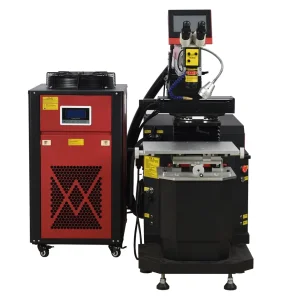
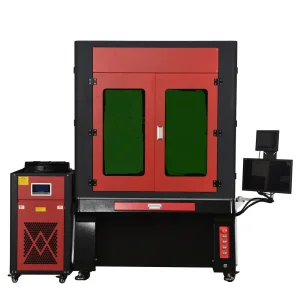
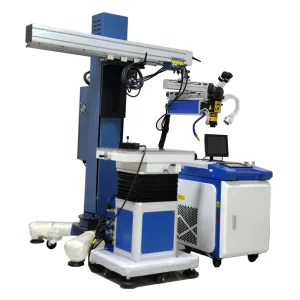
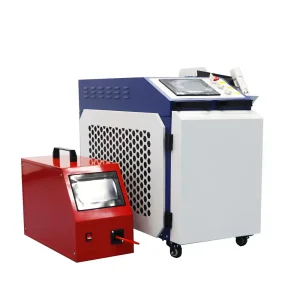
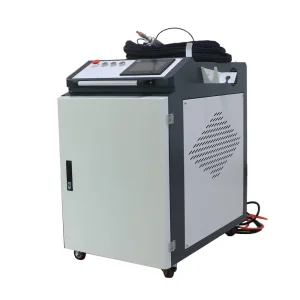
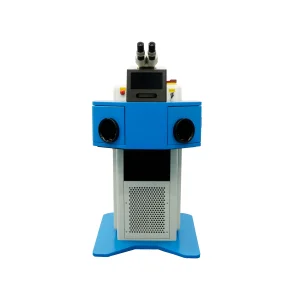
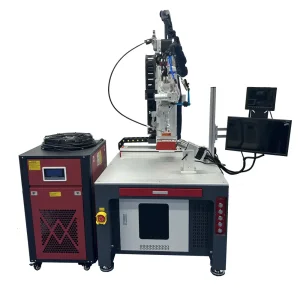
Complementary fiber systems covering heavy mold repair, closed-chamber automatic CNC welding, multi-axis industrial motion, and pulsed surface cleaning.

Consult directly with our Shenzhen optical and process engineers. Share your alloy specifications, plate thicknesses, and cycle-time objectives to receive a comprehensive factory-direct quotation within 12 business hours.
